Tà Xùa.
The cloud-window runs October–April, peaks December–February. Best at dawn.The “Dinosaur Spine” ridge walk and the 500-year-old wild tea trees are the daytime activities.
Luxury infrastructure is thin. Tà Xùa has no Aman, no Four Seasons, no Six Senses. The right pick for TBT clients is Tà Xùa Mây Resort — a small mountain lodge with private cloud-view villas — or staying in Sapa (better luxury infrastructure) and day-tripping. This is a destination for clients who want the experience over the polish.
The trip works as 2 nights — arrive afternoon day 1, sunset on the ridge, cloud-dawn day 2, ancient tea forest walk day 2 afternoon, dawn-cloud day 3 again before driving back to Hanoi. The local Mông ethnic villages are part of the experience — homestay-style visits, traditional tea ceremonies, weaving demonstrations.

Before you arrive.

Above the weather.
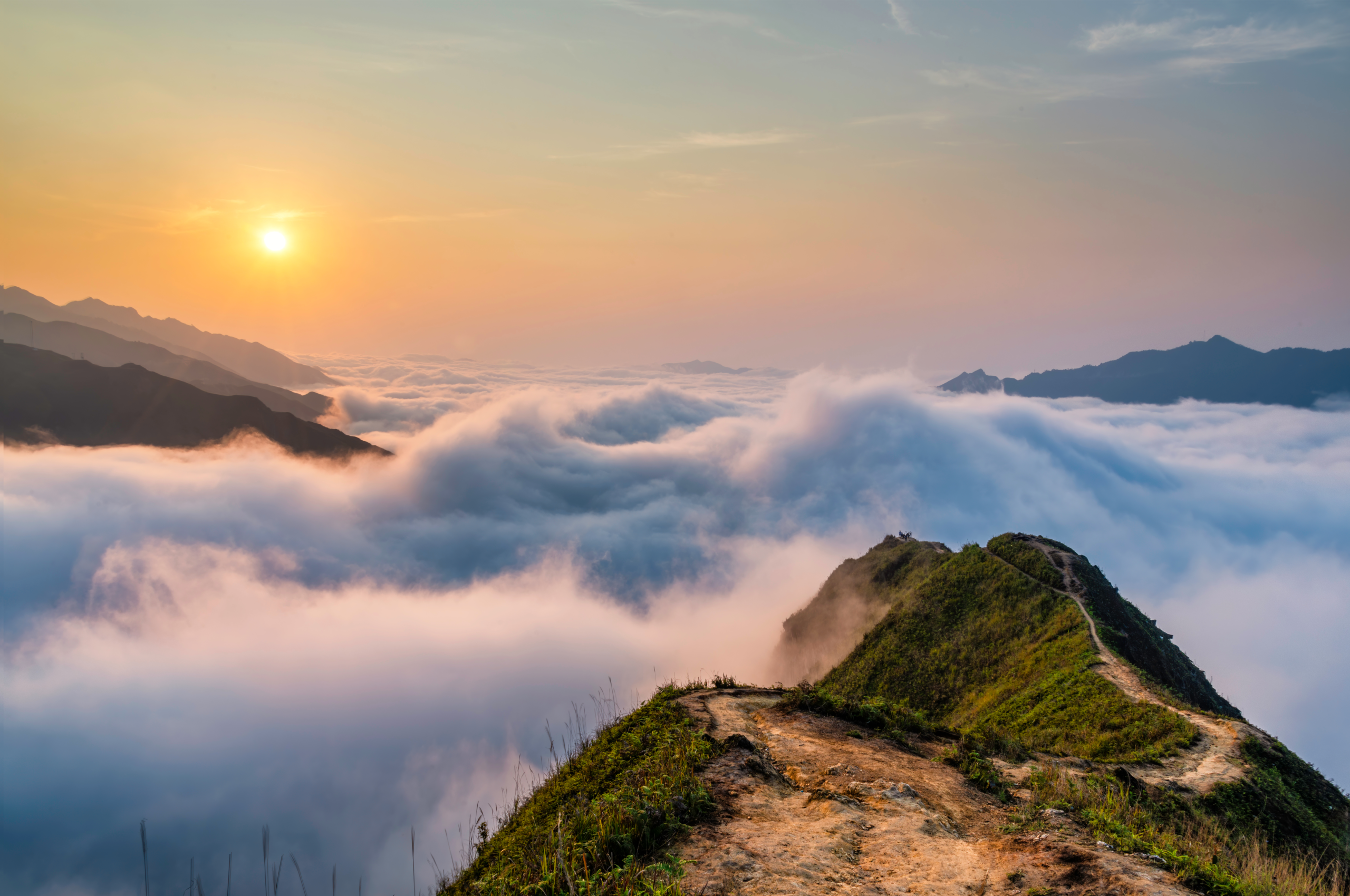
Tà Xùa is two things at once. It’s a working highland of the Mông people — Shan Tuyết tea trees that have stood for generations, terraced corn and rice, stilt homes scattered across ridges that disappear into fog by mid-morning. And it’s a single meteorological event you build a trip around: the bể mây, the sea of clouds, when the valleys fill with a thick white layer and the peaks above stand in clear blue sky. You wake before dawn, climb to the ridge, and watch an ocean move at your feet.
You don’t come to Tà Xùa for polish. There’s no Aman here, no Michelin counter, no rooftop bar. You come for the dawn on the Dinosaur Spine, the 500-year-old tea forest, the lookout where the cloud line breaks at 5:45am. The reward isn’t the room. It’s the silence above the weather — the moment you stand higher than the clouds and the rest of Vietnam disappears beneath them.
The sea of clouds at dawn.
The bể mây — Tà Xùa’s sea of clouds — is a temperature phenomenon, not a tourist set piece. On cold, still nights the warm, moist valley air condenses into a dense white layer that pools in the lowlands below the village. By first light it fills every valley to the horizon while the peaks above sit in clear sky. You don’t watch it from a window. You climb a ridge before dawn and stand above it.
The window runs roughly November through April, peaking December to February — the months when the day-night temperature swing is sharpest. The cloud forms overnight and burns off as the sun climbs, so the experience is short and early. You’re on the ridge by 5:30, the light breaks around 5:45 to 6:15, and by mid-morning the clouds have lifted and the spell is gone.
It’s never guaranteed — that’s the point. Some mornings the valley stays clear, some mornings the fog swallows the ridge itself. When it lands, there is nothing else in Vietnam like standing higher than the weather, watching an ocean of cloud move in total silence.
The Dinosaur Spine.
The Sống Lưng Khủng Long — the “Dinosaur Spine” — is a narrow ridge trail that connects two peaks above Tà Xùa, named for its jagged, undulating silhouette. The path is roughly 1.5 kilometers long, in places only a meter or two wide, with the land dropping away more than 300 meters on both sides. On a clear cloud morning, the drops on either side fill with white, and you walk a thin spine of earth between two oceans.
It is not a casual stroll. The footing is exposed dirt and rock, slick after rain, and the ridge is fully open to wind. But it is the single most dramatic walk in northern Vietnam — and at dawn, with the cloud sea rising on both flanks, it is one of the most extraordinary stretches of trail in the country.
We pair every ridge walk with a local Mông guide who knows the footing and the weather, and we time it to the cloud window. For clients who want the view without the full exposure, there are stable lookout points along the approach that frame the same scene from solid ground.
The ancient tea trees.
Tà Xùa is one of the great Shan Tuyết tea origins in Vietnam. The name means “snow tea” — for the fine white down on the young buds, and for the cold, cloud-wrapped slopes where it grows. These are not plantation bushes in tidy rows. They are wild, gnarled trees, many of them a century old and the oldest reckoned at several hundred years, scattered across the high forest above the village.
The Mông families who tend them still harvest by climbing the trees and picking by hand, then withering and pan-firing the leaf the traditional way. The result is a tea prized across Vietnam — clean, mineral, faintly smoky, with the high-mountain character that only old trees in thin, cold air produce.
The forest walk is the daytime counterpart to the dawn cloud. After the clouds lift, you climb through the old trees with a local picker, learn how the leaf is read and graded, and sit for a proper hillside brewing — the same water, the same slopes, the same hands that have made this tea for generations.
The Mông highland.
Tà Xùa is not an empty viewpoint. It’s the home of the Mông people, who have farmed these ridges and tended the tea forests for generations. The cloud sea you came to see is, for them, simply the weather. The way you understand a place like this is to spend unhurried time with the families who live it.
A village day here is slow and real: a walk through stilt homes and corn terraces, a sit with a Mông household over Shan Tuyết tea, a look at hand-weaving and traditional indigo cloth, a home-cooked highland meal of grilled meat, sticky rice, and forest greens. There’s no staged show. The value is exactly that it isn’t performed for you.
We work only with families and guides who host on their own terms, and we keep the visits small and respectful. For travelers who want depth, a single afternoon in a Mông home often outlasts the photographs from the ridge.
Don’t come on a clear-season weekend.
Tà Xùa has become a domestic photo magnet, and on dry-season weekends the ridge viewpoints and the Lonely Tree fill with day-trippers from Hanoi by mid-morning. Come midweek, sleep up top, and own the dawn before the cars arrive. The cloud is gone by the time the crowds get there anyway.
Don’t try to do it as a day trip.
The cloud only forms overnight and breaks by mid-morning — a car arriving from Hanoi at 11am sees nothing but bare ridges. The entire point is to be on the mountain before first light. Sleep at a cloud-view lodge the night before, or the trip isn’t worth the five-hour drive.
Don’t force the Dinosaur Spine in rain.
The ridge is exposed dirt with 300-meter drops, and it turns dangerous when wet or wind-blown — people push it for the photo and shouldn’t. If the weather’s against you, take the lookout points along the approach instead. They frame the same cloud sea from solid ground, and the ridge will still be there next trip.

Where you sleep matters.
Ta Xua Ecolodge
The closest thing Tà Xùa has to a polished stay, perched at roughly 1,640m with a 180° view over the mountains and terraced fields. Two traditional stilt houses and ten bungalows built to sit with the landscape, not against it. This is where most TBT clients sleep — and where you’ll wake to the cloud sea.
Pơ Mu Homestay
A larger highland retreat in the heart of Tà Xùa with 11 bedrooms sleeping up to 16 — built for a private buyout. The TBT move here is to take the entire house: your own cloud-view lodge for a family or a small group, with a fully equipped kitchen for a private cook.
Stay in Sapa, day-trip up
Tà Xùa’s lodges are genuine but modest — there is no five-star property on this mountain. Travelers who want polished rooms, a proper spa, and full service can base in Sapa (5–6 hours north, real luxury infrastructure) and run Tà Xùa as a dedicated cloud-chasing leg, or split the trip across both.
Sleep on the mountain
The dawn cloud only rewards those already on the ridge. Accept a modest eco-lodge room as the price of admission — the view does the work the room can’t.
Take a full-house buyout
A whole-lodge buyout gives a family or group privacy, a shared hearth, and a kitchen for a private cook — the most comfortable way to do Tà Xùa together.
Base in Sapa
Want a spa and full service at night? Base in Sapa’s luxury hotels and run Tà Xùa as a day or overnight cloud leg. You trade dawn proximity for polish.

The lodge and the highland.
Where you’ll actually eat.
Tà Xùa Mây · the lodge table
The cloud-view lodge that anchors most TBT stays serves a fixed family-style dinner built from what’s local — grilled mountain pork, garden greens, sticky rice, Shan Tuyết tea to finish. Eaten on the terrace as the cloud settles into the valley below, it’s the meal you’ll remember from the trip.
The Mông family table
Arranged through a host family — a home-cooked highland meal eaten on the floor of a stilt house: grilled meat over the hearth, foraged greens, bamboo-tube sticky rice (cơm lam), and corn wine. Not a restaurant, not a show. The most authentic meal in Tà Xùa, and the one no menu can sell you.
Tà Xùa village eateries
A handful of simple local kitchens line the village center — plastic stools, no English, cash only. They’re where you warm up after a freezing dawn on the ridge: a hot bowl of phở, grilled skewers, or thắng cố, the highland stew. Honest, hot, and exactly what you want at 7am off the mountain.
What the mountain grows.
Tà Xùa Shan Tuyết tea
The reason gourmets know Tà Xùa’s name. Tea from ancient mountain trees — clean, mineral, faintly smoky, with the white down (“snow”) on the young bud that gives it its name. Best drunk where it grows, brewed by the family that picked it.
Cơm lam + grilled pork
Glutinous rice packed into a bamboo tube and roasted over coals until the cane chars and the rice steams sweet inside. Paired with grilled or smoked highland pork (lợn cắp nách), it’s the staple plate of the northwest mountains — the dish you eat at every village table.
Thắng cố
The signature stew of the northwest highlands — a long-simmered pot of meat, offal, and mountain herbs that the Mông cook at markets and gatherings. Earthy, intense, and built for the cold. An acquired taste, but the most local thing you can eat up here.
Want a chef in your villa?
For longer stays or special dietary protocols — recovery nutrition, performance macros, post-training meals — we arrange a private cook in your lodge villa, sourcing from the village and the highland garden. Single dinners or every meal of the stay. Quietly handled.

How the mountain moves.
HAN → Tà Xùa ridge.
No airport. The only way in is overland from Hanoi — roughly 5 hours west by private 4WD on mountain roads that turn from highway to switchback the final two hours.
Private 4WD + Driver. Toyota Fortuner or Land Cruiser with a driver who runs this route weekly. Meet you at your Hanoi hotel, full luggage, climate-controlled, the only way to do this comfortably.
Same driver typically stays for the duration of the mountain stay. Arranged through us directly — this is not a route mainstream operators run.
Once you’re up.
Private 4WD + driver stays with you throughout. The lodges are spread across the ridge — your driver shuttles between viewpoints, villages, and the lodge.
The ridge walks are on foot — Dinosaur Spine, the tea forest, the Mông village paths. A local guide leads; the driver waits at the trailhead.
No Grab. No taxis. No rideshare. The whole point is you don’t have to think about transport — the team handles it.
What you’ll actually do in Tà Xùa.

What you actually need.
Required vs. recommended.
What to pack before you fly.
How Tà Xùa affects the body.

What we tell you that nobody else does.
This is not a Six Senses destination.
The lodges in Tà Xùa are boutique mountain stays — 8 to 20 rooms, traditional Mông or H’mong style, locally run. Tà Xùa Mây is the most polished option and still reads as a high-end eco-lodge, not a five-star hotel. There is no Aman, no Six Senses, no Park Hyatt at this altitude — and there won’t be.
If you came for marble bathrooms, concierge desks, and a Michelin tasting menu, you came for the wrong mountain. Tà Xùa rewards travelers who want the experience over the polish.
Bể mây depends on the weather.
The “sea of clouds” phenomenon requires a specific stack of conditions — temperature inversion, humidity, no wind. Even in peak season (Oct–April) it appears maybe 1 in 3 mornings. Nobody can guarantee any single sunrise.
The fix: we book 3 nights minimum, giving the ridge two or three dawn windows. The miss days become tea-forest days, village days, ridge-walk days. The cloud sea is the bonus, not the contract.
Five hours of mountain switchbacks.
The drive from Hanoi runs roughly 5 hours — the final 2 are continuous switchbacks at altitude. Travelers prone to motion sickness will feel it. June–August adds landslide risk and washout closures.
The plan: private 4WD with a driver who runs this route weekly, dry-season scheduling, pre-stage Bonine or Dramamine if motion sickness is a concern. We brief you on the route before you sit in the truck.
Patchy signal. No nightlife. Early bedtimes.
Mobile signal varies by ridge. Some lodges run on generator power overnight. There is no late-night anything — the mountain shuts down with the sun. This is the design, not a defect.
If you need to be reachable 24/7, this is the wrong stay. If you came to disappear for 3 nights, Tà Xùa delivers exactly that.
The ways you fly.
What locals notice on the mountain.

The bespoke details.
Services not on any booking site.
Doors that aren’t on any aggregator.
Doors the mountain keeps closed.
The fluent people behind every visit.
We don’t ship itineraries.
The other guides give you a day-by-day plan. We don’t. A bespoke trip starts with what’s true for you: your training schedule, your dietary protocols, your sleep window, the experience you’d fly for. You answer. We build.
What we ask before we build.
The questions that shape your trip more than any itinerary ever could.
The moments we build around.
Not a checklist — a list of the kinds of anchors that often appear in a TBT-built trip.
Tell us about you. We build the rhythm.
Sanctum members answer the 7 prompts above. We build the trip from there. Private transfer from Hà Nội, the cloud-view lodge, dawn timing, a Mông ridge guide, the tea forest, the village meal — all pre-arranged before you arrive. No template. No itinerary you didn’t ask for.
What Tà Xùa taught me.
Want Tà Xùa handled?
Sanctum members can request a custom Tà Xùa route — private transfer from Hà Nội, the cloud-view lodge, dawn ridge timing, a Mông guide, the ancient tea forest, an in-home highland meal — pre-booked, the whole rhythm of the trip mapped before you arrive.
Tà Xùa is the launch pad.
The northwest highlands don’t end at the ridge. Within a half-day’s drive — most of it through the same mountain country — you can reach plateaus, rice valleys, nature reserves, and the gateway city itself. Each gets its own dedicated guide. Or build your own way through them.
Enter your details to open this guide — and every guide in our atlas.
The trips we don’t list publicly
The full Tà Xùa guide—our exact stays, tables, and routes—lives inside Sanctum.
Unlock the Guide