Singapore.
Raffles holds the Singapore that predates Singapore, the Long Bar and the colonial archways still functional after the 2019 restoration. Marina Bay Sands holds the city’s 21st-century skyline, the SkyPark infinity pool the most photographed object on the island. Between them is a city-state whose register is exact, expensive, and uncannily smooth.
What Singapore rewards is the traveler willing to take it on its own terms rather than as a Southeast Asian stopover. A serious Singapore stay engages the depth — the hawker centers, the Peranakan museums, the architecture history of the Tanjong Pagar shophouses, the Burnt Ends bar morning. Done that way, Singapore stops being a transit hub and becomes the destination the city has spent forty years engineering itself into.
Singapore is the cleanest major city on earth. It’s also a city-state — a country the size of New York City, ranking #2 globally in per-capita GDP, with 5.9 million people stacked across 285 square miles. Founded in 1819 as a British trading post, independent since 1965, today the financial + logistics + technology hub of Southeast Asia.
Four official languages. Three Michelin three-star restaurants.The world’s only Michelin-starred hawker stalls (Bib Gourmand tier $5 meals).
What every first-time visitor underestimates is the bilingual confidence. English is the working language of Singapore — the legal system, the schools, the airport, the business class. Zero language barrier for TBT clients. Service operates at a tier between Tokyo’s precision and Hong Kong’s polish. The locals (a population that’s 75% ethnic Chinese, 14% Malay, 9% Indian) navigate four cultures simultaneously.
For TBT clients, Singapore plays three roles: (1) the elegant stopover — 2-3 nights between long-haul flights to Bali, Maldives, or Australia; (2) the standalone destination — 4-5 nights to do Marina Bay, Gardens by the Bay, Sentosa, Orchard Road, and the hawker scene properly; (3) the regional hub — base in Singapore, day-trips to Bali (2.5 hr flight), Phuket (1.5 hr), or Hong Kong (4 hr).
The strict laws are real. Chewing gum is illegal to import in quantity. Vandalism = caning. Drug offenses can carry death penalty. The trade-off is the cleanest, safest city in Asia. No tipping — service charge already included. Tap water safe. Cards everywhere; cash optional. The country runs on rails. Match it.

Before you arrive.

1819 to today.
Singapore splits into three operating zones. Marina Bay is the modern showcase — Marina Bay Sands, Gardens by the Bay, the Singapore Flyer, the Esplanade. This is the city’s signature postcard. Orchard Road is the shopping spine — 2.2km of luxury retail, ION Orchard, Paragon, Takashimaya. Sentosa Island (10 min from Tanjong Pagar) is the resort island — Capella Singapore, beaches, Universal Studios, golf. And then the cultural districts — Chinatown, Little India, Kampong Glam, Tiong Bahru — that hold Singapore’s pre-1965 layers.
But you don’t come to Singapore for any single one. You come for the contrast: $700 omakase at Sushi Hibiki at lunch, $5 Michelin-starred chicken rice at Hawker Chan for dinner — same day, same city. The hawker culture is the secret. Singapore is the only country where Michelin-starred meals exist on $5 hawker stalls, and where the world’s best fine dining sits 5 minutes from those stalls. That contrast is the city’s gift.
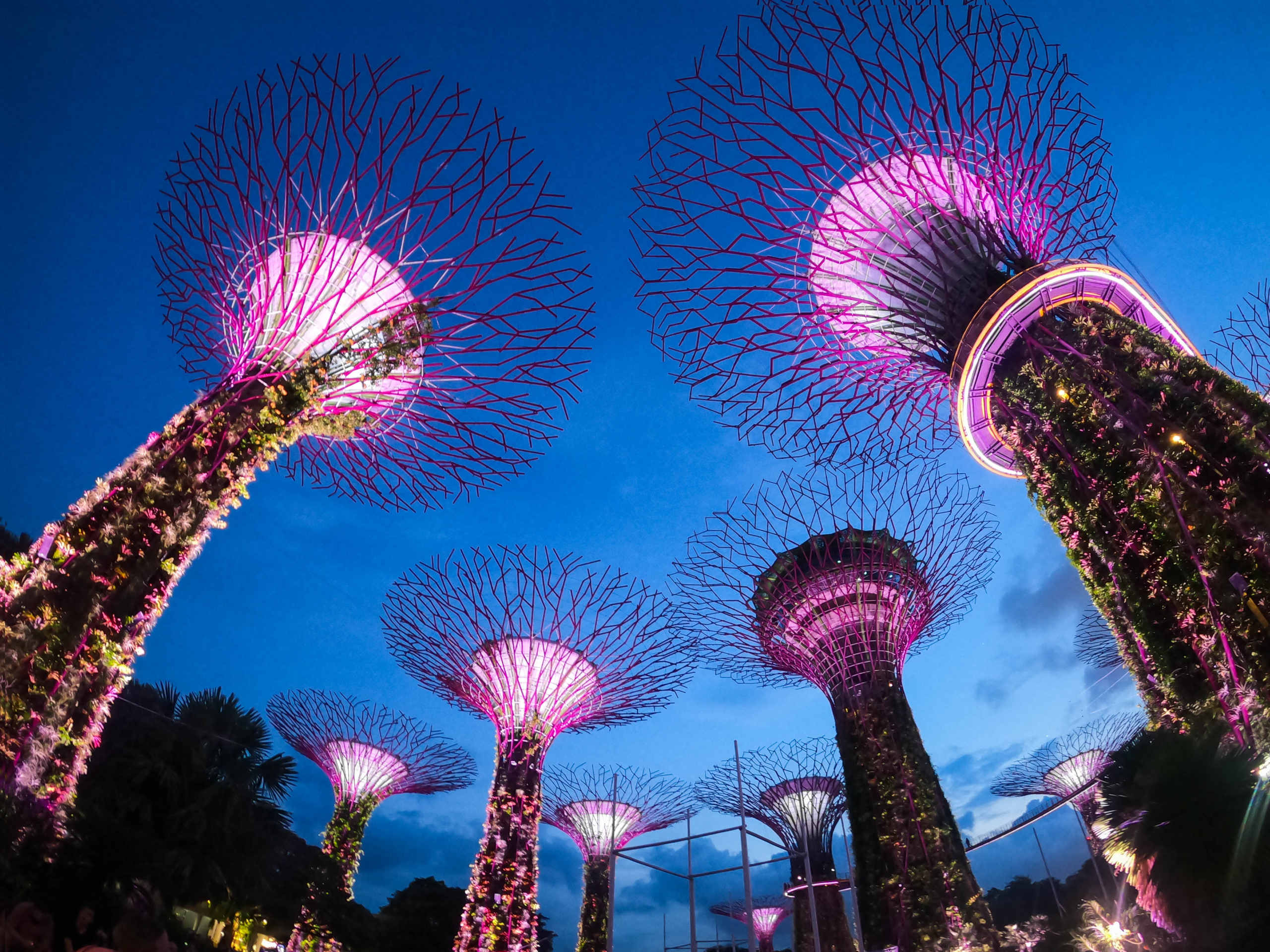
Gardens by the Bay at night.
Gardens by the Bay is a 101-hectare nature park behind Marina Bay Sands. Opened 2012 at a cost of $1 billion SGD, it includes the iconic Supertree Grove — 18 vertical garden structures, 25-50 meters tall, planted with 162,900 plants on their exterior surfaces. The Supertrees collect solar energy by day and put on a synchronized light + music show twice nightly.
The play: arrive at 7:30pm for the first Garden Rhapsody show (7:45pm), walk the OCBC Skyway between two Supertrees during the show for the elevated perspective. Then dinner at Marina Bay Sands or hawker dinner at the adjacent Satay by the Bay open-air food court. The light show repeats at 8:45pm — many TBT clients stay for both rounds.
If you want depth beyond the light show, the Cloud Forest (35m indoor waterfall + mountain ecosystem in a glass dome) and Flower Dome (world’s largest glass greenhouse, climate-controlled gardens by region) require day-time tickets and 2-3 hours.
Raffles Hotel.
Raffles is not a hotel you check into and forget. It is the colonial heart of Singapore made physical — opened 1887 by the Sarkies brothers, listed as a National Monument in 1987, fully restored 2017–2019. Every president, every monarch, every literary figure who passed through Southeast Asia in the 20th century slept here. Rudyard Kipling. Joseph Conrad. Charlie Chaplin. Queen Elizabeth II.
The pilgrimage move is the Long Bar. In 1915, bartender Ngiam Tong Boon mixed gin, cherry brandy, Bénédictine, Cointreau, pineapple, lime and grenadine and called it the Singapore Sling — designed to look like fruit juice so women could drink alcohol in public without scandal. The recipe hasn’t changed in 110 years. The peanut shells still get thrown on the floor. The bar is on the second level — take the staircase up.
Then Tiffin Room for the original North Indian curry tiffin (served since 1892), or the Grand Lobby for high tea under the dome. For Sanctum members staying off-property, we book a Personality Suite for the night — Somerset Maugham, Ava Gardner, Charlie Chaplin each have a named suite preserved as it was when they slept there.
Sentosa Island and the Civic District walk.
This is the half-day that resets how you read the city. Start in the morning in the Civic District. Walk from the Padang lawn — where the British Empire surrendered Singapore to Japan in 1942 — to the Old Supreme Court and City Hall, now fused as the National Gallery. Across the field, the Cricket Club still operates the same lawn it has since 1852. Walk past Parliament House (1827, the oldest government building in the city), the Asian Civilisations Museum, and out to the Cavenagh Bridge over the Singapore River — the only suspension bridge in the city and the last one built before the country gained independence.
Lunch at Empress inside the Asian Civilisations Museum — Cantonese, river-facing, the best of the colonial-quarter dining rooms.
Then cross to Sentosa. Take the cable car from Mount Faber — 8 minutes over the harbour, the city behind you, the South China Sea ahead. Sentosa is 500 hectares of resort island and the southernmost point of continental Asia. The move is Capella Singapore — 30 acres designed by Norman Foster, built around two restored 1880s British military buildings (Tanah Merah). Spa, lap pool, jungle. This is where the Trump-Kim summit happened in 2018. Stay overnight or come for a long lunch at Cassia and use the pools.
End the day at Tanjong Beach Club for sunset over the strait. Two Singapores, one afternoon — the empire that built the port, and the island they built once the empire was gone.
Hawker centre, with a private guide.
You cannot understand Singapore without eating at a hawker centre. UNESCO inscribed hawker culture as Intangible Heritage in 2020 — the only food court system in the world with that designation. There are 121 of them across the island, run mostly by single families across two or three generations. The whole country eats here. Cabinet ministers, taxi drivers, surgeons, students. Same plastic trays. Same fluorescent lights. The food is on a level a S$300 tasting menu cannot match because it cannot.
The play for our clients is not to drop in randomly. The play is a 3-hour private hawker tour across two centres with a local food historian. Start at Maxwell Food Centre — Tian Tian Hainanese Chicken Rice (Bourdain’s stall), Zhen Zhen porridge, Marina South Delicious Food. Then Grab to Chinatown Complex for Liao Fan Hong Kong Soya Sauce Chicken Rice & Noodle — the first hawker stall in the world to earn a Michelin star (2016) and held it since. A plate of soy chicken rice costs S$3.80 (~US$2.80). The line is 45 minutes for the public. We skip it.
Finish at Lau Pa Sat at night for the satay street — closed-off road, charcoal smoke, ice-cold Tiger beer. This is the everyman ritual. Suits, contractors, families, athletes — same satay stick, same chili dip. You leave understanding more about how the city actually works than you would from any museum.
You can go, but we don’t think you should.
Universal Studios Sentosa is a regional theme park designed for school holidays and ASEAN family weekends. It is not the Sentosa your trip is about. Skip it, spend the day at Capella’s pools and the South Beach instead — same island, completely different texture.
You will see it. You don’t need to pose at it.
The Merlion is the city’s mascot, photographed from the deck of every river-cruise boat in Singapore. You will see it walking the Marina Bay loop. The Merlion does not require a stop, a photo, or a queue. Keep walking to the National Gallery instead.
Skip the open-top hop-on hop-off buses.
Bright red double-deckers loop the city center every 30 minutes. They were built for the cruise-ship day-tripper. A private car with a historian guide covers Marina Bay, the Civic District, Chinatown, Little India and Kampong Glam in 4 hours — and you actually learn the four colonial-era ethnic quarters that built modern Singapore.

Where you sleep matters.
Capella Singapore
112 rooms, suites and standalone villas across 30 acres on Sentosa’s southern coast. Designed by Norman Foster — modern white curves wrapping two restored 1880s British military buildings (Tanah Merah). Opened 2009. This is where the Trump-Kim summit happened in June 2018.
The play here is a one-bedroom Garden Villa with private pool. You are 15 minutes from Marina Bay and a world away from it.
Raffles Hotel Singapore
Opened in 1887 by the Sarkies brothers. Singapore National Monument since 1987. Fully restored 2017–2019 by aedas and Champalimaud Design. Every guest stays in a suite — there are no rooms, only 115 suites.
This is where Somerset Maugham wrote on the verandah, where the Singapore Sling was mixed in 1915, where Charlie Chaplin, Queen Elizabeth II and Rudyard Kipling all stayed. The Personality Suites — Maugham, Ava Gardner, Chaplin — are preserved exactly as they were when those guests slept in them.
Mandarin Oriental Singapore
5 Raffles Avenue, the fan-shaped tower at Marina Square. 527 rooms across 21 floors. Every room faces either Marina Bay or the South China Sea — there are no bad views. Premier Bay rooms above the 15th floor frame Marina Bay Sands, the Esplanade and the city skyline directly in your window.
This is the technical-luxury Singapore stay — service-driven, business-traveler precision, the best in-room view of Marina Bay in the city. A different play from Capella’s retreat or Raffles’ heritage. For the trip that runs on the city’s clock.
Marina Bay Sands
The 57-floor SkyPark and 150m infinity pool are the most photographed amenity in Asia. Suites in the towers are vast, the views are real. Book a Premier Bay-facing suite or skip — the standard rooms underdeliver against the price.
The Fullerton Bay Hotel
100 rooms on stilts over Marina Bay water, looking directly at the Sands towers. Sister to the historic Fullerton Hotel (1928 colonial post office). Quiet, intimate, the rooftop Lantern bar at sunset is the move.
The St. Regis Singapore
Orchard Road. 299 rooms, traditional butler service, Brasserie Les Saveurs for French formality. Best when the trip is meetings-led and the days run through Orchard, not Marina Bay.

The stars and the stalls.
The Michelin three-stars.
Les Amis
Opened 1994 by Chef Sebastien Lepinoy and proprietor Desmond Lim. The oldest fine-dining French restaurant in Singapore, the most awarded, and the only Singapore-born restaurant to have held three Michelin stars. 40 seats. The 11,000-bottle wine cellar is the deepest in Southeast Asia. Lunch is the move — same kitchen, half the spend.
Odette
Chef Julien Royer’s 40-seat dining room inside the National Gallery, named after his grandmother. Three Michelin stars since 2019. Light-filled, museum-quiet, the tasting menu is built on French terroir + South-East Asian ingredients. Booked 60 days in advance — concierges at Capella, Raffles and Mandarin Oriental can pull priority tables.
Zén
Chef Tristin Farmer’s three-floor townhouse on Bukit Pasoh — Singapore sister to Frantzén in Stockholm. 24 seats across three floors. The meal is choreographed across three rooms: drinks in the lounge, mid-course on the second floor, the kitchen counter for the finale. Three Michelin stars. The most theatrical meal in the city.
Burnt Ends, Cloudstreet and the world’s first Michelin hawker.
Burnt Ends
Chef Dave Pynt’s open-fire restaurant — three custom wood-fired ovens, two grills, a 12-seat counter facing the kitchen. The whole menu cooks over Australian almond, English oak and apple wood. Has held a Michelin star since 2018. The Burnt Ends sausage and the smoked-quail-egg-on-toast are the lock-in orders.
Cloudstreet
Chef Rishi Naleendra’s intimate dining room on Amoy Street. Earned its second Michelin star in 2022 — a Sri Lankan-Australian chef cooking modern Australian. 30 seats, two seatings a night. Reservations open 60 days in advance and disappear in minutes. Sanctum members are routed direct.
Liao Fan Hawker Chan
Chan Hon Meng’s stall inside Chinatown Complex. The first hawker stall in the world to earn a Michelin star, 2016 — and the cheapest Michelin meal on the planet. A plate of soya sauce chicken rice is S$3.80 (~US$2.80). The line is 45 minutes for the public; with a Sanctum concierge it is not.
The Long Bar at Raffles.
Long Bar · Raffles
Bartender Ngiam Tong Boon mixed the first Sling here in 1915 — gin, cherry brandy, Bénédictine, Cointreau, pineapple, lime, grenadine. The recipe hasn’t moved in 110 years. Peanut shells on the floor. Two is the move, three is a decision.
Manhattan Bar · Regent
Two-time Asia’s 50 Best Bars #1 (2017, 2018). Period-themed Prohibition-era Manhattan recreated on the 2nd floor of the Regent. The barrel-aged Manhattans are the move.
LAVO · Marina Bay Sands
57 floors up at the top of Marina Bay Sands. Italian-American kitchen, the rooftop is the move — direct view of Gardens by the Bay, the harbour and the city skyline. Sunset 7pm seating is the right one.
Atlas · Parkview Square
The art-deco lobby of Parkview Square — gilded ceilings, a 3-story gin tower holding the largest gin library in the world (1,300+ labels). Suit-and-cocktail-dress crowd. Big-band Thursdays.
Want a chef in your suite or villa?
For longer stays or special dietary protocols — recovery nutrition, performance macros, post-training meals — we arrange a private Singapore chef to cook in your suite or villa. Market run included (Tekka Centre for produce, Tiong Bahru wet market for seafood). Three meals a day or single dinners. Quietly handled.
How the city moves.
SIN → city center.
Singapore Changi (SIN). Voted World’s Best Airport 12 times. ~20km · 20–25 min from Marina Bay. T1, T2, T3 and T4 — most ultra-long-haul carriers land at T3.
Private Transfer. Black car or Mercedes V-Class booked through your hotel — Capella, Raffles and Mandarin Oriental all run their own fleets. Meet-and-greet airside through Changi’s Premier Service is the upgrade — they collect you at the jet bridge, walk you past immigration via the diplomatic line, and your bags are at the car before you are.
Private aviation. Seletar Airport (XSP) handles business jets — 30 min to Marina Bay.
Once you’re in.
Private car and driver. The standard for the trip. English-fluent, on call, same driver every day. Singapore’s road network is small (50km tip to tip) — your car is never more than 15 minutes from anywhere.
The MRT is the cleanest, safest, fastest metro in Asia — and for a 90-minute downtown stretch, it can outpace the car at rush hour. EZ-Link card or a contactless Visa taps in.
Grab and Gojek are downloadable for solo runs. Singapore is the only Asian city where flagging a regular taxi off the street still works flawlessly — ComfortDelGro blue cabs are everywhere.
What you’ll actually do in Singapore.

What you actually need.
Required vs. recommended.
What to pack before you fly.
How Singapore affects the body.

What we tell you that nobody else does.
Singapore’s laws are not a punchline.
Death penalty for drug trafficking (still actively enforced — recent executions on the record). Caning is on the statute books for vandalism, overstay, and certain assaults. Chewing-gum sale is banned. Jaywalking, smoking in non-designated zones and eating on the MRT are all fineable. The Misuse of Drugs Act treats trace cannabis residue in your bloodstream as possession — even if consumed legally abroad before the flight.
What we do about it: we brief every traveler pre-arrival. Anything you would not bring into a US federal courthouse, leave at home. The rules are clear, the enforcement is total, and there is no diplomatic margin. The trade is the lowest violent-crime rate of any major city in the world.
It is blazing. 365 days a year.
1° north of the equator. The temperature does not change. Daily highs run 86–90°F every day of the year with 84% humidity stacked on top — heat index 100°F+ from 11am to 4pm. There is no shoulder season for heat. Mid-day outdoor experiences are not viable.
The fix: the trip runs on a Singaporean rhythm — outdoor at sunrise and after sundown, hotel pool / spa / museum / shopping mall (the malls are air-conditioned cathedrals here) in the middle of the day. No exception.
July–October can shut the sky.
Agricultural burns on Sumatra (Indonesia) blow a haze layer over Singapore in some years — PSI (Pollutant Standards Index) jumps from 50 (clean) to 150–200 (unhealthy) on bad weeks. 2015, 2019 and 2023 saw multi-week closures of outdoor school and sports.
The plan: if booking Jul–Oct, monitor the National Environment Agency PSI live tracker 14 days out. We adjust the rhythm — Sentosa day-pass and Capella jungle replaces Marina Bay walking on red-PSI days.
Singapore is not a 7-night trip.
This is the best-organized city in Asia, the cleanest, the safest, the most service-oriented. It is also small (50km tip to tip), and the experience is concentrated — Marina Bay + Civic District + Sentosa + a hawker tour + Raffles is 3 nights. After that, the city repeats itself.
Use Singapore as the anchor. The right play is 3 nights here, then onward to Bali, Maldives, Phuket, Bangkok or Hong Kong. Singapore is the gateway. The country it connects you to is where the trip stretches.
The ways you fly.
What locals notice.

The bespoke details.
Services not on any booking site.
Doors before opening hours. After closing.
Doors the city keeps closed.
The fluent people behind every visit.

We don’t ship itineraries.
The other guides give you a day-by-day plan. We don’t. A bespoke trip starts with what’s true for you: your training schedule, your dietary protocols, your sleep window, the experience you’d fly for. You answer. We build.
What we ask before we build.
The questions that shape your trip more than any itinerary ever could.
The moments we build around.
Not a checklist — a list of the kinds of anchors that often appear in a TBT-built trip.
Tell us about you. We build the rhythm.
Sanctum members answer the 7 prompts above. We build the trip from there. Flights, hotels, drivers, Michelin tables, hawker tour, Sentosa day-pass, harbour yacht — all pre-arranged before you land. No template. No itinerary you didn’t ask for.
What Singapore taught me.
[Draft scaffolding — for voice memo replacement.]
Singapore is the easiest hard city in the world. Everything works. The plane lands at the best airport on earth, the car is at the curb, the hotel knows your name before you say it, the bay is lit up like a stage set, the food is the best of every cuisine in Asia within a 30-minute drive. There is nothing to figure out. Which is the part that takes the longest to figure out.
The first trip, I tried to outrun it. I wanted to find the rough edges, the unscripted corner, the city behind the city. I kept looking for what Singapore wasn’t telling me — and I missed what it was. Because what it’s telling you, plainly, is that a country can decide to be the best version of itself, and execute on it for 60 years straight, and the result is what you’re standing in.
The second trip, I stopped looking. I sat in the Long Bar at Raffles, ordered a Sling I knew was overpriced and undermixed, and watched the room. Different ages, different races, different passports, all in the same room, all on time, all polite. That’s not an accident. That’s the country.
Singapore is not a city you fall in love with. It’s a city you respect. You arrive, you behave, you eat at the hawker centre next to the heart surgeon and the cabbie, and you leave understanding what discipline can build.
Stay 3 nights. Use it as the gateway it is. And come back when you want to remember what a city can be when nobody cuts corners.
Want Singapore handled?
Sanctum members can request a custom Singapore route — flights, hotels, drivers, Michelin tables, private hawker tour, Capella + Sentosa day-pass, harbour yacht — pre-booked, the whole rhythm of the trip mapped before you land.
Singapore is the gateway.
Within a 4-hour flight from Changi, you can step into 5 entirely different worlds — Balinese spirituality, Maldivian over-water silence, Thai island heat, Hong Kong’s vertical density, Bangkok’s market chaos. Singapore positions you at the geographic center of all of Asia. Use it as the base, then go.
Enter your details to open this guide — and every guide in our atlas.
The trips we don’t list publicly
Our exact stays, tables, and routes live inside Sanctum.
Unlock the Guide