Rome.
The luxury infrastructure is among Europe’s most mature.Hotel de la Ville (Rocco Forte), Hotel Eden (Dorchester), Hassler Roma — all anchor the historic center within walking distance of the Spanish Steps.
The food culture is its own register — Roman cuisine (carbonara, cacio e pepe, amatriciana, saltimbocca) is distinct from northern Italian cooking, simpler, sharper, more vegetable-and-pasta-led. 16 Michelin-starred restaurants including three 2-stars (Aroma, Imàgo, La Pergola). Trastevere for the casual neighborhood scene; Testaccio for the traditional working-class food.
The trip works as 4–5 nights. 90 days visa-free Schengen for US passports. Best windows April–May and September–October (peak Italian shoulder seasons — warm without the August heat). Avoid August (locals leave, half the city closes) and December–February (cold + crowds for Christmas at Vatican). Pair with Florence (1.5 hr by Frecciarossa) for the Tuscan extension.

Before you arrive.

753 BC to today.
Rome layers, it doesn’t replace. The Centro Storico is the medieval-baroque core — cobblestone lanes opening onto the Pantheon, Piazza Navona, the Trevi Fountain, all walkable, all stacked on Roman foundations. Across the Tiber, Trastevere keeps the neighborhood register: ivy-draped alleys, family trattorie, the city’s most unhurried evenings. To the east, the archaeological spine — Colosseum, Roman Forum, Palatine Hill — runs straight through the center like an open-air museum the size of a district.
But you don’t come to Rome for the checklist. You come for the Forum at 8am before the gates fill, the Sistine Chapel essentially empty on a before-hours private slot, the Pantheon’s oculus throwing a single shaft of light onto 2,000-year-old marble. You come for the Appian Way at sunrise, riding past tombs and umbrella pines on the original Roman road. The reward of Rome isn’t the monuments. It’s the moment the crowds aren’t there and the city is yours.
Colosseum, Forum, Palatine.
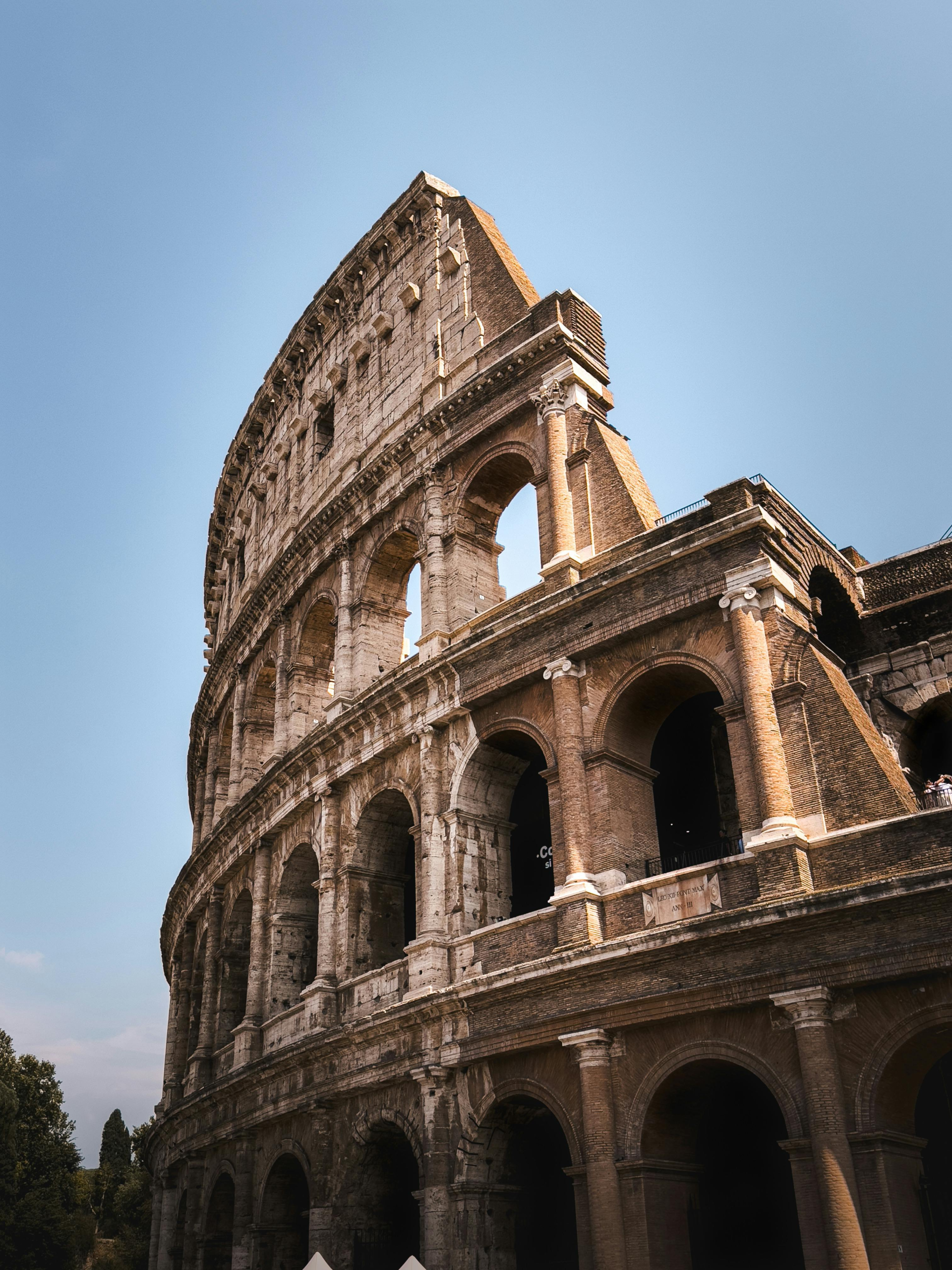
The three sites sit in one continuous archaeological park. The Colosseum — inaugurated in 80 AD under Emperor Titus — held 50,000+ spectators and is the largest amphitheater ever built. The Roman Forum below it was the civic heart of the Republic and Empire for over a thousand years: the Senate house, the temples, the road where triumphs marched. The Palatine Hill rising above is where Rome was founded and where the emperors built their palaces — the word “palace” comes from it.
This is where you understand Rome’s scale. You stand on the arena floor of the Colosseum and look up at the same tiered seating that 50,000 Romans climbed. You walk the Via Sacra through the Forum past the Arch of Titus and the Temple of Saturn, columns still standing 2,000 years on. The stones are real, original, and you are walking on them.
The trick is timing. By 10am the park is shoulder-to-shoulder. At opening — and on a private before-hours slot with arena-floor and underground access — it’s a different experience entirely: the hypogeum tunnels where gladiators waited, the wooden arena reconstruction, the Forum in the long morning light.
Sistine Chapel before hours.
Vatican City is a sovereign state inside Rome — the smallest country on earth, and the home of the most concentrated collection of art ever assembled. The Sistine Chapel ceiling, painted by Michelangelo between 1508 and 1512, and his Last Judgment on the altar wall (1536–1541), are the reason most people come to Italy at all.
By midday the chapel holds 2,000+ people shoulder-to-shoulder, guards shushing the room every few minutes. The art is the same; the experience is not. The move is the before-hours private entry — in before the doors open to the 25,000+ daily public visitors, through the Vatican Museums and the Raphael Rooms unhurried, into the Sistine Chapel when it’s nearly silent.
Then St. Peter’s Basilica — the largest church in the world, Bernini’s baldachin over the high altar, Michelangelo’s Pietà behind glass, the dome you can climb for the view down the nave and out over the city. On a Wednesday morning, the papal General Audience in St. Peter’s Square can be arranged with front-section access.
Pantheon to the Trevi Fountain.
This is the Centro Storico loop — the dense medieval-baroque core, all on foot, best in the early-morning quiet before the day-tour crowds arrive. Four masterpieces, none more than ten minutes from the last.
Start at the Pantheon. Rebuilt by Emperor Hadrian around 126 AD, it is the best-preserved building of ancient Rome and still holds the record for the world’s largest unreinforced concrete dome — 1,900 years on. The oculus, the nine-meter hole at the dome’s center, is the only light source; at noon a single shaft moves across the marble floor. Raphael is buried inside.
Walk to Piazza Navona, built over Domitian’s ancient stadium, its baroque shape still tracing the racetrack. Bernini’s Fountain of the Four Rivers anchors the center; Borromini’s Sant’Agnese church faces it — the two rival architects of baroque Rome, staring each other down across the square.
Cross to Sant’Eustachio il Caffè for the city’s most famous espresso, then the Trevi Fountain — Nicola Salvi’s 1762 baroque theatre of Neptune and tritons, fed by the ancient Acqua Vergine aqueduct that still runs. Throw the coin over your left shoulder; the tradition says you’ll return to Rome.
End at the Spanish Steps — 135 travertine steps climbing to the Trinità dei Monti church, the Grand Tour’s most-painted staircase, the Hassler and Hotel de la Ville at the top.
One morning. Two thousand years of building, from Hadrian’s concrete to Salvi’s marble. The complete arc of how Rome kept rebuilding itself in place.
The Appian Way at sunrise.
The Via Appia Antica — the Appian Way — is the road the Romans called the “Queen of Roads.” Begun in 312 BC by the censor Appius Claudius Caecus, it ran 560 km south to Brindisi and the Adriatic. The first stretch out of Rome still has its original basalt paving stones, worn smooth by 2,300 years of feet, hooves, and cartwheels.
At sunrise it is the most cinematic morning in Rome. You ride or walk past umbrella pines, ancient tombs, and crumbling mausoleums — the road was lined with the graves of patrician families because Roman law forbade burial inside the city walls. The catacombs of San Callisto and San Sebastiano run beneath. The Circus of Maxentius and the round tomb of Cecilia Metella stand right on the road.
It’s car-free and quiet in the early hours, especially Sundays when the whole archaeological park closes to traffic. After the density of the Centro Storico, this is the open-sky counterweight — flat, green, lined with two millennia of stone, and almost entirely yours before 9am.
This recalibrates the trip. You spend two days inside the crowds at the Colosseum and Vatican, then one morning out on the open road the legions marched, and Rome stops feeling like a museum and starts feeling like a place people actually lived.
Skip the tables with a view of the monument.
The restaurants ringing the Trevi Fountain, Piazza Navona, and the Spanish Steps charge triple for tourist-grade Roman food and a photogenic view. The carbonara is from a bag. Eat the canon where the kitchen is serious — Roscioli, Armando al Pantheon, or Da Enzo in Trastevere — and visit the monuments separately, early, with coffee.
Skip the costumed “centurions” at the Colosseum.
Men in plastic armor outside the Colosseum and Forum push you into a photo, then demand €10–20 a head. It’s a long-running shakedown the city periodically bans. If you want the real thing, our before-hours arena-floor and underground access puts you where the gladiators actually stood — no costume required.
Skip the open-top bus loops.
The double-decker hop-on-hop-off buses crawl through Rome’s traffic and drop you at the most crowded entrances at the most crowded hours. A private car-and-driver with a guide covers the same ground on your schedule — and walks you into the Centro Storico, which no bus can enter, at the quiet end of the day.

Where you sleep matters.
Hotel de la Ville
Opened 2019 by Rocco Forte. 104 rooms in the Palazzo della Trinità dei Monti at the top of the Spanish Steps — the most prized address in central Rome. Olga Polizzi interiors translate Grand Tour-era Rome through 21st-century luxury. The Cielo Terrace bar on the rooftop is consistently named the city’s best sunset spot.
Hotel Eden Rome
Opened 1889, reopened 2017 under Dorchester Collection ownership. One of the 7 TBT-tier luxury brand stable properties in Rome. 98 rooms with rooftop dining at La Terrazza (Michelin one-star) and the Il Giardino restaurant — both on the top floor, with panoramic Roman skyline. Federico Fellini lived here for two decades.
Hassler Roma
Opened 1893. The most historically loaded grand hotel in Rome — owned by the Wirth family for 6 generations, currently run by Roberto Wirth. The hotel sits literally at the top of the Spanish Steps — walking out the front door puts you on Trinità dei Monti looking down at the steps. Audrey Hepburn, JFK, Princess Diana all stayed here.
Bvlgari Hotel Roma
Opened 2023 on Piazza Augusto Imperatore, facing the Mausoleum of Augustus. Antonio Citterio Patricia Viel interiors, Niko Romito dining, the city’s most polished new spa. Modern Italian luxury at the highest tier.
Six Senses Rome
A 15th-century palazzo near the Trevi Fountain, opened 2023. The brand’s signature spa and Roman-bath-inspired wellness floor — biophilic design, sustainability focus. Central, quiet, restorative.
W Rome
Two restored palazzos on Via Liguria near Via Veneto. Bold contemporary design, a rooftop scene, energy the grand hotels don’t have. Best for travelers who want Rome with a pulse rather than a hush.

The stars and the canon.
The Michelin tier.
La Pergola
Chef Heinz Beck’s rooftop temple at the Rome Cavalieri — Rome’s only three-Michelin-star restaurant, held since 2005. Light, precise Mediterranean cooking, a 60,000-bottle cellar, and a terrace view across the entire city. Book 6–8 weeks out; concierge essential.
Aroma
Chef Giuseppe Di Iorio’s restaurant atop Palazzo Manfredi — the terrace looks straight into the Colosseum, table-height. One Michelin star, refined Roman-Mediterranean cooking, and the single most dramatic dinner view in the city. The 8pm seating at golden hour is the move.
Acquolina
Inside The First Roma Arte hotel — two Michelin stars for chef Daniele Lippi’s seafood-led modern cooking. Familiar Mediterranean ingredients turned unexpected with real technical authority. The most serious fine-dining seafood kitchen in Rome.
Roman cooking, done right.
Roscioli
A salumeria-with-kitchen near Campo de’ Fiori — and home to one of the most cited carbonaras in Rome: crisp guanciale, Parisi eggs, DOP pecorino, three peppers. The cured-meat and cheese counter alone is worth the booking. Reserve well ahead.
Armando al Pantheon
Steps from the Pantheon, family-run since 1961 — the most consistently excellent Roman classics in the center. Guanciale that crunches in every bite, a kitchen that hasn’t drifted in six decades. Tiny room, lunch and dinner, booking required.
Da Enzo al 29
A tiny trattoria in the heart of Trastevere, no-reservations, line out the door — and worth it. Silky rigatoni carbonara and cacio e pepe many Romans rate the best in the city, supplì and seasonal Roman dishes done without a single shortcut. Go early or send the car ahead to hold the line.
Want a chef in your suite or villa?
For longer stays or special dietary protocols — recovery nutrition, performance macros, post-training meals — we arrange a private Roman chef to cook in your suite or villa. The carbonara done right, Sunday-lunch roast lamb, market run included. Three meals a day or single dinners. Quietly handled.

How the city moves.
FCO + CIA → city center.
Leonardo da Vinci–Fiumicino (FCO). ~32km · 35 min by private car. Primary international gateway — every long-haul carrier lands here.
Ciampino (CIA). ~15km · 25 min. Budget carriers and most private-jet traffic. The FBO transfer is the cleanest landing in Rome.
Private Transfer. Black Mercedes E-Class or V-Class meet-and-greet at the gate, name card, bags handled, straight to your hotel. The same driver stays with you the trip.
Once you’re in.
Private car and driver for the trip — same driver every day, English-fluent, on call. Essential for Vatican, Borghese, and any out-of-center movement.
The Centro Storico walks itself. Pantheon, Trevi, Piazza Navona, Campo de’ Fiori — cobblestone, pedestrian-only zones. Walk in, walk out, car picks you up at the perimeter.
Avoid the metro at peak hours. Termini and Vatican-area lines are pickpocket territory. Cabs (white, metered) work; FreeNow is the local app.
What you’ll actually do in Rome.

What you actually need.
What’s required, what’s smart.
What to pack before you fly.
How Rome reads on the body.

What we tell you that nobody else does.
Without a private booking, the Vatican will eat your day.
Public Vatican Museums lines run 2–4 hours on a weekday and longer on weekends. The Sistine Chapel at midday holds 2,000+ people shoulder-to-shoulder. The art is the same; the experience is not.
What we do about it: we book the 7:30am before-hours private tour with a Vatican-employed guide — Sistine Chapel essentially empty, Raphael Rooms unhurried, St. Peter’s before the day groups. Wednesday-morning papal-audience tickets when clients want them.
Half of Rome closes for ferragosto.
From mid-August through the first week of September, Roman families leave for the coast and the mountains. Trattorias, family shops, the city’s best places — closed for 2–3 weeks. What’s left is the tourist-trap layer and the heat.
The plan: avoid Aug 10–Sept 1 if you can. If August is the only window, we work the open list (luxury hotels stay open, La Pergola open, Vatican open) and slot Capri or Amalfi days in the rhythm.
Petty theft is the only real crime risk.
Rome is safe at the violent-crime level. Pickpocketing in Termini Station, on the 64 bus to the Vatican, and the crush around the Trevi Fountain is professional and constant. Phones, wallets, watches in side bags — all targets.
The fix: front pockets only, no backpack worn behind you in crowds, watches off in Termini. Our drivers route you around the worst chokepoints.
Roman cooking is its own register.
The dishes that matter here — carbonara, cacio e pepe, amatriciana, saltimbocca, coda alla vaccinara, supplì — are Roman, not generic Italian. Pesto is Ligurian. Bolognese is Emilian. Pizza margherita is Neapolitan. Ordering off-register in Rome reads tourist.
What we do: we brief you on the Roman canon before arrival and book the rooms that do it right — Roscioli, Armando al Pantheon, Roma Sparita in Trastevere, and the three-star apex at La Pergola.
The ways you fly.
What Romans notice.

The bespoke details.
Services not on any booking site.
Doors before opening hours. After closing.
Doors the city keeps closed.
The fluent people behind every visit.
We don’t ship itineraries.
The other guides give you a day-by-day plan. We don’t. A bespoke trip starts with what’s true for you: your training schedule, your dietary protocols, your sleep window, the experience you’d fly for. You answer. We build.
What we ask before we build.
The questions that shape your trip more than any itinerary ever could.
The moments we build around.
Not a checklist — a list of the kinds of anchors that often appear in a TBT-built trip.
Tell us about you. We build the rhythm.
Sanctum members answer the 7 prompts above. We build the trip from there. Flights, hotels, drivers, restaurants, private chef, before-hours Vatican, Appian Way ride, all pre-arranged before you land. No template. No itinerary you didn’t ask for.
What Rome taught me.
Rome doesn’t reward a checklist. The Colosseum, the Vatican, the Trevi, the Pantheon — pack them into 48 hours and you’ve seen four monuments and absorbed none of the city. The first version of Rome most travelers experience is the version that’s been built for them: the queue, the selfie, the gelato stand, the back to the hotel. That version is real, and it is also the thinnest possible read.
The second version requires re-routing. Pick a neighborhood — Monti, Trastevere, or the streets behind Campo de’ Fiori — and walk it three times before walking anywhere else. Drink your espresso standing at the bar at Sant’Eustachio, not sitting. Eat dinner after 9pm, not at 7. Take the Vatican before-hours slot, not the 11am wave. The city is the same; the angle of approach is what changes.
The third version is the one that earns the trip. It’s the late aperitivo in Piazza Trilussa with no plan after. It’s the Caravaggio in San Luigi dei Francesi, three blocks from the Pantheon, free to enter, no line. It’s the cacio e pepe at a trattoria with eight tables and no English menu. It’s the realization that 90% of what makes Rome Rome happens between the monuments — in the bars, the side streets, the church naves you walked past on the way to the famous thing.
Don’t try to see Rome in four days. Anchor a Forte or Hassler hotel, layer the city in three passes — the monuments, the neighborhood routine, the late-night Roman tempo — and come back for the next layer.
Want Rome handled?
Sanctum members can request a custom Rome route — flights, hotels, drivers, Michelin reservations, private chef, before-hours Vatican and Colosseum access, Appian Way ride, region arc extension — pre-booked, the whole rhythm of the trip mapped before you land.
Rome is the launch pad.
Within a half-day’s reach by high-speed train, car, or helicopter, you can land in 5 different versions of Italy — the Renaissance city, the coast and its islands, the Tuscan hills, a Renaissance garden, and a buried Roman town. Each gets its own dedicated guide.
Enter your details to open this guide — and every guide in our atlas.
The trips we don’t list publicly
The full Rome guide—our exact stays, tables, and routes—lives inside Sanctum.
Unlock the Guide