Pisa.
Pisa is a day-trip from Florence, not a destination.TBT clients stay at Four Seasons Firenze and visit Pisa by private car in a half-day.
The luxury infrastructure is intentionally limited — Pisa is a small university city, not a 5-star hotel destination. Bagni di Pisa Palace & Thermal Spa (a 18th-century thermal palace in the surrounding hills) is the boutique 5-star pick if you do want to overnight. Hotel Bologna and Grand Hotel Duomo handle the in-town 4-star options. For ultra-luxury Tuscany clients, Pisa is the morning museum visit — not the trip’s center.
The trip works as a single half-day from Florence or as a 1-night Bagni di Pisa thermal-spa add. 90 days visa-free Schengen. Best windows April–May and September–October. Pair with the Tuscan coast (Forte dei Marmi, Versilia) and Lucca (30 minutes) for a more rounded west-Tuscan day.

Before you arrive.

1064 to today.
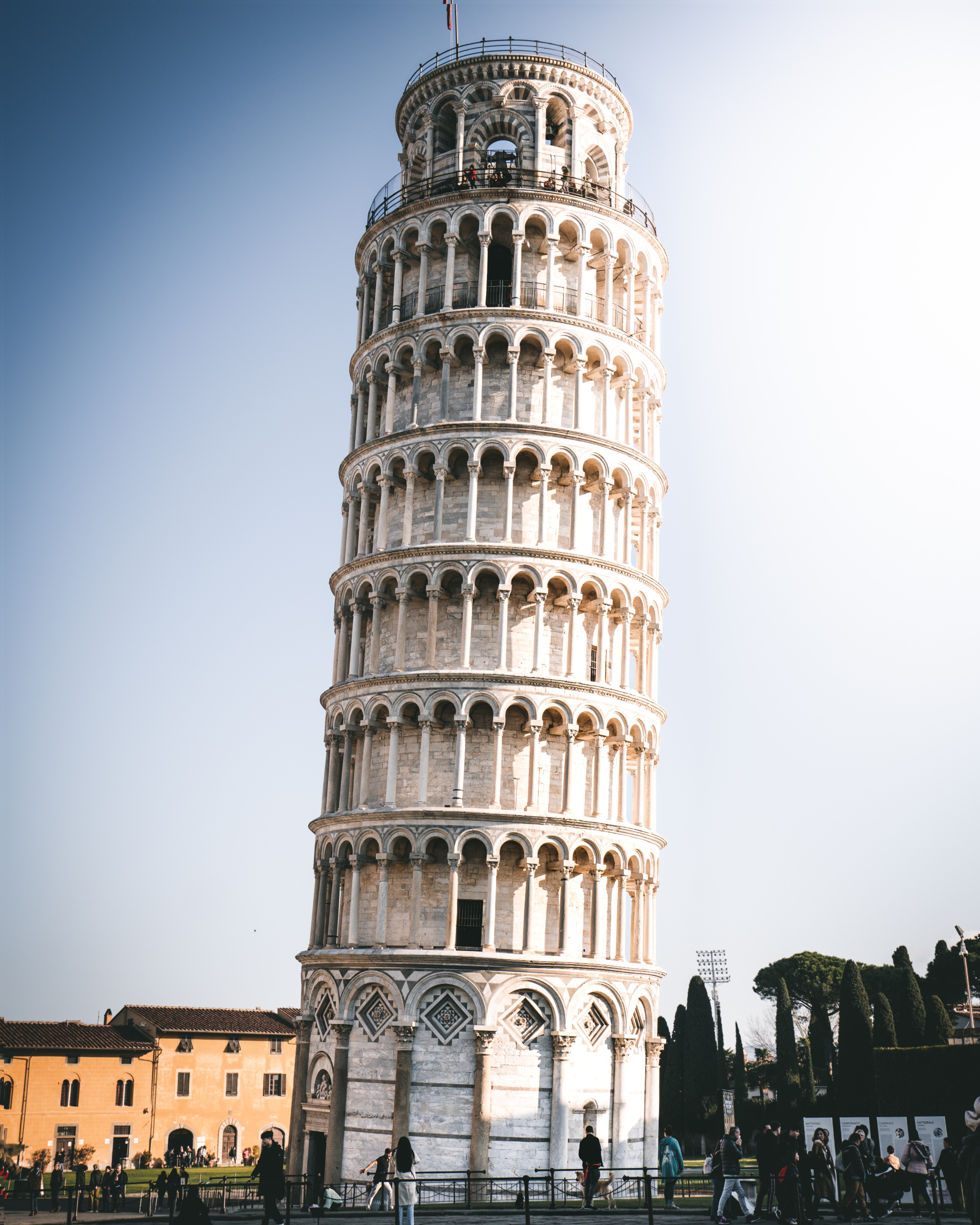
Pisa reads as one famous photograph, and that’s the trap. The Leaning Tower is real and worth the climb — but it’s the campanile of a cathedral, standing on a single open lawn beside a Baptistery and a Gothic cemetery, all clad in the same banded marble. The whole complex is the point, not the tilt. Get there before the day-tour buses and the Piazza dei Miracoli is one of the most coherent medieval ensembles in Europe.
Then there’s the Pisa almost no day-tripper sees. The Knights’ Square, where Vasari built the seat of a chivalric order that now houses one of Italy’s most elite universities. The Arno embankments — the Lungarni — that light up with 70,000 candles one night each June. A Keith Haring mural on a church wall, his last great public work. Pisa rewards the traveler who treats it as a real Tuscan city for an afternoon, then bases somewhere richer for the night.
Piazza dei Miracoli, early.
The single open lawn of the Piazza dei Miracoli holds four masterpieces of medieval architecture clad in the same banded marble. The Cathedral was begun in 1064 at the height of Pisa’s maritime power and consecrated in 1118 — the founding example of the Pisan Romanesque style. The round Baptistery, the largest in Italy, was started in 1153; stand inside and the acoustics ring for seconds.
The famous tilt belongs to the Leaning Tower, the cathedral’s free-standing campanile. Construction began in 1173 and the lean started almost immediately as the soft ground gave way; the structure was finished only in the 14th century and stabilized by an international engineering team that finished work in 2001. You can climb the 251 steps — the floor visibly slopes under you.
Behind it all is the Camposanto Monumentale, the Gothic cloister-cemetery begun in 1278, said to hold soil shipped back from Golgotha by Pisan crusaders. Arrive at opening, before the coach groups, and the whole green is yours — the marble against the morning light, no crowd between you and a thousand years.
Piazza dei Cavalieri.
A few minutes’ walk from the Tower, most visitors never find the Piazza dei Cavalieri (Knights’ Square) — the political heart of medieval Pisa, redesigned by Giorgio Vasari from 1558 for Cosimo I de’ Medici as the seat of the Knights of St. Stephen, a maritime chivalric order.
Its centerpiece is the Palazzo della Carovana, built by Vasari in 1562–64, its façade covered in intricate sgraffiti — allegorical figures and zodiac signs designed by Vasari himself. Since 1846 it has housed the Scuola Normale Superiore, the university founded under Napoleon on the model of the École Normale in Paris and now among the most selective institutions in the world. The square is quiet, scholarly, and almost entirely free of the Tower crowds.
This is the corrective to the photograph. The Knights’ Square shows you Pisa as it actually was — a Mediterranean power with a sharp intellectual edge that still runs through the city today. A guided half-hour here changes how the whole visit reads.
The Lungarni and the Haring mural.
This walk isn’t on the coach itinerary. It follows the river Arno through the half of Pisa that has nothing to do with the Tower — the embankments, the arcades, and one of the great murals of the 20th century. Roughly 2.5 kilometers, all flat, and it’s how you see Pisa as a living city.
Start on the Lungarni — the elegant streets lining both banks of the Arno, faced with ochre and pastel palazzi reflected in the water. Walk down the Lungarno Mediceo past the tiny Gothic jewel of Santa Maria della Spina (1230), a riverside oratory once built to hold a thorn from Christ’s crown.
Cut into Borgo Stretto, the medieval arcaded main street where Pisans actually shop and take their coffee — the colonnades, the morning market on Piazza delle Vettovaglie, the cafés that have nothing to prove to tourists.
End at Tuttomondo — the 180-square-meter mural Keith Haring painted on the rear wall of the church of Sant’Antonio in 1989, one of his last public works before his death. Thirty interlocking figures on a theme of harmony, the only Haring mural conceived from the start as permanent. It’s a five-minute walk from the train station, and most Tower visitors never know it’s there.
One afternoon. Medieval river city to late-20th-century street art. The Pisa that isn’t a photograph.
The Luminara di San Ranieri.
Pisa has a single essential night, and almost no foreign visitor knows to plan for it. On 16 June, the eve of the feast of the city’s patron saint Ranieri, Pisa stages the Luminara di San Ranieri — and the floodlights go out.
Roughly 70,000 wax candles, set in white wooden frames, are placed by hand to trace the outline of every palazzo, church, bridge, and window along both banks of the Arno. The river reflects the whole city back as a double of flickering light. The tradition dates to 1688, when the saint’s remains were placed in the cathedral; it remains one of the most beautiful civic spectacles in Italy and ends in fireworks over the river.
This is the rare case where Pisa is worth an overnight rather than a half-day. If your Tuscany trip touches mid-June, we build the evening around a riverside table and a private vantage on the Lungarni, away from the crush. The next morning, the Regatta di San Ranieri rows the Arno.
Outside that night, the equivalent move is timing the Piazza dei Miracoli for golden hour and a Tuscan-coast sunset afterward. But if you can be here on the 16th — be here.
Skip the Via Santa Maria stalls.
The street feeding the Piazza dei Miracoli is a wall of mini-tower keychains, fake-leather bags, and “hold up the Tower” photo touts. Walk straight through to the lawn, then have your guide take you out the back toward the Knights’ Square — the real Pisa starts the moment you leave the souvenir run.
Don’t base your trip in Pisa.
Pisa is a small university city with thin 5-star inventory — overnighting in town rarely matches the rest of a Tuscany trip. Base in Florence (1 hr by train), on the Forte dei Marmi coast, or at the Bagni di Pisa thermal palace nearby, and treat Pisa itself as the morning visit.
Give the Piazza more than the gag shot.
Most visitors spend 40 minutes here: one “propping up the Tower” photo, then back on the bus. With a private guide the same square becomes a real morning — inside the Baptistery for the acoustics, the Camposanto frescoes, the Cathedral’s bronze doors — then a proper Tuscan lunch instead of a panini queue.

Where you sleep matters.
Bagni di Pisa Palace & Spa
If you do overnight near Pisa, Bagni di Pisa is the pick — an 18th-century nobleman’s thermal palace at San Giuliano Terme, the historic spa retreat of the Grand Dukes of Tuscany, ~15 minutes from the Piazza. Natural thermal waters, frescoed ceilings, a Michelin Guide hotel, with the Leaning Tower visible from the grounds.
Four Seasons Firenze
For most clients the right move is to base in Florence — 1 hour from Pisa by direct train — and run Pisa as a half-day. The Four Seasons Firenze occupies the 15th-century Palazzo della Gherardesca, set in an 11-acre private garden (the Giardino della Gherardesca), the largest in the city. Frescoed salons, a Michelin-starred restaurant, full spa.
Augustus Hotel & Resort
For a coast-led trip, base at Forte dei Marmi, ~40 minutes north of Pisa — the Tuscan Riviera’s most exclusive resort town. The Augustus Hotel & Resort, open since 1953, spreads across historic villas and private garden villas with one of the most exclusive private beaches on the coast, reached by a private underpass. Pisa and Lucca are both easy half-days from here.
Relais dell’Orologio
A restored 14th-century tower house in the historic center, a short walk from the Piazza dei Miracoli. The most atmospheric place to actually sleep inside Pisa — small, antique-filled, quietly run.
Grand Hotel Duomo
A 4-star directly beside the Piazza dei Miracoli — some rooms and the roof terrace look straight onto the Tower and Cathedral. The convenient in-town option for an early start at the square.
Grand Universe Lucca
Autograph Collection, inside Lucca’s Renaissance walls, ~30 min from Pisa. A 19th-century grand hotel with a rooftop bar — the better base if you want a real Tuscan town, not just the Tower.

Lunch in Pisa. Dinner nearby.
The honest Pisa table.
Osteria dei Cavalieri
In the historic heart near the Knights’ Square — sincere Tuscan cooking with a refined, creative edge. Listed in the Michelin Guide and a perennial local favorite. The right lunch after a morning at the Piazza dei Miracoli. Book ahead.
Al Ristoro dei Vecchi Macelli
A long-running Pisa classic near the Arno — refined regional cooking, strong on fish, with a serious cellar. Listed in the Michelin Guide. The city’s go-to for a more formal Pisa lunch or dinner if you do overnight.
Foresta
15 minutes from the center at Marina di Pisa, overlooking the Tyrrhenian Sea — top-quality fish in a classic style. Listed in the Michelin Guide. Pair it with a coast afternoon when you want the sea instead of the city.
The starred tables nearby.
Ristorante Giglio
Inside Lucca’s walls on Piazza del Giglio (~30 min from Pisa) — the city’s standout kitchen, run by a young three-chef team in a frescoed 18th-century room. Held a Michelin star until the team handed it back to cook on their own terms; the food is unchanged. Michelin Guide.
Lorenzo
The quintessential restaurant of Forte dei Marmi (~40 min from Pisa) since 1981 — the benchmark for Tyrrhenian seafood on the Versilia coast. One Michelin star. The dinner to anchor a coast-based night.
Dei Lorena · Bagni di Pisa
The restaurant of the Bagni di Pisa thermal palace at San Giuliano Terme — a health-conscious take on Tuscan cooking with a view to the Leaning Tower across the plain. The convenient fine table if you overnight at the spa.
Want a chef in your villa?
For longer Tuscany stays or special dietary protocols — recovery nutrition, performance macros, post-training meals — we arrange a private Tuscan chef to cook in your villa or suite. Market run included. Single dinners or three meals a day. Quietly handled.

How the day moves.
FLR + PSA → Piazza dei Miracoli.
From Florence by car. 90 min on the FI-PI-LI superstrada with our driver. Stop in Lucca on the way back (30 min north — walled medieval city, the trip’s quiet highlight). Total day: 6–7 hours.
From Florence by train. 1 hr direct from Santa Maria Novella to Pisa Centrale. 10-min cab or walk to the Piazza. The cleanest budget version.
Galileo Galilei (PSA). 15 min from the Piazza. Handles budget Tuscany flights (Ryanair, easyJet, Wizz). For our clients, fly long-haul to FCO or FLR — PSA is rarely the right field.
Pisa is small.
The Piazza dei Miracoli walks itself. Tower, Duomo, Baptistery, Camposanto — all within a 5-minute radius. The entire monument complex is contained on one open lawn.
The rest of Pisa. The river Arno walk down Lungarno Mediceo to Borgo Stretto is the quiet half of the city most day-trippers skip. 30-minute stroll.
Driver waits at the perimeter — historic center is partial-ZTL (camera-enforced). Pickup at Piazza Manin or the train station.
How the day actually runs.

What you actually need.
What’s required, what’s smart.
What to pack for the day.
How the day reads on the body.

What we tell you that nobody else does.
The luxury infrastructure here is thin.
Pisa has 90,000 residents, 2 hotels at the luxury threshold, and the entire reason most clients come (the Tower) is a 15-minute activity. Outside the Piazza dei Miracoli, the city is a quiet university town with a handful of trattorias. It is not Florence. It is not Rome.
What we do about it: we frame it correctly. Pisa is a half-day in the rhythm of a Florence-based trip, paired with Lucca (30 min north). Overnight only if you’re pivoting to Forte dei Marmi or the Tuscan coast — then Pisa becomes the gateway, not the destination.
4 hours on a summer day. No exceptions.
The Leaning Tower limits climbers to 45 at a time, 15-minute slots, 296 steps each way. In July and August the public line runs 3–4 hours under the full Tuscan sun with no shade. The Tower booking site sells out 2–4 weeks ahead in shoulder season.
The fix: we book the after-hours private climb — Tower closed to the public, your group of 8–12 only, the Piazza emptying around you. Same protocol for the Camposanto Monumentale frescoes (the ones most visitors skip).
For most clients, anyway.
Roughly 80% of visitors to Pisa spend 90 minutes total: arrive, do the Tower-pushing-photo, walk into the Duomo, leave. The Camposanto Monumentale (the medieval cemetery with restored frescoes), the Baptistery acoustic demonstrations, and Piazza dei Cavalieri are all skipped.
What we add: a private curator for the Camposanto, the Baptistery’s three-note acoustic demonstration (the guard sings, the dome holds the chord for 12 seconds), and the medieval quarter walk to Piazza dei Cavalieri.
1 hour west — the Tuscan luxury beach.
If you want Pisa as more than a day-trip, the move is to overnight in Forte dei Marmi — the Tuscan coast’s luxury beach village, 1 hour west. Hotel Byron, Augustus, Principe Forte dei Marmi. Beach clubs, sailing, the Versilia coast at its quiet best.
The framing: Pisa becomes the gateway to Forte — a half-day in the Piazza, then 1–2 nights at the coast, then back through Lucca to Florence. The trip earns its overnight.
The ways you fly.
What Tuscans notice.

The bespoke details.
Services not on any booking site.
Doors before opening hours. After closing.
Doors the region keeps closed.
The fluent people behind the day.
We don’t ship itineraries.
The other guides give you a day-by-day plan. We don’t. A bespoke trip starts with what’s true for you: your training schedule, your dietary protocols, your sleep window, the experience you’d fly for. You answer. We build.
What we ask before we build.
The questions that shape your trip more than any itinerary ever could.
The moments we build around.
Not a checklist — a list of the kinds of anchors that often appear in a TBT-built trip.
Tell us about you. We build the rhythm.
Sanctum members answer the 7 prompts above. We build the trip from there. Flights, hotels, drivers, restaurants, private chef, motorcycle tour, paragliding, all pre-arranged before you land. No template. No itinerary you didn’t ask for.
What Pisa taught me.
The tower is the photograph. That is what Pisa is, in the global imagination — a 12th-century campanile that began listing during construction and was finally arrested at 3.97 degrees by NASA engineers in 2001. Most travelers come for the picture, climb the 296 steps, eat a sandwich, and leave inside three hours. That version of Pisa is real, and it is also the least interesting version of what’s actually here.
Twenty minutes from the tower lies a Tuscany most travelers skip. The Monti Pisani — the low coastal range between Pisa and Lucca — is olive groves, cypress lanes, and 18th-century thermal villas that have been resort properties since the Grand Tour. Bagni di Pisa Palace & Thermal Spa, fifteen minutes outside the city, is the kind of quiet luxury anchor most of Tuscany lost when the cypresses got photographed. It is a working thermal bath in the hills, not a styled hotel.
The river-mouth seafood on the Arno is the other angle. Marina di Pisa, eleven kilometers west, is where the river meets the Tyrrhenian — small trattorie, the day’s catch, white wine from the Tuscan coast, no tour buses. The cycling routes through the Migliarino-San Rossore park between the city and the sea are flat, paved, and almost empty on a weekday morning.
Half a day for the tower. A night at Bagni di Pisa. A morning at the marina. Pisa is small — let it stay small, and use the time you save to find the Tuscany that doesn’t make the postcard.
Want Pisa handled?
Sanctum members can request a custom Pisa route — base hotel nearby, drivers, before-hours Campo dei Miracoli access, the Tower climb, riverside lunch, a starred dinner in Lucca or on the coast, region arc extension — pre-booked, the whole rhythm of the day mapped before you land.
Pisa is the launch pad.
Pisa is the door, not the room — and the door opens fast. Within an hour by car or train you can land in 5 different versions of Tuscany and Liguria: the walled music city, the Renaissance capital, the cliffside coast, the celebrity beach, and the alabaster hill town. Each gets its own dedicated guide.
Enter your details to open this guide — and every guide in our atlas.
The trips we don’t list publicly
The full Pisa guide—our exact stays, tables, and routes—lives inside Sanctum.
Unlock the Guide