thebespoketraveler
Japan
KyotoCity Guide Volume 01
CITY GUIDE · 2026

Kyoto.

1,200 years. Still operating on its own time.
HIGASHIYAMA · KYOTO

Kyoto was Japan’s imperial capital for over a thousand years. From 794 to 1868. While the rest of Japan churned through shoguns, civil wars, and Westernization, Kyoto held the court — the emperor, the tea masters, the kaiseki chefs, the Zen abbots, the geiko houses. The city is a thousand years of refinement compressed into 230 square miles.

1,600 Buddhist temples. 400 Shinto shrines. 17 UNESCO World Heritage sites.The most concentrated cultural archive in Asia.

What every first-time visitor underestimates is that Kyoto isn’t slow — it’s deliberate. There’s a difference. Kyoto runs at the pace it has run for a millennium, which means the tea ceremony takes 90 minutes by design, the kaiseki dinner is 14 courses for a reason, the temple bow is performed precisely. Watch the locals: the maiko walking to her teahouse appointment moves at exactly one speed. Match it or get out of the way.

“Kyoto is the city Japan keeps for itself. The court that survived 1,200 years and still operates on its own time.”

The restraint here is total. The dress code is more formal than Tokyo’s. The hospitality is quieter. The food is more intricate. Even the language is softer — Kyoto’s Kansai-ben dialect has a famous indirectness to it that takes longer to read. If Tokyo is the modern Japanese performance, Kyoto is the original Japanese text.

Slowness here isn’t laziness. It’s the operating mode of a city that doesn’t have to prove anything to anyone.

All that being said — welcome to Kyoto. Let’s break it down.
— 01 —
WHAT YOU NEED TO KNOW

Before you arrive.

The brief.
VISA · US PASSPORT Visa-free, up to 90 days. No application required. Passport must be valid for the duration. Pre-register via Visit Japan Web before arrival.
BEST WINDOW Early April · Mid-November CHERRY BLOSSOM:April 1 — 14 (a week later than Tokyo) AUTUMN FOLIAGE:November 15 — December 5 (Kyoto’s peak) AVOID:Gion Matsuri (mid-Jul) · Golden Week (Apr 29 — May 5) · NYE (Dec 28 — Jan 3)
LANGUAGE Japanese · Kyoto dialect (Kansai-ben). Kyoto Japanese is softer than Tokyo’s. English is thinner here than in Tokyo — translation apps essential for traditional restaurants and ryokans. Custom Kyoto phrase pack available on request.
CURRENCY JPY (¥). ~¥155 per $1 USD. Cards accepted at Aman Kyoto, Four Seasons, ROKU, and the kaiseki houses. Kyoto runs more cash-heavy than Tokyo — temples, tea ceremonies, and older ryokans are cash-only. Carry ¥50,000–¥80,000 cash for temple donations and the kaiseki tip envelope tradition. Concierge pre-arranges.
eSIM · DATA Roamless eSIM — activate before landing. Add ExpressVPN for digital privacy. Kyoto has full 5G; older parts of Higashiyama have slightly weaker signal inside temple grounds — let the temple stay quiet.
TAP WATER Safe to drink everywhere. Kyoto tap water actually has a reputation among Japanese chefs — it’s used for traditional tea ceremonies. Ice at all restaurants is safe.
NIGHTS 3 minimum. 5 ideal. Kyoto rewards slow exploration. 3 nights covers the temples + 2 kaiseki dinners + a Nara or Osaka day trip. 5 nights lets you actually breathe.
CULTURAL CODE Maiko / geiko etiquette: don’t touch, don’t grab, no flash photos. Gion district enforces this with fines for photography in private alleys. Don’t block narrow lanes (Ponto-chō, Hanami-kōji). Shoes off at temples, ryokans, and many traditional restaurants. Quiet inside shrine grounds.
MEDICAL & EMERGENCY Kyoto University Hospital. 54 Kawahara-cho, Shogoin · Sakyo-ku. English-speaking floor, JCI-accredited. Tel: +81 75-751-3111.

US Embassy Tokyo. 1-10-5 Akasaka, Minato. Emergency 119 (ambulance) · 110 (police). Closest US Consulate: Osaka (45 min by Shinkansen).
MANNERISM Quiet reverence. Kyoto’s service culture runs softer and slower than Tokyo’s. Bows are deeper. Tea ceremonies are followed precisely. Don’t rush conversations. Don’t take ringing phones into temples. The city was the imperial capital for 1,000 years and still moves like an old court — restraint is the operating mode.
— 02 —
THE EXPERIENCES

794 to today.

Kyoto was Japan’s imperial capital from 794 to 1868 — over a thousand years of unbroken court refinement. 1,600 Buddhist temples. 400 Shinto shrines. 17 UNESCO sites. The most concentrated cultural archive in Asia. 4 experiences anchor this trip.

Kyoto splits in two. Higashiyama is the eastern hills — temples, geisha districts, the original streets the imperial court walked. Kiyomizu-dera, Sanjusangen-do, Gion, Pontocho — all here, all walking-distance from each other, all functioning on the same rhythm they have for 12 centuries. This is where you stay, this is where you wander, this is where you eat your kaiseki.

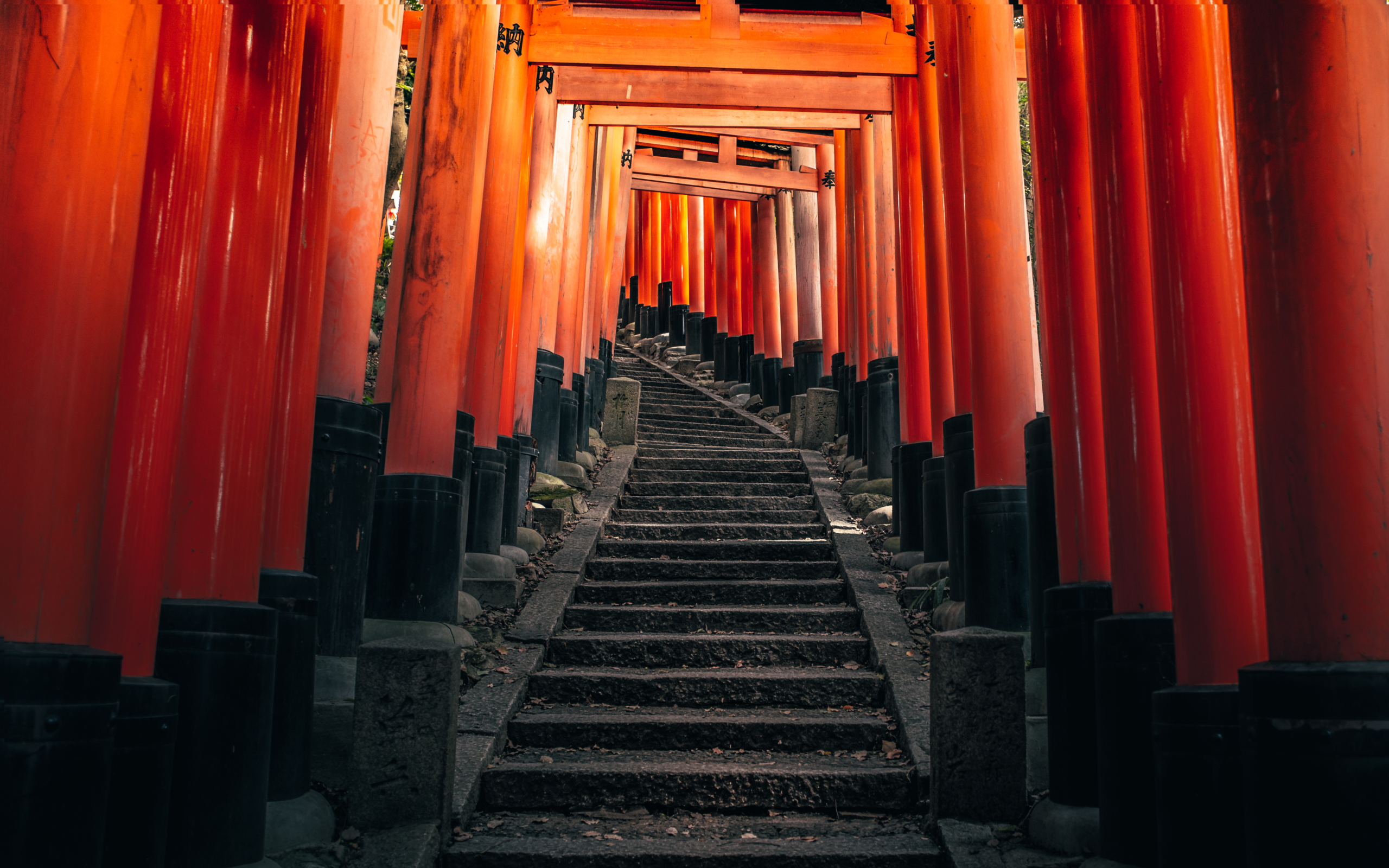
But you don’t come to Kyoto for the temples alone. You come for Fushimi Inari at 5:30am, when the 10,000 torii gates are silent. You come for the maiko shadow flashing past a paper lantern in Pontocho. You come for a 14-course kaiseki at Hyotei that’s been served on the same Nanzenji grounds for 200 years. The reward of Kyoto isn’t the monument count. It’s the precision. It’s knowing that every meal, every tea ceremony, every temple bow has been refined for a millennium and is being performed for you with that exact same care.

FUSHIMI INARI · 10,000 TORII
— 01 of 04 · IMMERSIVE —
THE SUNRISE CLIMB

Fushimi Inari at dawn.

10,000 torii gates. 4km climb. Empty at 5:30am.

Fushimi Inari is Kyoto’s most photographed shrine. Roughly 10,000 vermilion torii gates wind 4 kilometers up Mount Inari, donated by individual businesses and patrons over 1,300 years. The bottom 200 meters are clogged with tour buses by 9am. The full ascent is empty before 7.

The play is to be at the Romon Gate at 5:30am. You climb in dim blue light through the first dense cluster of gates — Senbon Torii — alone, with the foxes (Inari’s messengers) on every plinth. The full loop takes 2 hours at a meditative pace, 45 minutes at a fast hike, and roughly 25 minutes at a true run. You see the city open below you at the halfway mark, Yotsutsuji intersection. The Pacific to the east, the mountain quiet in front of you.

You’re back at the base by 7:30, before the buses arrive. The locals running the morning loop are mostly Kyoto residents — this is their daily route. Match their pace. Don’t talk. The mountain is the operating system here.

HOW TO DO IT
WHEN
different times, different vibes: 5:30amblue light, gates empty, locals running 6:30–7:00amsunrise at Yotsutsuji halfway point 8am+tour buses arrive — descend by 8:30 nightgates lit by lanterns — eerie, beautiful, less crowded
WHERE
JR Inari Station (or hotel car 15 min from Higashiyama) · Fushimi-ku
BRING
Trail-capable shoes. Layer for sweat → cool. Water (vending at the base).
NOTE · INARI FOXES The fox statues (kitsune) guarding every torii are Inari’s messengers — the deity of rice, sake, prosperity, and merchants. Each fox holds a different object in its mouth: a key (to the rice granary), a jewel, a scroll, a sheaf of rice. Patrons donate torii gates here for business success — which is why you see corporate names carved into many of the older posts.
— 02 of 04 · CULTURAL —
THE CEREMONY

Private tea ceremony.

90 minutes inside Japan’s most refined ritual. Done properly, with a master.

The Japanese tea ceremony — sadō (the way of tea) — was perfected in Kyoto in the 16th century by Sen no Rikyū. It is the most exacting cultural practice in Japan: every movement, every utensil, every grain of matcha is calibrated. The host has trained for 10+ years before performing publicly. The 90-minute ceremony is the closest thing in the world to active meditation.

The tourist version of this — the 30-minute “tea experience” in a converted house — misses the point entirely. The TBT version is a private ceremony with a recognized tea master in an actual tea room (chashitsu), often arranged through Aman Kyoto’s cultural team, Four Seasons’ Shakusui-tei teahouse, or via a direct introduction to one of Kyoto’s three remaining authentic tea schools: Urasenke, Omotesenke, or Mushakōjisenke.

You sit seiza (kneeling) on tatami. The master prepares thick matcha (koicha) in silence. You bow when offered, rotate the bowl twice clockwise, drink in three sips, return the bowl. Then thin matcha (usucha) is served with seasonal wagashi sweets. The ritual is finite, complete, and unrepeatable — the same as every kaiseki course, every shrine bow, every Kyoto interaction at its highest level.

HOW TO DO IT
WHEN
Morning ceremonies (10am or 11am) are formal. Afternoon (3pm) is more relaxed. Allow 2 hours total — the ceremony is 90 min plus dressing.
WHERE
Urasenke headquarters · Gion private teahouse · Aman Kyoto’s chashitsu · Four Seasons Shakusui-tei.
ENTRY
$300-800 per person depending on master + venue. Private parties of 2-4 work best.
DRESS
Smart casual. No strong perfume (will be smelled against the wagashi). Easy-off shoes (you’ll remove at the chashitsu threshold).
SANCTUM ACCESS Sanctum members can request a ceremony with a Living National Treasure — one of the 10 tea masters in Japan formally designated as cultural property bearers. Multi-week lead time required.
CHASHITSU · TEA ROOM
KIYOMIZU-DERA · 778 AD
— 03 of 04 · CULTURAL AND HERITAGE —
THE WALK

Higashiyama walking arc.

1,200 years of imperial Kyoto, walked in one afternoon.

The Higashiyama district — Kyoto’s eastern hills — holds the largest concentration of intact historic Kyoto in the city. 5 kilometers, 6 anchor sites, 1,200 years of Japanese court culture compressed into one walking arc. Most travelers do half of this and miss the connection. The full route ties it all together.

Start at Kiyomizu-dera (778 AD). The wooden veranda extends 13m off the hillside without a single nail — UNESCO World Heritage. The Otowa Waterfall beneath splits into 3 streams: longevity, success, love. Drink from one, not all three.

Walk down Sannenzaka and Ninenzaka — the preserved 200-year-old shopping streets, sloped stone lanes, tea houses, ceramic shops. This is the Kyoto every photographer chases.

Yasaka Shrine anchors the western end — 9th century, Gion Matsuri’s host shrine. Walk through the south gate at dusk for the lantern lighting.

Enter Gion. The geisha district. Stone-paved Hanami-koji is the iconic photograph. Maiko (apprentice geiko) walk to appointments between 5:30 and 6:30pm. Do not stop them. Do not flash-photograph. Do not block the alley. The district is enforced via fines.

End at Pontocho. A 500m-long alley along the Kamogawa River. 130+ restaurants and bars in narrow wooden buildings, the riverbanks below crowded with locals on summer nights. Choose a kaiseki here for the trip’s anchor dinner.

One afternoon. 1,200 years. This is the architectural and cultural argument of Kyoto.

HOW TO DO IT
WHEN
Half-day · start 3pm. Light hits Kiyomizu best 4–5pm. Gion at dusk (5:30pm) is the move.
ROUTE
Kiyomizu-dera → Sannenzaka → Ninenzaka → Yasaka Shrine → Hanami-koji (Gion) → Pontocho.
DISTANCE
~5km · 4-5 hours with stops + dinner.
— 04 of 04 · IMMERSIVE-EXTENSION —
THE MOUNTAIN NIGHT

Miyamasou mountain ryokan.

overnight in Kyoto’s newest 3-star Michelin. Foraged-mountain kaiseki. 120 years old.

An hour by car from central Kyoto, deep in the Hanase mountain village at the edge of Sakyo-ku, there’s a 120-year-old ryokan called Miyamasou. In 2026, it was promoted to three Michelin stars — the first Kyoto restaurant to earn that promotion in 6 years. The chef, Hisato Nakahigashi, forages the mountain the morning of your service. The cuisine is called tsumikusa ryori — “foraged-grass cuisine” — and you cannot have it anywhere else on earth.

The ryokan has 7 rooms. You stay overnight. You eat dinner in the small dining room facing the forest. You sleep on tatami. You take a cypress-bath in the morning. You eat breakfast on the veranda watching the mountain wake up. Then your car arrives and takes you back to Kyoto.

This is the single most refined experience in Kyoto for travelers who want something the average ultra-luxury circuit doesn’t offer. It’s not in any guidebook’s top 10. It requires booking 3+ months out. And it’s the trip’s anchor memory.

HOW TO DO IT
WHEN
Best in autumn (Oct-Nov koyo) and early summer (Jun) when the foraging is richest. Closed mid-winter (heavy snow).
WHERE
375 Hanase-Harachicho · Sakyo-ku · 1 hr by car from Kyoto Station.
LEVELS
Dinner-only (book the day) · Stay + dinner + breakfast (the move).
BRING
Cash for service. Comfortable yukata-replacement (provided). Camera for the morning forest.
WE ARRANGE
Private car both directions, booking lead time, special dietary protocols, English translation for chef interaction.
NOTE · WHY HERE Miyamasou earned its third Michelin star because Nakahigashi reinterpreted what kaiseki could be: not the formal court tradition perfected in central Kyoto, but a mountain version using only what grows on the surrounding slopes. The cuisine is unrepeatable elsewhere because the ingredients don’t exist elsewhere. The 1-hour drive is the point.
MIYAMASOU · HANASE VILLAGE
A WORD ON · ARASHIYAMA BAMBOO AT PEAK HOURS

The 5-minute photo, then the elbow crowd.

The Arashiyama Bamboo Grove is iconic — and 350 meters long. Every guidebook lists it. By 10am it’s a shoulder-to-shoulder selfie tunnel. The play: arrive at sunrise (6:00am) when the bamboo is silent, or skip the grove entirely and route to Tenryū-ji Temple’s Sōgen Garden next door — same area, 1/10 the crowd, 100× the depth.

A WORD ON · GEISHA-SPOTTING IN GION

The maiko are not props.

In 2019, Gion’s private alleys (Hanami-koji and Pontocho) implemented fines for unauthorized photography. Tourists chasing maiko down the street is a real problem the district is actively pushing back on. The respectful way: watch from across the alley, no flash, never block, never grab. Or book a private dinner with a maiko + geiko through Aman Kyoto or Four Seasons’ cultural team.

A WORD ON · NINJA OR SAMURAI EXPERIENCES

Skip the staged “ninja training.”

You’ll see ads for Samurai Kembu Theater, Ninja Kyoto, etc. — costume-and-throwing-star tourist experiences. Theatrical, expensive, hollow. If the warrior tradition matters to you, we book a private session with a kyudo (Japanese archery) master at a working dojo — the same practice the samurai trained at for 400 years.

— 03 —
WHERE YOU REST YOUR HEAD

Where you sleep matters.

Each earns its place differently — heritage, height, character.
01 · the anchor
CURATOR’S PICK · ONSEN

Aman Kyoto

— tranquil retreat surrounded by nature. Higashiyama, former secret garden.

Hidden in a private 32-acre garden in Higashiyama at the foot of Mt. Hidari Daimonji. 26 suites + 2 private villas across 6 pavilions in dense pine forest. Designed by Kerry Hill — the late Aman architect — interiors blend natural cedar, washi paper, and Kyoto craft. Aman Spa onsen pools draw from natural hot springs.

INSIDER ACCESS
  • Pavilion suites — private gardens visible from your tatami
  • Aman Spa onsen pools — indoor + outdoor, traditional rotenburo
  • The Living Pavilion — afternoon tea ceremony, daily 3pm
  • Taka-an restaurant — kaiseki by Chef Junpei Ueno
  • Forest meditation paths — guided morning walks at 6am
02 · the landmark
800-YEAR-OLD POND GARDEN

Four Seasons Hotel Kyoto

— modern luxury wrapped around an 800-year-old garden.

Higashiyama, central Kyoto. Built around the Shakusui-en pond garden — over 800 years old, mentioned in the 12th-century Tale of Heike. 123 rooms, 57 suites. The hotel is essentially a contemporary glass-and-cedar envelope wrapped around a Heian-era pond — every room sees water and momiji.

Kafele’s confirmed pick (per Japan Travel Glossary). Best for travelers who want modern luxury bones with deep historical context, walking distance to Sanjusangen-do Temple and Kyoto National Museum.

INSIDER ACCESS
  • Garden Suite — overlooking Shakusui-en pond, the headline view
  • The Spa — full pool, hammam, signature Kyoto matcha treatment
  • Brasserie — Garden-side French dining
  • Sushi Wakon — omakase counter, Michelin-listed
  • Tea ceremony in the original 18th-century Shakusui-tei teahouse
03 · the new
NEW FORBES FIVE-STAR 2026

ROKU Kyoto, LXR Hotels & Resorts

— forested setting + natural onsen. The “affordable shift” pick.

Newly awarded Forbes Travel Guide Five-Star for 2026. Forested setting in Takagamine, northern Kyoto — 20 minutes from city center. 114 rooms, all overlooking the Tenjin River valley. Hilton’s Luxury Reserve brand.

Kafele’s “affordable shift” pick — moves budget toward bigger experiences elsewhere (e.g., Aman Tokyo) while still delivering 5-star Kyoto. Natural onsen pools drawn from Takagamine hot springs.

INSIDER ACCESS
  • Riverside Suites — direct Tenjin River view, private terraces
  • Natural onsen baths — indoor + outdoor, sourced from Takagamine
  • TENJIN restaurant — modern Kyoto cuisine + river views
  • Hidden Tea Garden — 17th-century preserved tea pavilion
  • Morning meditation by the river — daily 6:30am
— HONORABLE MENTIONS — Three more to consider — each fits a specific kind of Kyoto stay.
FOR THE FORBES PURIST

The Ritz-Carlton, Kyoto

9 consecutive years Forbes Five-Star — Kyoto’s longest-tenured top rating. Riverside Kamogawa, near Nijō Castle. Classic luxury. (NOT in TBT’s 7-brand stable, but Forbes anchor.)

FOR THE CONTEMPORARY-LUXURY-WITH-ONSEN

HOTEL THE MITSUI KYOTO

Luxury Collection / Marriott. Former Mitsui family residence opposite Nijō Castle. Has natural onsen drawn from a 1,000-meter underground spring. Contemporary design meets Edo-period history.

FOR THE TRADITIONAL RYOKAN EXPERIENCE

Tawaraya Ryokan

Operating since 1709. 18 rooms only. Has hosted Apple Jobs, Bill Gates, Sting. The most discreet luxury experience in Kyoto. Bookings 12 months out via personal introduction; we arrange.

— 04 —
WHERE TO EAT

Six anchors of kaiseki.

Kyoto has 92 Michelin-starred restaurants — Japan’s gourmet capital and the heart of kaiseki tradition. These six anchor the experience. Then wander.
THE STARS · THE THREE

The grand kaiseki tier.

— Kyoto holds 6 three-Michelin-star restaurants. These three are the most coveted.
KAISEKI · 200 YEARS

Hyotei

ORDER: the seasonal kaiseki · 14 courses

~200 years old. Located on the grounds of Nanzenji Temple. Fourteen generations of one family. Master Yoshihiro Takahashi continues a culinary lineage that began as a roadside teahouse for pilgrims in the Edo period. The Kyoto temple of kaiseki.

— 35 Kusagawa-cho, Nanzenji · Sakyo-ku
★★★MICHELIN · THREE STARS
KAISEKI · 6 DINERS PER SERVICE

Mizai

ORDER: omakase · the only option

Only 6 diners per service. Reservations booked a year in advance. Maruyama Park, secluded teahouse setting. Chef Hitoshi Ishihara delivers the most intimate kaiseki experience in Japan. The grail of Kyoto fine dining.

— Maruyama Park · Higashiyama-ku
★★★MICHELIN · THREE STARS
KAISEKI · GION DISTRICT

Gion Sasaki

ORDER: the chef’s tasting · evening

Chef Hiroshi Sasaki’s modern kaiseki in the heart of Gion — the geisha district. The counter seats 10. Sasaki was raised in a kaiseki family but built his name independently. Three Michelin stars retained since 2012. The geisha-quarter setting is part of the experience.

— 566-27 Komatsucho · Higashiyama-ku
★★★MICHELIN · THREE STARS
THE OTHER FAVORITES

Three more across cuisines + booking tiers.

— the most historic kaiseki house · the first new 3-star in 6 years · the accessible-booking sister.
KAISEKI · FOUNDED 1912

Kikunoi Honten

ORDER: hassun + kaiseki · multiple courses

Master Yoshihiro Murata’s flagship. Founded 1912. Higashiyama. Murata literally wrote the book on kaiseki (the definitive English-language guide to the cuisine). Three Michelin stars for over a decade. Honten = Main House.

— 459 Shimokawara-cho · Higashiyama-ku
★★★MICHELIN · THREE STARS
MOUNTAIN CUISINE · NEW 2026

Miyamasou

ORDER: stay + tsumikusa ryori (foraging cuisine)

NEW Three Michelin Stars 2026 — the first Kyoto restaurant promoted to 3-star in 6 years. A 120-year-old inn in Hanase mountain village, 45 min from central Kyoto. Chef Hisato Nakahigashi forages the mountain morning of service (“tsumikusa ryori” = foraged-grass cuisine). Stay overnight; the inn has 7 rooms.

— 375 Hanase-Harachicho · Sakyo-ku (mountain)
★★★MICHELIN · THREE STARS · NEW 2026
KAISEKI · BOOK-ABLE

Kikunoi Roan

ORDER: the seasonal tasting · lunch or dinner

Sister restaurant to Kikunoi Honten — same Murata family lineage. Two Michelin stars + a more accessible booking. The Kikunoi philosophy at a slightly more achievable reservation tier. Best lunch counter in Kyoto.

— 118 Ponto-cho Hashimoto-cho · Nakagyo-ku
★★MICHELIN · TWO STARS
— PRIVATE CHEF · ARRANGED ON REQUEST —

Want kaiseki in your suite or ryokan?

For longer stays or special dietary protocols — we arrange a private kaiseki chef to cook in your suite at Aman Kyoto, Four Seasons, or your ryokan. Kyoto-style multi-course tasting, market run included. Quietly handled.

REQUEST A CHEF
— 05 —
CLIMATE · TRANSPORT · TIMING

How the city moves.

Climate by month, the airport route, getting around the city, and the rhythm of Kyoto.
CLIMATE BY MONTH — KYOTO · °F (°C)
JAN
33–49°
1–9°C
50mm
FEB
34–51°
1–11°C
65mm
MAR
40–57°
4–14°C
105mm
APR
49–67°
9–19°C
130mm
MAY
58–76°
14–24°C
155mm
JUN
66–83°
19–28°C
200mm
JUL
74–90°
23–32°C
220mm
AUG
77–92°
25–33°C
130mm
SEP
70–84°
21–29°C
175mm
OCT
58–72°
14–22°C
130mm
NOV
47–62°
8–17°C
70mm
DEC
38–53°
3–12°C
45mm
RECOMMENDED sakura early Apr · koyo peak Nov · daily highs 49–72°F AVOID tsuyu rainy season Jun · the brutal August (Kyoto is the hottest of the 3 Japan cities) · Gion Matsuri Jul (crowds)
Kyoto sits in a mountain bowl — summer trapped heat is the worst in Japan, winter snow rare but possible. The shoulder seasons (April + November) are the operating windows.
AIRPORT · PRIVATE TRANSFER

KIX or HND → Kyoto.

Kansai International (KIX) — 100km from Kyoto. Direct private transfer ~80 min, or Haruka Limited Express train 75 min to Kyoto Station (Green Car / 1st class available). KIX is the standard route into Kansai.

From Tokyo Haneda (HND) — Shinkansen Nozomi from Tokyo Station, 2 hr 15 min in Green Car. Often the right move if pairing Tokyo + Kyoto: fly into HND, train to Kyoto.

Private Mercedes V-Class or Lexus LS arranged through Aman Kyoto / Four Seasons / ROKU. Driver meets at the gate or train platform.

GETTING AROUND

Once you’re in.

Private car + English-fluent driver is the default — same driver every day. Kyoto’s grid is logical (north-south streets, east-west streets), but traffic in central Higashiyama and Gion is dense. Your driver knows the shortcuts.

Higashiyama is for walking — too narrow for cars in many alleys, and the experience is the walk itself. Car drops at Yasaka Shrine or Kiyomizu base, picks up at Pontocho riverbank.

Shinkansen + Green Car for Osaka (15 min), Nara (45 min), Himeji (45 min), Kanazawa (2h 15min). Tokyo (2h 15min). Faster than flying for everything Kansai.

THE DAILY RHYTHM

What you’ll actually do in Kyoto.

5:30–7:30am
Fushimi Inari climb. 10,000 torii gates before the buses arrive. The full mountain loop is 2 hours.
8:00–9:00am
Breakfast. Ryokan-style at Aman Kyoto or Four Seasons garden-side. Matcha + grilled fish + miso.
9:30–11:30am
Temple deep-dive. Kinkaku-ji (Golden Pavilion) early before the busloads arrive. Or Ryōan-ji rock garden.
11:30am–1:00pm
Lunch. Kikunoi Roan or a Higashiyama tofu kaiseki (Okutan near Nanzenji).
1:00–3:00pm
The reset. Aman Kyoto onsen, Four Seasons spa, or ROKU’s natural hot spring. The day’s quiet middle.
3:00–5:00pm
Tea ceremony with a master — 90 min. Or the Higashiyama walking arc (Kiyomizu → Sannenzaka → Yasaka).
5:00–6:30pm
Golden hour. Gion Hanami-koji at dusk — maiko walking to appointments. Or Pontocho riverside lantern walk.
7:00–10:00pm
Dinner. Hyotei, Mizai, Gion Sasaki, Kikunoi Honten — the kaiseki anchor dinner. The trip orbits this seating.
— 06 —
VACCINATIONS · HEALTH · KIT

What you actually need.

Required vs. recommended. What to pack.
VACCINATIONS

Required vs. recommended.

REQUIRED · DIRECT US ENTRYNone.
RECOMMENDEDRoutine boosters (MMR, Tdap, flu, COVID up to date). Japan does not require special vaccinations. Optional: Japanese Encephalitis only for extended rural exposure.
OVERBLOWNHepatitis A/B — only for extended stays. Yellow Fever — not relevant.
PRE-TRIPStandard prescription kit: anti-inflammatories, melatonin for jet-lag, motion-sickness if you’ll do Shinkansen Green Car or helicopter to Hakone.
THE ESSENTIALS

What to pack before you fly.

TRAINING-SPEC FOOTWEARTwo pairs: one for the Fushimi Inari mountain loop (trail-capable), one for the temple-and-restaurant slip-off rotation. Kyoto’s pace is high-step-count even at recovery pace.
ELECTROLYTESLMNT or Liquid IV — 14 packets for a 7-night trip. Kyoto summer is the hottest of the 3 Japan cities (mountain-bowl trapped heat).
RECOVERY TECHWhoop or Oura for jet-lag tracking. Compression sleeves for the flight. Eye mask. Kyoto’s UTC+9 is the harder shift — 13 hours from NYC. Day 1 sleep anchored at 5:30am Fushimi climb locks the rhythm.
POWER · 100V TYPE AJapan uses 100V Type A (US flat pins, same sockets). Most US devices work without converter. Hotel-provided charging is fine at your tier.
FOR THE TRAVELER WHO TRAINS

How Kyoto affects the body.

SLEEP · JET LAGUTC+9 — 13 hours from NYC, 8 from London. Eastward shift hits harder. The Fushimi Inari pre-dawn climb at 5:30am day 1 is the fastest circadian anchor available.
HUMIDITY · HEAT INDEXKyoto’s mountain-bowl traps summer heat — July–August averages 80%+ humidity, heat index 95–100°F+. Worst of the 3 Japan cities. Outdoor walking before 8am or after 7pm only Jun–Sep.
AIR QUALITYKyoto air is among the cleanest in major Japanese cities (AQI typically 30–50). No N95 needed. Cedar pollen season (Mar–Apr) can affect some sufferers — bring antihistamines if reactive.
TRAINING + RECOVERYAman Kyoto’s Aman Spa is among Asia’s top hotel wellness centers — full gym, traditional onsen pools, Kampo therapy. Four Seasons has a full spa + lap pool. ROKU has natural-spring onsen. For specific training protocols (lifting, sport-specific), tell us in advance — we coordinate with the hotel performance team.
— 07 —
THE HARD TRUTHS

What we tell you that nobody else does.

The realities of Kyoto that shape how the trip actually feels. Honest framing first; everything else after.
PRIORITY · 01 THE TEMPLE-CROWD PROBLEM

Kyoto is the most touristed city in Japan.

50 million visitors a year to a city of 1.45 million residents. By 10am Kiyomizu-dera, Fushimi Inari, Arashiyama Bamboo Grove, and Golden Pavilion are wall-to-wall tour buses. The locals have started actively pushing back — Gion fines, alley closures, posted “no photos” zones.

What we do about it: sunrise visits to every iconic site (5:30am Fushimi · 6am Kinkaku-ji · 7am Arashiyama). After-hours private temple access via TBT concierge. Off-the-list temples (Daitoku-ji subtemples, Honen-in, Anraku-ji) for the deep-Kyoto afternoons. Tour buses don’t go there.

PRIORITY · 02 MOUNTAIN BOWL HEAT

Kyoto summer is worse than Tokyo.

Kyoto sits in a basin surrounded by mountains. Summer heat gets trapped — July–August averages 80%+ humidity and 90°F+ daily highs. Heat index pushes 100°F+. It’s the hottest of the 3 Japan cities. Mid-day outdoor temple visits Jun–Sep are tolerable only with strategy.

The fix: sunrise temple visits (5:30–8am), mid-afternoon hotel-spa reset (Aman Kyoto onsen, Four Seasons spa), evening experiences from 5pm onward.

TYPHOON SEASON

August–September can disrupt.

Typhoon systems hitting Kyoto can shut down Shinkansen service for 24–48 hours, ground domestic flights, and force outdoor temple visits indoors. Kyoto itself handles them fine, but the day-trip plans (Nara, Himeji) get derailed.

The plan: if booking Aug–Sep, build flex into the itinerary. We monitor JMA (Japan Meteorological Agency) 7 days out and adjust day-trip timing.

THE LANGUAGE WALL

English is thinner here than in Tokyo.

Kyoto’s English signage is decent at major temples and Higashiyama tourist zones. But step into a small kissaten in Pontocho or a ryokan in Gion and the language drops — Kyoto’s dialect (Kansai-ben) is softer and more indirect than Tokyo’s, with famous double meanings that confuse even other Japanese.

The fix: Google Translate works. Hotel concierge handles bookings + dietary needs in Japanese. For deep cultural sites (kaiseki, tea ceremony, ryokan) we always send a brief in advance.

PRIVATE · HELICOPTER · COMMERCIAL

The ways you fly.

PRIVATE JET ARRIVALKansai International (KIX) has a business aviation terminal. Direct transfer from the FBO to your Kyoto hotel — 80 min by car. KIX is the right move for the Kansai region.
HELICOPTER CHARTERSTokyo → Kyoto helicopter transfers exist (~90 min) but the Shinkansen Green Car (2h 15min) is faster door-to-door and more comfortable. Helicopter is right for: Kyoto → Mt. Koya / Kyoto → Awaji Island / Kyoto → private beach time on Naoshima.
COMMERCIAL · DOMESTICANA + JAL are world-class. Both fly between Tokyo HND and Osaka ITM (Itami) but for KIX (Kansai International) the Shinkansen is typically faster.
SHINKANSEN > FLIGHTSFor Tokyo ↔ Kyoto (2h 15min Green Car) and Kyoto ↔ Hiroshima (1h 45min Green Car), the bullet train beats flying door-to-door. JR Pass Green Car upgrade is the move.
COMMERCIAL · INTERNATIONALMost TBT clients fly into Tokyo HND, train to Kyoto. Or direct international to KIX from Singapore, Hong Kong, ME hubs (Qatar, Emirates).
THE LOCAL CODE

What locals notice.

NO TIPPINGIn Japan, tipping reads as transactional — service is already inside the price at your tier. Don’t leave cash on the table at restaurants. If you must show appreciation: a written thank-you + small wrapped gift is the local equivalent.
DON’T STAND CHOPSTICKS VERTICALLY IN A RICE BOWLThis mimics incense at a funeral altar. Lay chopsticks flat across the bowl or on the chopstick rest. Locals will notice immediately. Verified across Japanese, Chinese, Vietnamese, and Korean cultures.
GION PHOTOGRAPHY RULESHanami-koji and Pontocho private alleys: no photography of maiko/geiko, no blocking the alley, no following. Fines enforced. The respectful pattern: across the street, no flash, never stop. Or book a private maiko + geiko dinner via TBT — that’s the right context for photos.
QUIET INSIDE TEMPLESSpeak in low tones. No phone calls. Many temples post “no photography” signs at specific halls (Sanjusangen-do’s 1,001 Buddhas, Daitoku-ji’s tatami rooms). Respect them.
SHOES OFF AT RYOKAN + TEMPLES + KAISEKI HOUSESWatch for the “genkan” step-up zone at the entrance. Slippers usually provided. Don’t wear bathroom slippers back into the main room.
— 08 —
WHAT WE DO BEHIND THE SCENES

The bespoke details.

Kinds of arrangements made before you land.
— 01 —
WE ARRANGE

Services not on any booking site.

Quiet logistics, set before you arrive.
  • PRIVATE CHEFKaiseki in your suite at Aman Kyoto, Four Seasons, or ROKU. Multi-course tasting, market run included.
  • TEA CEREMONY MASTERPrivate session at an authentic chashitsu — Urasenke, Omotesenke, or Aman’s tea room. 90 min, full formal ritual.
  • MAIKO + GEIKO DINNERPrivate banquet with maiko + geiko entertainers in a Pontocho ochaya. Booking 6+ weeks out via the iemoto.
  • MIYAMASOU OVERNIGHTMountain ryokan + 3-star Michelin tsumikusa ryori. Private car both directions, 3+ month lead time.
  • IN-SUITE WELLNESSMassage, shiatsu, breathwork, onsen-style recovery — sent to your hotel by Aman Spa or Four Seasons wellness.
— 02 —
WE OPEN

Doors before opening hours. After closing.

Private access to the sites the public lines up for.
  • KINKAKU-JI PRE-DAWNPrivate visit to the Golden Pavilion before 9am opening. Empty grounds, the Buddha-statue-quiet morning version.
  • RYŌAN-JI ZEN GARDENBefore-hours private contemplation. The 15-rock dry garden, no other visitors.
  • NIJŌ CASTLE NIGHTINGALE FLOORSAfter-hours private tour. The Tokugawa shogun’s anti-assassin floors that “sing” when stepped on.
— 03 —
WE ACCESS

Doors the city keeps closed.

Relationships built over years, opened for you.
  • MICHELIN RESERVATIONSHyotei, Mizai (1-year wait), Gion Sasaki, Kikunoi — 2-3 months out via the iemoto network.
  • PARTNER GMsAman Kyoto, Four Seasons Kyoto, ROKU Kyoto — direct GM intros at check-in.
  • OFF-LIST RYOKANSTawaraya (1709, 18 rooms), Hiiragiya — historic ryokans not on aggregators. Booking by personal introduction.
  • HOTEL UPGRADESQuietly arranged before arrival, not negotiated at the desk.
— 04 —
WE TRANSLATE

The fluent people behind every visit.

English-speaking fixers, on the ground, on your terms.
  • PRIVATE GUIDESKyoto historians, tea ceremony scholars, kaiseki experts — matched to your interest.
  • DRIVERSEnglish-fluent. Mercedes V-Class or Lexus LS. Same driver every day.
  • FIXERSFor complex needs — medical, last-minute Michelin reservations, sensitive errands.
  • CULTURAL BRIEFSSent ahead of arrival — including kaiseki menu translations, tea ceremony etiquette, maiko-greeting protocol.
— 09 —
THE SHAPE OF A KYOTO TRIP

We don’t ship itineraries.

Bespoke means we build the rhythm around you, not the other way around. Here’s what we ask before we start.
HOW BESPOKE ACTUALLY WORKS

The other guides give you a day-by-day plan. We don’t. A bespoke trip starts with what’s true for you: your training schedule, your dietary protocols, your sleep window, the experience you’d fly for. You answer. We build.

— THE INPUTS —

What we ask before we build.

The questions that shape your trip more than any itinerary ever could.

  • 01.
    What time do you wake at home? Do you want to keep that here, or use the jet lag to shift earlier?
  • 02.
    Are you training during the trip? If so — what’s the schedule, what equipment do you need, and what climate adjustments matter?
  • 03.
    Any dietary protocol — macros, recovery nutrition, fasting window, allergens, religious or cultural restrictions?
  • 04.
    The one experience you’d fly for. Is it a meal, a place, a person, a quiet morning, something we haven’t mentioned?
  • 05.
    Density or quiet? Do you want a full city day, or the slow afternoon and the long lunch?
  • 06.
    Anniversary, milestone, recovery trip, work trip — what’s this trip for?
  • 07.
    Solo, couple, family, or group? Each shape differently.
— THE ANCHORS —

The moments we build around.

Not a checklist — a list of the kinds of anchors that often appear in a TBT-built trip.

  • The Fushimi Inari sunrise climbThe single most Kyoto-specific morning. 10,000 gates before the buses, the mountain to yourself.
  • The kaiseki anchor dinnerHyotei (200 years on Nanzenji), Mizai (1-year wait), Gion Sasaki, or Kikunoi Honten. The trip orbits this seating.
  • The Higashiyama walking arcKiyomizu → Sannenzaka → Yasaka → Gion → Pontocho. 1,200 years in one afternoon.
  • The tea ceremony90 minutes inside Japan’s most refined ritual. A recognized master, in an authentic chashitsu, in silence.
  • The Region Arc launchOne of the 5 routes — Osaka (15 min), Nara, Himeji, Kanazawa, or Koyasan. Built into the trip if it fits.
— SANCTUM —

Tell us about you. We build the rhythm.

Sanctum members answer the 7 prompts above. We build the trip from there. Flights, hotels, drivers, restaurants, private chef, motorcycle tour, paragliding, all pre-arranged before you land. No template. No itinerary you didn’t ask for.

REQUEST A SANCTUM ROUTE

What Kyoto taught me.

— Kafele
SANCTUM

Want Kyoto handled?

beyond the ordinary.

Sanctum members can request a custom Kyoto route — flights, hotels, drivers, kaiseki reservations, tea ceremony master, maiko + geiko dinner, Miyamasou overnight, region arc extension — pre-booked, the whole rhythm of the trip mapped before you land.

REQUEST A ROUTE
— FROM KYOTO · 5 ROUTES BEYOND THE OLD CAPITAL —

Kyoto opens to all of Kansai.

Within an hour to two hours by Shinkansen or train, Kyoto opens into the 5 destinations that complete a Kansai trip — Japan’s food capital, the deer city, the white-castle photograph, the gold-leaf court, and a working Shingon Buddhist mountain. Each gets its own dedicated guide.

— 01 —
Osaka
15 MIN · SHINKANSEN
Japan’s food capital. Dotonbori takoyaki, kushikatsu, kuidaore. The casual counterweight to Kyoto’s restraint.
— 02 —
Nara
45 MIN · TRAIN
Tōdai-ji’s Great Buddha (15m, world’s largest bronze statue). 1,000 free-roaming sacred deer. Japan’s original 8th-century capital.
— 03 —
Himeji Castle
45 MIN · SHINKANSEN
Japan’s finest surviving feudal castle. UNESCO. 17th century, never destroyed. The “White Heron” castle — most photographed in Japan.
— 04 —
Kanazawa
2H 15M · SHINKANSEN
Gold leaf capital (99% of Japan’s gold leaf made here). Kenroku-en — one of Japan’s “Three Great Gardens.” Geisha district intact.
— 05 —
Mt. Koya (Koyasan)
2H · TRAIN + CABLE CAR
UNESCO Shingon Buddhist mountain. Overnight stay in a working monastery (shukubo). Vegetarian shojin ryori meals. The other Japan.
thebespoketraveler · Kyoto · City Guide template v7
The Bespoke Atlas

Unlock the city guide

Enter your details to open this guide — and every guide in our atlas.

WELCOME BACK