Hội An.
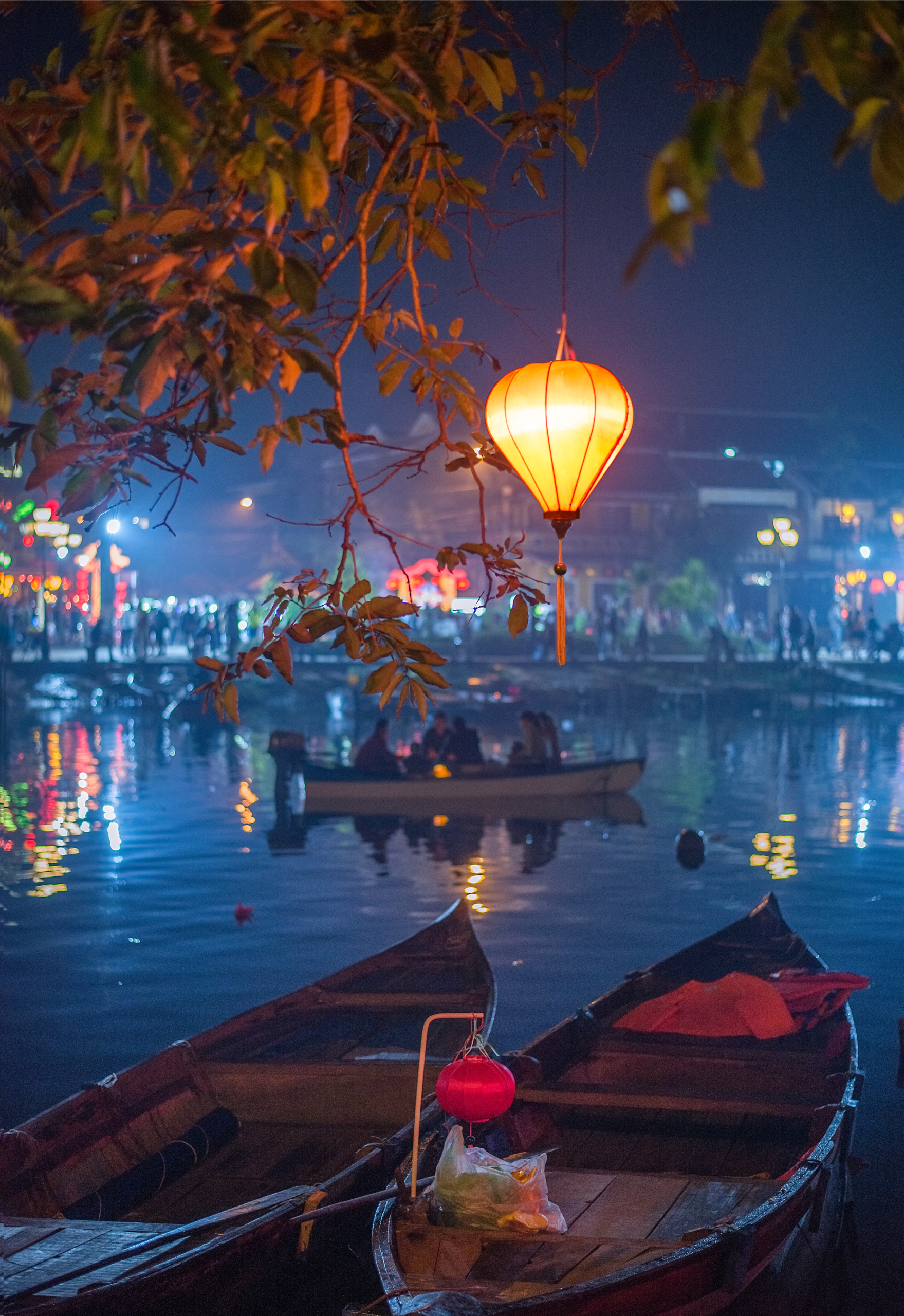
Every night at sunset, the town lights 5,000+ silk lanterns and floats candle-lit paper boats down the river.It is the most photographed evening hour in Vietnam — and the reward of the trip.
The luxury infrastructure sits outside the old town. Four Seasons Resort The Nam Hai is the anchor — 100 villa pavilions on Hà Mỹ Beach, 15 minutes by car from the old town. The Bensley-style is everywhere. Anantara Hoi An sits on the riverfront 5 minutes from the lanterns. Victoria Hoi An anchors the Cua Dai Beach side.
The trip is 3–4 nights. Beach mornings, cooking classes at lunch (Hội An is a major Vietnamese culinary destination — the cao lầu noodle and the white rose dumpling exist only here), old-town afternoons, lantern-river evenings, dinner on a balcony over the water. Day trips to Mỹ Sơn (4th-century Hindu Cham ruins) and Cù Lao Chàm (snorkel island) extend the trip.

Before you arrive.

The lantern town.
Hội An lives in layers. There’s the ancient town — 14 hectares of yellow-ochre shophouses, Chinese assembly halls, and the 16th-century Japanese Covered Bridge, closed to vehicles each afternoon so it can become a walking museum. There’s the river — the Thu Bồn, where wooden boats carry candle-lit paper lanterns downstream after dark. And there’s the country around it — An Bàng’s beach to the east, the coconut-palm water-world of Cẩm Thanh, the Cham temple valley of Mỹ Sơn inland. The luxury infrastructure sits outside the old town, on the beach. That’s where you sleep.
But you don’t come to Hội An to sleep. You come for the old town at 6am, before the day-trippers, when the lanterns are dark and the shophouse doors are just opening. You come for the tailor who measures you on day one and hands you a finished suit on day three. You come for the lantern hour at dusk and a bowl of cao lầu — a noodle that exists only here. The reward of Hội An isn’t a single monument. It’s the spell the whole town casts once the engines stop and the candles go on the water.
The ancient town at dawn.
By night the old town belongs to the cameras — thousands of them, under five thousand lanterns. By dawn it belongs to whoever shows up. Come at 6am, before the day-trip buses arrive from Đà Nẵng, and you have the place almost to yourself: the yellow shophouse walls catching the first light, the river still, an old woman setting out her cà phê stall, the 16th-century Japanese Covered Bridge empty for the first photograph of the day.
This is the way to actually see the architecture UNESCO protected in 1999 — the Chinese assembly halls, the Tấn Ký merchant house that’s been lived in by the same family for seven generations, the Fujian congregation temple. In the morning quiet you can read the town as the trading port it was, not the lantern set it becomes after dark. Both are real. The dawn version is the one most visitors never see.
Then circle back for the other Hội An at dusk: the lantern hour, when the town cuts its electric lights and floats candle-lit paper boats downstream. Two visits to the same square kilometer, twelve hours apart, two completely different towns.
Mỹ Sơn at sunrise.
An hour southwest of Hội An, in a bowl of jungle ringed by mountains, stand the brick towers of Mỹ Sơn — the spiritual heart of the Hindu kingdom of Champa, which ruled central Vietnam for more than a thousand years. The Cham kings built and rebuilt this temple complex here, dedicated chiefly to Shiva, between roughly the 4th and 14th centuries AD. UNESCO inscribed it as a World Heritage Site in 1999, the same year as Hội An itself.
What survives is extraordinary and a little haunting. The towers are built of fired brick fitted without visible mortar — a Cham technique still not fully understood — and carved directly into the brick with sandstone deities. Some were lost to American bombing during the war; the craters are still there beside the standing towers. It is Vietnam’s answer to Angkor, on an intimate, ruined, jungle-quiet scale.
Go at opening, before the heat and the buses. The early light through the valley mist on the red brick is the reason to set the alarm. A Cham-history guide turns a field of old bricks into a thousand-year civilization.
A wardrobe in three days.
Hội An made its fortune on silk, and the trade never left. Today the old town holds hundreds of tailors, and the best of them are genuinely good — fast, exacting, and inexpensive by Western measure. This is the one experience that’s unique to Hội An on the entire central coast: you arrive with a reference photo or a favorite jacket, you’re measured on day one, and you walk out two or three days later with a made-to-measure piece that fits like it was always yours.
The trick is choosing well. The serious houses — names like Yaly Couture at the high end, Bebe Tailor for reliable mid-range — keep their own pattern-cutters and use real wool, linen, and silk rather than the synthetics the tourist shops push. A good tailor will talk you out of a bad idea, do a proper second fitting, and ship the finished pieces home if you’ve moved on.
Done right, it’s not shopping — it’s commissioning. A suit, a set of shirts, an evening dress, a winter coat for back home — built to your measurements in the time it takes to do everything else in town. Bring the garments you wish you could replace; you can, here.
Cẩm Thanh and An Bàng.
Five minutes from the old town, the Thu Bồn fans out into Cẩm Thanh — a maze of brackish channels lined with nước dừa water-coconut palms, the half-wild buffer where the river meets the sea. Fishermen here still work from thúng chai, the round woven-bamboo basket boats unique to this coast. Take one out with a local rower: it’s calm, low, and genuinely beautiful gliding through the palm tunnels, and the rowers will spin the boat in dizzy circles if you let them.
The palm forest also tells a harder story — it was a guerrilla hideout during the war, and the local guides who grew up here know the channels intimately. It’s the antidote to the lantern crowds: quiet, green, and on the water.
Then due east is An Bàng Beach, four kilometers from the old town — a long, uncrowded stretch of soft sand with a string of good beach bars, the locals’ answer to the over-built Cửa Đại strip. Mornings for a swim and a run on the firm sand; late afternoons for a drink as the light goes long over the water. The two together — palm channels and open beach — are how you balance a Hội An trip so it isn’t all old-town and lanterns.
Skip the disco basket-boat circus.
At Cẩm Thanh, dozens of operators now blast pop music and spin tourists in basket boats for tips, churning the same fifty meters of channel. It’s loud and graceless. Go with a quiet private rower deeper into the palm tunnels instead — the real thing is calm, green, and worth it.
Don’t chase the 24-hour bargain suit.
The shops promising a full suit overnight for next to nothing use fused synthetic cloth and skip the second fitting — it looks fine in the mirror and falls apart at home. Use an established house, real wool or linen, and a proper two-fitting timeline. We match you to one.
Don’t do the ancient town at noon.
Between 10am and 4pm the day-trip buses from Đà Nẵng pack the heritage streets shoulder-to-shoulder in full heat. It’s the worst possible window. See the old town at dawn and again at the lantern hour; spend the middle of the day at the beach or the spa.

Where you sleep matters.
Four Seasons Resort The Nam Hai
Opened 2006, taken over by Four Seasons in 2017. 100 one-, two-, three-, and five-bedroom villas across 35 hectares on a private stretch of Hà Mỹ Beach, 20 minutes north of Hội An old town. Designed by Reda Amalou (AW2 Paris) — modernist white pavilions raised on stone platforms, three infinity pools cascading toward the East Sea.
This is the central Vietnam standard. Pair with Hội An’s evening for the complete trip. The villa pools, the spa pavilions in their own lily-pond enclosures, the Heart of the Earth restaurant — every detail of the property is engineered for a slow stay.
Anantara Hội An
94 rooms in a French-colonial villa setup directly on the Thu Bồn River, a 5-minute walk from the Japanese Covered Bridge and the heart of the lantern district. The only luxury property inside walking distance of the UNESCO old town. The right pick for clients who want the lanterns at their doorstep, not a 15-minute car ride away.
The pool sits at the river’s edge. The Lanterns Restaurant runs the riverside dinner with the boats floating past. Anantara Spa runs Vietnamese rituals plus a sound-bath program.
Victoria Hội An Beach Resort & Spa
Cua Dai Beach, 5 km east of Hội An old town. 109 rooms in a French-colonial-style village pavilion layout. The largest beachfront luxury resort in the area — best for multi-generational trips, weddings, and clients who want full beach-club amenities on site. Older property than Four Seasons but recently refurbished.
The kids’ club, the multiple pools, the easy beach access make this the most family-friendly luxury anchor in Hội An. Old town shuttle service every hour.
Hotel Royal Hội An — MGallery
On the Thu Bồn River, a 7-minute walk to the old town. 187 rooms themed on a 16th-century Vietnamese-Japanese love story, two pools, Woosah Spa. The polished design-hotel option closest to the lanterns.
Almanity Hội An
A short walk from the old town. My Chi Spa is the largest on the central coast, with daily yoga, tai chi, and herbal-tea meditation built into the stay. The reset base for clients who came to slow down.
La Siesta Hội An
Townhouse villas and four pools — including an infinity pool over the rice fields — 15 minutes’ walk from the old town. Intimate, tropical, attentive. The character pick when the big beach resorts feel too large.

The town and the stools.
The refined rooms.
Morning Glory
Chef Trịnh Diễm Vy’s flagship — the room that put Hội An’s home cooking on the map for international diners. Faithful versions of the local canon, made well and consistently. The reliable first dinner: order the regional specialties and let the kitchen show you the town.
Vy’s Market Restaurant
Ms. Vy’s market-hall concept — a covered courtyard of live cooking stations where you watch each dish made and order across the room. The best single education in central-Vietnamese food: noodles, dumplings, grills, and a working cooking academy upstairs.
White Rose Restaurant
The family kitchen that makes the white rose dumpling — bánh bao vạc — for much of the town: translucent rice-dough parcels of spiced shrimp, pinched to look like little roses. The menu is essentially two dishes. Go to the source, watch them fold by hand.
The Hội An icons.
Cao Lầu Thanh
Hội An’s defining dish, made nowhere else: thick chewy noodles said to need water from the town’s old Bá Lễ well and ash from a specific island, topped with char siu pork, greens, and crisp crackers — no soup. A local institution for the real version.
Cơm Gà Bà Buội
The town’s famous chicken rice — turmeric-yellow rice cooked in chicken stock, hand-shredded poached chicken, herbs, and a sharp papaya pickle. Bà Buội is the long-standing local name for it. Simple, perfect, and unique to Hội An’s table.
Bánh Mì Phượng
The bánh mì Anthony Bourdain called the best in the world on No Reservations. A crackling baguette loaded with house pâté, pork, herbs, and a dozen sauces. Expect a line out the door; it moves fast, and it’s worth it.
The Bạch Đằng riverfront
Not a single address but the move: a riverside table on Bạch Đằng as the lanterns come on, a Vietnamese coffee or a cold beer, and the paper boats drifting past. The whole town becomes the meal. Come at dusk, stay for the light.
Want a chef in your villa?
For longer stays or special dietary protocols — recovery nutrition, performance macros, post-training meals — we arrange a private central-Vietnamese chef to cook in your villa, or a hands-on cao lầu and white-rose class at a local cooking academy. Market run included. Quietly handled.

How the town moves.
DAD → old town.
Đà Nẵng International (DAD). ~30km · 30–35 min from Hội An’s old town. There’s no Hội An airport — DAD serves the entire central coast. Modern terminal, easy customs, short drive south.
Private Transfer. Black car or Mercedes V-Class. Meet-and-greet at the gate with a name card, bags handled, straight to Four Seasons The Nam Hai, Anantara, or Victoria Hội An.
The same driver stays with you for the whole trip — same standard whether you’re old-town-only or doing Mỹ Sơn day trips.
Once you’re in.
Old town is for walking only. The UNESCO zone is car-free — narrow lantern-lit lanes, the Japanese Covered Bridge at one end, the Thu Bồn River at the other. Step out of the car at the perimeter and walk in.
Bicycle. Every luxury resort provides them; the most authentic way to move between old town, the rice paddies, and An Bàng Beach. 10-min cycle in any direction.
Private car for Mỹ Sơn (60 min west), Đà Nẵng airport, beach transfers, or evening dining outside the walking zone. Same driver every day.
What you’ll actually do in Hội An.

What you actually need.
Required vs. recommended.
What to pack before you fly.
How Hội An affects the body.

What we tell you that nobody else does.
September–December puts the UNESCO zone underwater.
Hội An sits where the Thu Bồn River meets the South China Sea — a geography that built the trading port and now floods it annually. Sept–early Dec, the river backs up and the old town goes under. Some streets fill to ankle height; in bad years, to chest. The locals row boats down Nguyễn Thái Học. Shops board up. Lantern festivals cancel.
What we do about it: the open window is Feb–Jul. If you must travel Sept–Dec, we book elevated resorts (Four Seasons The Nam Hai is on the beach, well above flood line), monitor the 10-day forecast 14 days out, and have rebooking authority with the partner hotels. Mỹ Sơn and Cù Lao Chàm both close in heavy rain.
The lantern town gets overrun on schedule.
Hội An’s lantern festival happens every full moon — and again at Tết (Lunar New Year, late Jan / early Feb). Beautiful nights, and the most photographed evenings of the year. They are also the most crowded. Day-trippers from Đà Nẵng cruise ships flood the old town from 5pm onward.
The play: we book full-moon nights at Four Seasons or Anantara (15 min from the noise). Arrive at the old town by 4pm for golden hour, eat by 6:30pm, do the lantern-boat sunset before the day-trip buses arrive, and back to the resort by 9pm. The crowd shows up at 7. We don’t.
Bespoke in 24 hours is bespoke in 24 hours.
Hội An is famous for tailors — and most of them are tourist-grade. They will deliver a suit in a day. They will not deliver a suit that lasts. The good ones — Yaly Couture, BeBe Tailor, Kimmy Custom Tailor — need 3–5 days minimum, two fittings, and someone watching the fabric choice.
The play: we send fabric briefs ahead, book the first fitting day 1 of the trip, the second fitting day 3, delivery day 4 or 5. Anyone promising same-day Savile-Row quality is selling something that won’t hold a shoulder.
Hội An rewards slow.
This is not a city of late nights, action sports, or non-stop stimulation. The reward of Hội An is the pace itself — lantern light on yellow walls, the river at dusk, cooking with one chef for three hours. Active travelers add Mỹ Sơn (4am dawn), Cù Lao Chàm snorkel, or An Bàng Beach training; otherwise, the rhythm is deliberately slow.
The shape: 3–4 nights. Pair with Đà Nẵng coast (20 min north) for beach-resort days or Huế (2 hr north) for imperial cultural depth. Hội An is the heart of central Vietnam. Treat it that way.
The ways you fly.
What locals notice.

The bespoke details.
Services not on any booking site.
Doors before opening hours. After closing.
Doors the town keeps closed.
The fluent people behind every visit.
We don’t ship itineraries.
The other guides give you a day-by-day plan. We don’t. A bespoke trip starts with what’s true for you: your training schedule, your dietary protocols, your sleep window, the experience you’d fly for. You answer. We build.
What we ask before we build.
The questions that shape your trip more than any itinerary ever could.
The moments we build around.
Not a checklist — a list of the kinds of anchors that often appear in a TBT-built trip.
Tell us about you. We build the rhythm.
Sanctum members answer the 7 prompts above. We build the trip from there. Flights, hotels, drivers, restaurants, private chef, motorcycle tour, paragliding, all pre-arranged before you land. No template. No itinerary you didn’t ask for.
What Hội An taught me.
Want Hội An handled?
Sanctum members can request a custom Hội An route — flights, hotels, drivers, restaurants, private chef, a vetted master tailor, a Mỹ Sơn sunrise, a cooking academy class, a Cù Lao Chàm island day — pre-booked, the whole rhythm of the trip mapped before you land.
Hội An is the launch pad.
Hội An sits at the soft center of Vietnam’s most concentrated cluster of culture and coast — a port city, the imperial capital, a Cham temple valley, a marine-reserve island, and a cloud-station mountain, all within a short drive. Each gets its own dedicated guide. Or go solo and build your own way through them.
Enter your details to open this guide — and every guide in our atlas.
The trips we don’t list publicly
Our exact stays, tables, and routes live inside Sanctum.
Unlock the Guide