Walk through the pagodas, ancient structures standing over 1,000 years, and the French colonial bones still visible throughout.The French left their imprint here, and you see it everywhere.
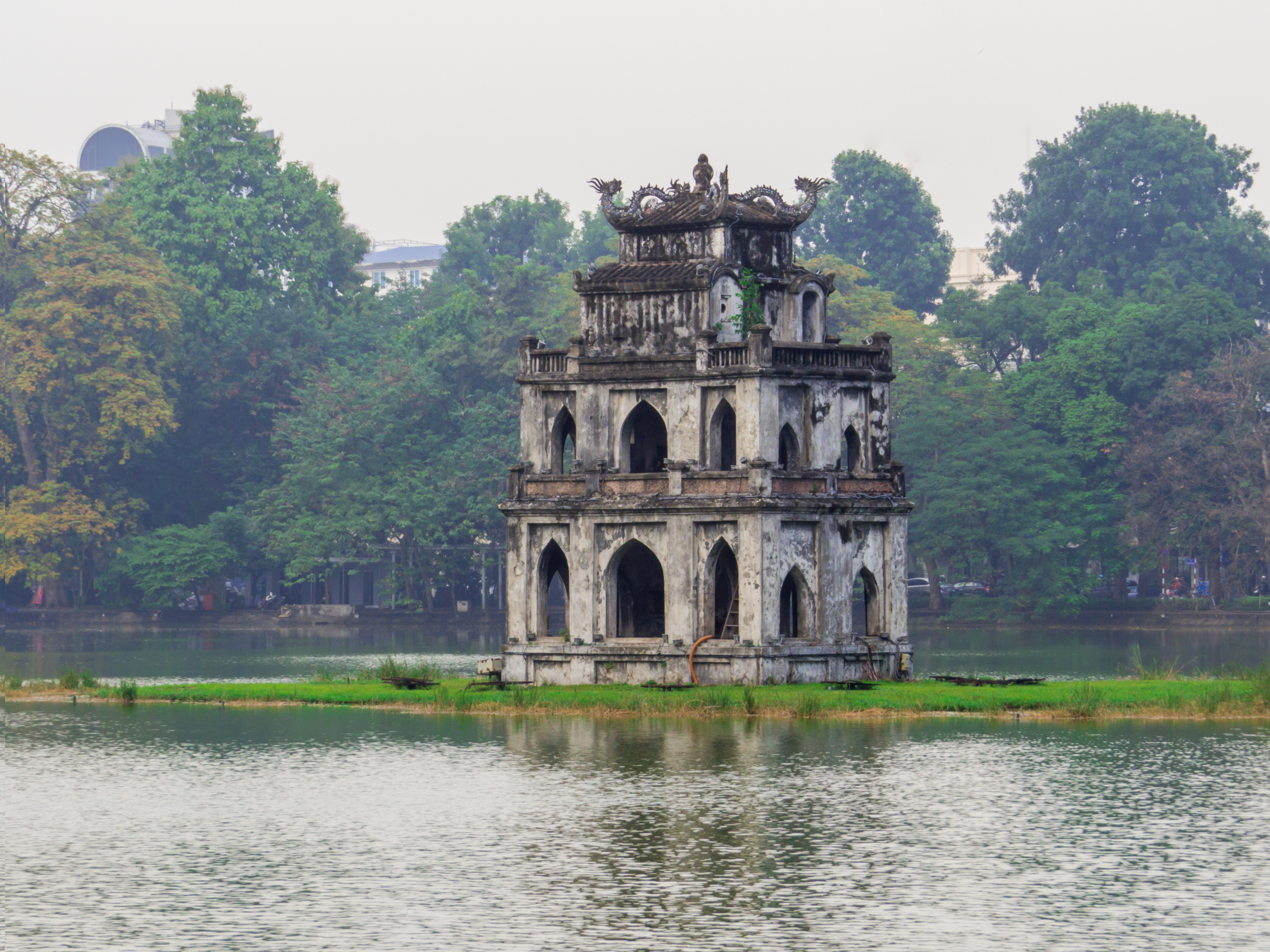
But what hits harder is the age itself. The discoloring on these buildings, the weathering on these monuments, the Temple of Literature, Trấn Quốc — none of it looks broken. It looks lived in. Like wine aging. These are the foundations Hanoi was built on.
The food is restrained. The dress is conservative. This is the Northern capital, and it doesn’t bend toward you — you bend toward it.
But beneath all that old-world restraint, there’s relentless energy. People are working. Building. Moving. And when the heat hits, depending on when you arrive, it can absolutely wreck you. That’s when you slip down to the lake in the center, order tea and a bánh mì, watch the city reflect back off the water, and finally understand. Slowness here isn’t laziness. It’s intention.

Before you arrive.

1010 to today.
Hanoi splits in two. The Old Quarter is soul — narrow alleys, shop fronts that haven’t moved in 70 years, food stalls still cooking the same way their grandmothers did. Vendors on bikes call out their goods at dawn. You walk in and the city swallows you. The French Quarter is the other side of that coin: wide boulevards, colonial villas, the lake sitting at the center like it owns the place. That’s where the luxury hotels are. That’s where you sleep.
But you don’t come to Hanoi to sleep. You come for West Lake at 6 in the morning, when the city’s still quiet. You see the old French architecture reflected in the water. You eat a bánh mì from a vendor who’s been selling from the same corner for decades. You drink lotus tea from a porcelain cup and finally get it. The reward of Hanoi isn’t the monuments. It’s the rhythm. It’s knowing that everything you’re experiencing right now has been happening exactly this way for 1,000 years.
West Lake at sunrise.
West Lake is 6 miles around. I know this not from research but from running it, biking it, living it during my time in Hanoi. At 3 in the morning, when the city sleeps, the lake becomes something else entirely. 1.5 hours on a bike, and you feel it — the spirit of Hanoi bouncing off the water, the breeze, the smells, the weight of 1,000 years pressing down soft. It’s not exercise. It’s a spiritual experience.
By dawn, locals are already there. Swimming. Bathing. Fishing. By 7am, the taxis and tour buses arrive and the vibe shifts. But it doesn’t matter what time you come to West Lake. Whether you’re moving through it or sitting still, whether you’re chasing the twin dragon statues rising from the water or finding a bench with egg coffee and a thermos, the lake gives you something. Maybe it’s a mental release. Maybe it’s a cultural connection. Maybe it’s just the breeze and the slow.
The whole point is that West Lake doesn’t perform for you. You show up, and whatever you need from it, it’s already there waiting.
Trấn Quốc Pagoda.
Trấn Quốc Pagoda sits on a tiny peninsula on West Lake’s south shore. It’s the oldest temple in Hanoi, built in 541 under Emperor Lý Nam Đế. For over 1,000 years, pilgrims have come here seeking protection and spiritual grounding. In the 1600s, when the Red River shifted course, the pagoda relocated to its current spot.
Inside stands a sacred bodhi tree, a gift from Sri Lanka’s President Rajendra Prasad in 1959. Bodhi trees carry deep spiritual significance in Buddhist tradition — they’re symbols of enlightenment and protection. This one has watched over Hanoi through wars, floods, and transformation.
Whether you visit at sunrise or in the afternoon, Trấn Quốc offers what ultra-luxury travelers and serious athletes actually seek: stillness, depth, and connection to something older and more significant than yourself. It’s a 1,000-year anchor point for a city built on the same foundation.
Temple of Literature to the Opera House.
This walk isn’t on every guide. 3 eras of Hanoi, all walking distance from each other. I did it myself, and I’ll tell you straight — this is how you actually understand the city.
Start at the Temple of Literature. Built in 1070 by Emperor Lý Thánh Tông. Vietnam’s first national university, dedicated to Confucius. For 700 years, the country’s top minds trained inside these 5 courtyards. The doctoral stelae from 1442 to 1779 still stand where they were carved. You walk through and you feel the weight of where Vietnamese intellectual life began.
Walk east into the Old Quarter. Each “Hàng” street is named after what was sold there 500 years ago — Hàng Bạc for silver, Hàng Gai for silk, Hàng Mã for paper goods. The shop fronts haven’t moved. The trades, in many cases, haven’t either. This is pre-French Hanoi, still operating on the same logic it had before the colonizers arrived.
Cross south into the French Quarter and the architecture flips. Wide boulevards. Beaux-Arts colonial villas. Manicured public squares. All built between the 1880s and 1920s when Hanoi was the capital of French Indochina. The French wanted to bring Paris to the East. They did.
St. Joseph’s Cathedral, completed in 1886, is the proof. Built to mirror Notre-Dame de Paris. Twin neo-Gothic bell towers, limestone facade. Services still held in Vietnamese and French. It still anchors the Catholic quarter.
End at the Hanoi Opera House. Completed in 1911. Modeled directly after the Palais Garnier in Paris. The marble grand staircase. The gilded interior. The 600 hand-painted seats. The most ostentatious building French Indochina ever produced — and the proof of how badly the colonizers wanted to be elsewhere.
One afternoon. 1,000 years. This is the complete architectural argument of Hanoi.
Paragliding? Seriously.
I walked into this skeptical. Hanoi is quiet, controlled, rhythmic — not the place you’d expect to find something that yanks you out of your comfort zone. But a 90-minute drive southwest, in the Vietnam Mountains, there’s May Paragliding. And they’ll teach you to fly.
I did the P1. 3 days sounds short until you’re living it — it’s compressed, deliberate, relentless. They move you piece by piece: how to rig, how to sit in the harness, the vocabulary you need, the physics that keeps you alive. The staff is meticulous. Safety first, always. The owner is a master paraglider. They speak English fluently. And they give a damn whether you actually learn or just complete a checkbox.
The real part: on the final day, you take off from a mountain in Vietnam and see the whole country from above. I don’t have words for that. You have to experience it yourself.
If you’ve got an extended stay in Hanoi or you’re willing to stretch one, this is a legitimate move. You need your passport. They handle the rest. P1 gets you certified to fly solo with an instructor or supervisor. Progress to P2, and you’re truly on your own — Switzerland, Brazil, South Africa, anywhere in the world. Want to progress further? They’ve got you. Small classes, weekend format mostly, instructors who actually know their craft.
This is the kind of thing that changes how you see a place. Do it.
You can go, but we don’t think you should.
A freight train threads narrow alley cafes at all times of day — morning, afternoon, evening. For our clients it’s underwhelming. Coffee on plastic stools watching a train pass isn’t worth your time. Catch a cocktail on a rooftop instead — and actually enjoy the hour.
Skip the water puppet show.
40 minutes of mediocre on a wet stage. The tradition is real; the tourist version isn’t. If puppetry matters to you, we can coordinate a private workshop with a master. Otherwise — walk Hoàn Kiếm Lake at dusk.
Skip the Jeep tours.
You’ll see jeep tours and full-size bus tours circling the Old Quarter. They rush 100 travelers past the city’s details in 2 hours. A private car with a guide takes the same route in half a day — and you actually see the city, learn its layers, and immerse yourself in everything being shown.

Where you sleep matters.
Capella Hanoi
47 suites directly behind the Hanoi Opera House. Designed by Bill Bensley — each suite themed as a 1900s opera-house dressing room: velvet, brass, hand-painted ceilings. Opened December 2018 under the Capella Hotels & Resorts ultra-luxury portfolio.
Sofitel Legend Metropole
Opened in 1901 — one of the oldest grand hotels in Southeast Asia. National historic landmark. Graham Greene wrote The Quiet American here. Charlie Chaplin honeymooned here in 1936. Every US President since Bill Clinton has slept under this roof.
The bomb shelter beneath the property — used during US bombing raids in 1972, where Joan Baez sheltered with journalists — was sealed for decades. Rediscovered in 2011. Now open for guest tours.
Pan Pacific Hanoi
1 Thanh Niên Road, sitting between West Lake and Trúc Bạch Lake. 20 floors, 273 rooms. West-facing rooms above the 14th floor have Trấn Quốc Pagoda framed directly in your window.
The 19th-floor rooftop is one of the most iconic in Hanoi — direct view of Trấn Quốc Pagoda, the lake at your feet, the city behind. Sunset from this rooftop is the reason you stay here.
Hotel de l’Opera Hanoi
M Gallery, French Quarter. Art-deco interiors themed around the opera house. Smaller scale, theatrical service. Walking distance to Hoàn Kiếm Lake.
JW Marriott Hanoi
Modern business-luxury in a dragon-shaped tower beside a private lake. Outside the city center, near the National Convention Center. Best for residential-style stays and quiet retreats.
InterContinental Hanoi Westlake
Pavilions sitting directly over West Lake water. Resort-feel within the city. 20 minutes by car from the Old Quarter — best when you want distance from the streets.

The stars and the stools.
The Michelin year.
Tầm Vị
Chef Vân Nguyễn’s tribute to traditional Northern Vietnamese cooking — her grandmother’s recipes, plated with restraint. Heritage Vietnamese ingredients, no fusion. Among the first restaurants in Vietnam to earn a Michelin star in 2023. Intimate, small dining room.
Gia Restaurant
Chef Sam Trần’s 12-seat counter — Vietnamese ingredients, French technique, Japanese precision. Earned its Michelin star in the 2024 Guide. Our pick for the meal of the trip.
Pots ‘n Pans
Modern Vietnamese, restrained presentation. Ingredients sourced within 100km of Hanoi. The duck broth is what tests the kitchen. Listed in the Michelin Guide — Bib Gourmand-tier value at fine-dining level.
The street icons.
Phở Gia Truyền
49 Bát Đàn since the 1960s — three generations of the same family. Hanoi-style phở: clean bone broth simmered overnight, thin slices, two herbs. Sold out daily by 10am. This is the bowl Hanoi was built on.
Bún Chả Hương Liên
The plastic-stool restaurant where President Obama and Anthony Bourdain shared a meal in 2016. The exact set they ordered — bún chả, nem cua bể, Hanoi beer — is now Combo #6 on the menu, permanently. The table they sat at has been preserved under glass.
Bánh Mì 25
25 Hàng Cá. Family-run, two locations on the same alley. Pâté made fresh in-house every morning, baguette baked on site. Two windows — one for takeaway, one for the standing-counter inside.
Café Giảng
Where Vietnamese egg coffee was invented in 1946 by Nguyễn Văn Giảng — a Sofitel Metropole bartender forced to improvise during a wartime milk shortage. Still family-run, third generation. The original spot is upstairs, hidden up an alley.
Want a chef in your suite or villa?
For longer stays or special dietary protocols — recovery nutrition, performance macros, post-training meals — we arrange a private Vietnamese chef to cook in your suite or villa. Market run included. Three meals a day or single dinners. Quietly handled.

How the city moves.
HAN → city center.
Nội Bài International (HAN). ~32km · 35–45 min from the city center. 2 terminals; T2 is international.
Private Transfer. Black car or Mercedes V-Class. Your driver handles everything — meet and greet at the gate with a name card, bags, straight to your hotel.
The same driver stays with you throughout your trip. Arranged through your hotel or directly through us.
Once you’re in.
Private car and driver extends for the whole trip. Same driver every day, English-fluent, on call — your guy. They take you to and from everything.
Old Quarter is for walking only — too narrow for cars, too slow for time. Step out, walk in, walk out, car picks you up at the perimeter.
Grab (Vietnam’s Uber / Lyft / Blacklane) is downloadable. Fun to have if you want to move around or get around on your own — or have food delivered to your hotel.
What you’ll actually do in Hanoi.

What you actually need.
Required vs. recommended.
What to pack before you fly.
How Hanoi affects the body.

What we tell you that nobody else does.
Hanoi’s air is the underrated concern.
Hanoi consistently ranks among the most polluted capitals in Southeast Asia. PM2.5 levels spike October through March, with winter mornings frequently hitting AQI 150–200 (the “unhealthy” range). Construction dust and motorbike exhaust compound it.
What we do about it: we check IQAir daily and shift outdoor experiences to clean-air windows. Sunrise West Lake walks become hotel-gym mornings on red-AQI days. We pre-arrange N95 masks for long outdoor sessions in winter.
It’s blazing hot. It is underestimated.
May–August looks like 82–91°F on paper. The reality: 80%+ humidity stacks on top, pushing the heat index over 100°F. It’s blazing. Mid-day outdoor experiences become tolerable only at sunrise or after 7pm.
The fix: early-morning windows for any walking, mid-afternoon hotel reset (pool, spa, nap), evening experiences from 5pm.
August–September shuts things down.
Typhoon systems can shut down Hạ Long Bay AND alley-level Old Quarter walking for 2–4 days. Sunrise walks become impossible. Outdoor markets close.
The plan: if booking Aug–Sep, build a 2-day inland Plan B (Pu Luông or Sapa). We monitor the 7-day forecast 14 days out and adjust the rhythm.
Hanoi isn’t built for action.
This is not a city of late-night clubs, blockbuster museums, or constant stimulation. The reward of Hanoi is stillness — food, lake walks, colonial architecture, slow afternoons, a 1,000-year-old pace.
If you came for nightlife or non-stop activity, you came for the wrong city. Hanoi rewards travelers who treat it as a reset. 3 nights here, then move to one of the 5 trips within 6 hours.
The ways you fly.
What locals notice.

The bespoke details.
Services not on any booking site.
Doors before opening hours. After closing.
Doors the city keeps closed.
The fluent people behind every visit.
We don’t ship itineraries.
The other guides give you a day-by-day plan. We don’t. A bespoke trip starts with what’s true for you: your training schedule, your dietary protocols, your sleep window, the experience you’d fly for. You answer. We build.
What we ask before we build.
The questions that shape your trip more than any itinerary ever could.
The moments we build around.
Not a checklist — a list of the kinds of anchors that often appear in a TBT-built trip.
Tell us about you. We build the rhythm.
Sanctum members answer the 7 prompts above. We build the trip from there. Flights, hotels, drivers, restaurants, private chef, motorcycle tour, paragliding, all pre-arranged before you land. No template. No itinerary you didn’t ask for.
What Hanoi taught me.
Want Hanoi handled?
Sanctum members can request a custom Hanoi route — flights, hotels, drivers, restaurants, private chef, motorcycle tour, paragliding — pre-booked, the whole rhythm of the trip mapped before you land.
Hanoi is the base camp.
Within a half-day’s drive or a helicopter ride, you can reach 5 different versions of Vietnam — mountains, motorbike loops, monsoon bays, river caves, cloud chasing. Each gets its own dedicated guide. Or go solo and build your own way through them.
Enter your details to open this guide — and every guide in our atlas.
The trips we don’t list publicly
The full Hanoi guide—our exact stays, tables, and routes—lives inside Sanctum.
Unlock the Guide