Florence.
The Uffizi Gallery holds 100,000+ works of Renaissance art — Botticelli’s Birth of Venus, Leonardo’s Annunciation, Caravaggio’s Medusa.All within 90 minutes of each other in a city you can walk across in 30 minutes.
The luxury infrastructure: Four Seasons Hotel Firenze (in the 15th-century Palazzo della Gherardesca with the largest private garden in Florence), Helvetia & Bristol Firenze – Starhotels Collezione (the historic central-piazza grand hotel), Hotel Savoy Rocco Forte (the Piazza della Repubblica anchor). For Tuscan extensions, Castello del Nero (Como brand) and Borgo Santo Pietro in the countryside.
The trip works as 3–4 nights. 90 days visa-free Schengen. Best windows April–May (Tuscan wildflowers) and September–October (harvest). Avoid August (heat + closures) and December–February (cold + Christmas-market crowds). Pair with Rome (1.5 hours by Frecciarossa) and the Tuscan countryside (Chianti, Siena, Cortona) for the full Italian Renaissance circuit.

Before you arrive.

The Renaissance, in 30 blocks.
Florence sits astride the Arno. The north bank holds the monumental city — the Duomo with Brunelleschi’s dome, the Uffizi, the Accademia and the David, the Piazza della Signoria where Florentine politics played out for centuries. It’s dense, walkable, and stacked with more Renaissance masterpieces per square meter than anywhere on earth. Across the Ponte Vecchio, the Oltrarno (“beyond the Arno”) keeps the working register: artisan workshops, leather and gold and frame-gilding studios, the Pitti Palace and Boboli Gardens, and the city’s most unhurried evenings.
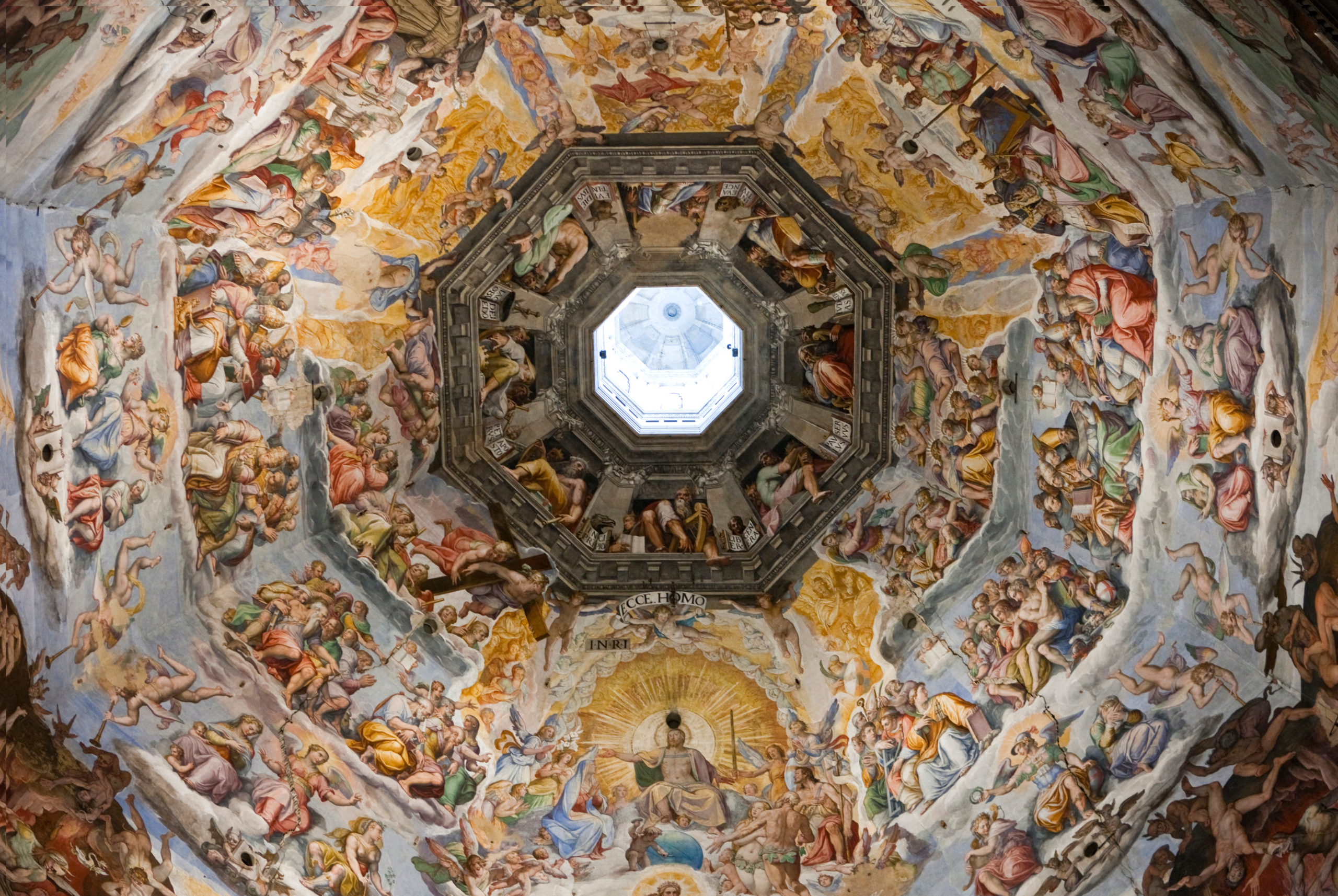
But you don’t come to Florence for the checklist. You come for the 463-step climb up the inside of Brunelleschi’s dome at opening, Vasari’s Last Judgment frescoes passing at arm’s length. You come for the Uffizi before the crowds, Botticelli’s Birth of Venus with room to breathe. You come for an Oltrarno workshop where a craftsman is doing exactly what his grandfather did. The reward of Florence isn’t the monuments. It’s standing in front of the things you’ve only seen in books — and finding the room nearly empty.
Brunelleschi’s dome.
The dome of the Cathedral of Santa Maria del Fiore is the symbol of Florence and the building that announced the Renaissance to the world. When Filippo Brunelleschi won the commission in 1418, no one knew how to span a hole that wide in masonry — the ancient technique had been lost for a thousand years. He built it anyway, between 1420 and 1436, without scaffolding, using a self-supporting double-shell design that’s still studied by engineers today. It remains the largest masonry vault on earth.
You climb it from the inside — 463 steps, no elevator, up between the two shells. Partway, the stairs open onto a gallery at the base of the dome where you pass Vasari’s vast Last Judgment frescoes at arm’s length, then emerge onto the lantern at the very top: the entire red-tiled city below, the Arno, the Tuscan hills, the bell tower at eye level.
The move is timing. The climb sells out weeks ahead in season, and the first slot of the day — before the heat and the crush — is the one to hold. Cool stone, quiet stairwell, the city still waking under you when you reach the top.
The Uffizi before crowds.
The Uffizi Gallery was built in 1560 by Giorgio Vasari as the administrative offices (“uffizi”) of the Medici dukes; within a century the family had filled it with the art they commissioned and collected. It holds over 100,000 works — and the densest single run of Renaissance masterpieces anywhere.
This is where you stand in front of Botticelli’s Birth of Venus and Primavera in the same room, Leonardo’s Annunciation, Michelangelo’s Doni Tondo, Caravaggio’s Medusa, Raphael, Titian, the entire arc of the period in roughly chronological order. The building itself frames the Arno and the Ponte Vecchio through its corridor windows.
By midday the galleries are packed and the Botticelli room is shoulder-to-shoulder. The move is the first entry of the day — or a before-hours private slot with an art historian — when the great rooms are nearly empty and you can actually stand still in front of the paintings. The difference between the two experiences is total.
The David to the Ponte Vecchio.
This is the spine of Florence, all on foot, best early before the day-tour groups fill the center. Four anchors, none more than ten minutes apart.
Start at the Galleria dell’Accademia and Michelangelo’s David. Carved from a single flawed block of Carrara marble between 1501 and 1504, when Michelangelo was in his twenties, the 17-foot figure stood originally in Piazza della Signoria as a civic symbol of the Florentine Republic. It moved indoors in 1873; what stands in the piazza now is a copy. In the Accademia, under its purpose-built skylight, the original stops you cold — the scale, the tension in the hand and brow, the unfinished Prigioni (“Prisoners”) lining the approach.
Walk down to the Piazza della Signoria — Florence’s open-air sculpture gallery and political stage for 700 years. The Palazzo Vecchio with its tower, the Loggia dei Lanzi with Cellini’s bronze Perseus and Giambologna’s Rape of the Sabine Women, the copy of the David on the spot where the original once stood.
Cross past the Uffizi to the Ponte Vecchio — the medieval bridge that has spanned the Arno since 1345, the only Florentine bridge the retreating Germans spared in 1944. Its shops have sold gold and jewelry since the Medici banished the butchers in 1593. Above them runs the Vasari Corridor, the private elevated passage the Medici used to cross the river unseen.
One morning. The civic, the sculptural, and the medieval heart of the Renaissance city — the complete argument of Florence, on foot.
The Oltrarno workshops.
Cross the Ponte Vecchio to the Oltrarno, the “other side of the Arno,” and Florence stops being a museum and becomes a workshop. This is the artisan quarter — narrow streets around Santo Spirito and San Frediano where the trades that made the Renaissance possible still operate: leather, gold-leaf gilding, frame-making, marbled paper, shoemaking, bronze casting, fresco restoration. Many of these botteghe are family-run across generations, doing by hand what their ancestors did for the Medici.
The point isn’t to shop — it’s to watch. A gilder laying gold leaf onto a carved frame. A bookbinder marbling paper in a tray of color. A leatherworker stitching by hand at a bench that hasn’t changed in fifty years. With the right introductions, the workshops open their back rooms; you watch the craft, talk to the maker, and understand where the Uffizi’s frames and the city’s restoration work actually come from.
Anchor the morning at the Pitti Palace and the Boboli Gardens just beyond — the Medici’s grand residence and the formal Italian garden that set the template for Versailles. Then drop into the workshops, lunch in Santo Spirito, and let the Oltrarno’s slower register reset the trip after the density of the north bank.
This is the experience that changes how you see Florence. The masterpieces are on the other side of the river; the hands that still make things are over here.
Skip the fluffy neon gelato near the Duomo.
The shops around the Duomo piling gelato into bright, fluffy mountains are selling industrial product pumped full of air and dye — the giveaway is the unnaturally vivid color and the towering mounds. Real gelato sits flat in covered tins, in muted natural colors. Go to a proper gelateria like Vivoli or Gelateria della Passera in the Oltrarno instead.
Skip the San Lorenzo market leather.
The stalls around the San Lorenzo market sell “Florentine leather” that’s often imported and machine-stamped, pushed with hard-sell pressure. For the real thing, we route you to a working Oltrarno leather workshop or the Scuola del Cuoio behind Santa Croce — actual artisans, actual provenance.
Skip the tables on Piazza della Signoria.
The restaurants ringing Piazza della Signoria and the Duomo charge a premium for tourist-grade Tuscan food and a view. Eat where the kitchen is serious — Sostanza, Cammillo, or a Santo Spirito trattoria in the Oltrarno — and visit the piazzas separately, early, with an espresso.

Where you sleep matters.
Four Seasons Firenze
Set in the Palazzo della Gherardesca, a restored 15th-century Renaissance palace, with the Giardino della Gherardesca — an 11-acre walled park, the largest private garden in the city — at its center. Frescoed ceilings, bas-reliefs, two restored historic buildings. The most serene grand-hotel stay in Florence.
Helvetia & Bristol
Open since 1885, when Florence was a fixed stop on the Grand Tour — and still the most atmospheric historic-grand stay in the center, a few minutes from the Duomo and the Uffizi. A recent renovation added a wing by designer Anouska Hempel and the largest luxury spa in the historic center, 550 square meters.
Hotel Savoy
The Rocco Forte property in the absolute center, on Piazza della Repubblica, a stone’s throw from the Duomo. Olga Polizzi interiors, Loro Piana fabrics, hand-blown Venetian chandeliers, Pietrasanta marble. The most central grand-hotel address in Florence.
Portrait Firenze
Lungarno Collection, on the Arno at the foot of the Ponte Vecchio. Residence-style suites, Ferragamo-family ownership, river views over the bridge. Intimate, contemporary, the best address on the water.
Villa San Michele
A Belmond hotel in the hills of Fiesole, a former monastery with a facade attributed to Michelangelo. Panoramic views over Florence, a five-hectare park, total quiet. For travelers who want the city at arm’s length.
The St. Regis Florence
On Piazza Ognissanti by the Arno, with the brand’s 24/7 butler service and a Bottega Veneta designer suite. Renaissance-grand interiors, central, classic luxury for the loyalist.

The stars and the stools.
The Michelin tier.
Enoteca Pinchiorri
Florence’s three-Michelin-star institution, in a 17th-century palazzo on Via Ghibellina — opened in 1972 by Annie Féolde and Giorgio Pinchiorri, holding three stars since 2004. One of the most celebrated wine cellars in the world. Book weeks ahead; jacket expected.
Santa Elisabetta
An intimate six-table room inside the Torre della Pagliazza — the oldest, and only circular, tower in Florence, at the Hotel Brunelleschi. Two Michelin stars for chef Rocco De Santis’s refined Mediterranean cooking, fish-led, with the influences of his native Campania. One of the most precise seatings in the city.
Gucci Osteria
Massimo Bottura’s Florence outpost on Piazza della Signoria, inside the Gucci Garden — one Michelin star for chef Karime López’s playful, well-traveled Italian cooking. The most fashionable serious table in the city, in the heart of the historic center.
Tuscan cooking, done right.
Trattoria Sostanza
A tiny trattoria open since 1869, nicknamed “Il Troia” — communal tables, no frills, and the dish people fly in for: petto di pollo al burro, a chicken breast cooked in nothing but foaming butter. The bistecca alla fiorentina here is a Florentine benchmark. Cash, two seatings, book ahead.
Cammillo Trattoria
A Borgo San Jacopo institution in the Oltrarno, family-run since 1945 — Tuscan cooking with a few worldly flourishes, a regulars-and-insiders room steps from the Ponte Vecchio. Where Florentines and visiting names quietly eat. Reservations essential.
Borgo San Jacopo
The Lungarno Collection’s Michelin-starred dining room on the Arno, looking across to the Ponte Vecchio — one Michelin star for refined contemporary Italian cooking. The terrace over the river at dusk is one of the most romantic seatings in Florence.
Want a chef in your suite or villa?
For longer stays or special dietary protocols — recovery nutrition, performance macros, post-training meals — we arrange a private Tuscan chef to cook in your suite or villa. The bistecca alla fiorentina done right, a Chianti-country market run included. Three meals a day or single dinners. Quietly handled.

How the city moves.
FLR + PSA → city center.
Amerigo Vespucci (FLR). ~6km · 15 min by private car to most central hotels. Compact airport, regional routes — direct from London, Paris, Amsterdam, Frankfurt.
Pisa Galileo Galilei (PSA). 1 hour by car or train — the budget Tuscany gateway. We sometimes route long-haul clients via Rome FCO + FrecciaRossa (90 min) over PSA.
Private Transfer. Mercedes E-Class or V-Class, name card at the gate, bags handled, straight to your hotel. Same driver for the trip.
Once you’re in.
The historic center is a UNESCO pedestrian zone. ZTL camera rules block cars from most of the Centro Storico — even hotel transfers drop you at the perimeter and you walk the last block.
Private car and driver for Chianti day trips, Pisa runs, Siena, and Forte dei Marmi. Inside the walls, walking is the move.
FreeNow + Uber Black work in the city for short hops. White metered taxis at Piazza della Repubblica and Santa Maria Novella station.
What you’ll actually do in Florence.

What you actually need.
What’s required, what’s smart.
What to pack before you fly.
How Florence reads on the body.

What we tell you that nobody else does.
Walk-up tickets are not a strategy.
The Uffizi sells out 4–8 weeks ahead in shoulder season and 8–12 weeks ahead in summer. The “skip the line” tickets sold around Piazza della Signoria are real but still drop you in a 60–90 minute queue. Mid-day the galleries are shoulder-to-shoulder.
What we do about it: we book the 8am private skip-the-line slot or, when available, the after-hours private tour — the Botticelli room and the Caravaggios essentially alone. Same protocol for the Accademia (David) and Pitti Palace.
Most clients never cross the Ponte Vecchio.
The Centro Storico north of the Arno is the Renaissance postcard — and the tour-bus chokepoint. The Oltrarno (south bank) is where the artisan workshops still operate: gold-leaf restorers, leather workshops, silk weavers, bookbinders. This is Florence at workshop pace.
The fix: we build a half-day with an Oltrarno historian — Santo Spirito, Piazza Santa Felicita, the artisan streets behind Palazzo Pitti. The trip’s quiet best moments usually happen here.
The worst window to come.
August stacks 90°F heat against peak American and Asian tour-group volume. The Duomo line runs 2+ hours, the Uffizi sells out months ahead, and the city’s better trattorias close for ferragosto. The Arno valley traps the heat — there’s nowhere to breathe.
The plan: if August is the only window, we lean into late-afternoon-and-evening rhythm, lock in indoor-museum private slots, and slot 2 days in Forte dei Marmi or Chianti to escape the city heat.
Florence is the basecamp, not the destination.
3 days inside the city walls is enough — past that, every great moment of a Florence trip happens within an hour’s drive. Chianti’s wineries, Siena’s piazza, San Gimignano’s towers, Forte dei Marmi’s beach, the Pisa day-trip. Stay in Florence; spend half your days outside it.
What we build: 3 city days, 3 countryside days. Private driver, sommelier-led winery visits, lunch at Castello di Ama or Antinori, dinner back in Florence.
The ways you fly.
What Florentines notice.

The bespoke details.
Services not on any booking site.
Doors before opening hours. After closing.
Doors the city keeps closed.
The fluent people behind every visit.
We don’t ship itineraries.
The other guides give you a day-by-day plan. We don’t. A bespoke trip starts with what’s true for you: your training schedule, your dietary protocols, your sleep window, the experience you’d fly for. You answer. We build.
What we ask before we build.
The questions that shape your trip more than any itinerary ever could.
The moments we build around.
Not a checklist — a list of the kinds of anchors that often appear in a TBT-built trip.
Tell us about you. We build the rhythm.
Sanctum members answer the 7 prompts above. We build the trip from there. Flights, hotels, drivers, restaurants, private chef, motorcycle tour, paragliding, all pre-arranged before you land. No template. No itinerary you didn’t ask for.
What Florence taught me.
Florence is small. That is the first thing to internalize. The historic center is roughly two kilometers across — you can walk from the Duomo to Santa Croce in 12 minutes, from the Ponte Vecchio to the Uffizi in 5. The temptation is to treat that compactness as license to rush. Don’t. The density isn’t geographic, it’s cultural. There is more concentrated Renaissance art per square meter here than anywhere on earth, and rushing through it is the surest way to feel nothing.
The Uffizi at 8:15am on a private before-hours slot is a different museum than the Uffizi at noon. The Botticellis are alone in the room. The light through the corridor windows is the same light Vasari designed the gallery around in 1560. Two hours at that pace will teach you more about the Renaissance than two days in the public crowd. The same rule applies to the Accademia — the David is meant to be circled, not photographed.
Beyond the canon, the move is the artisan workshops. The leather school at Santa Croce. The paper-marbling studios near Santo Spirito. The Boboli Gardens at 9am, before the day tour buses arrive. These are not the postcard Florence — they’re the working city beneath the monuments. The grandfather of the leather shop on Via San Giuseppe was apprenticing under Mussolini. The continuity is the trip.
Three nights. Four Seasons Firenze. Dinner at Pinchiorri once, Sostanza once, an osteria on the Oltrarno once. Don’t try to see all of Florence. See it slowly.
Want Florence handled?
Sanctum members can request a custom Florence route — flights, hotels, drivers, restaurants, private chef, before-hours Uffizi access, Brunelleschi dome climb, Oltrarno artisan circuit, region arc extension — pre-booked, the whole rhythm of the trip mapped before you land.
Florence is the launch pad.
Within a half-day’s reach by car or fast train, you can land in 5 different versions of Tuscany and the north — the medieval rival city, the wine hills, the cliffside fishing villages, the walled town with the leaning tower, and the cypress-lined heart of the Tuscan landscape. Each gets its own dedicated guide.
Enter your details to open this guide — and every guide in our atlas.
The trips we don’t list publicly
The full Florence guide—our exact stays, tables, and routes—lives inside Sanctum.
Unlock the Guide