Dubai.
Most of the TBT-tier luxury brands have flagship properties here.Bvlgari, Mandarin Oriental, Four Seasons, One&Only, Armani, Address — all in operation.
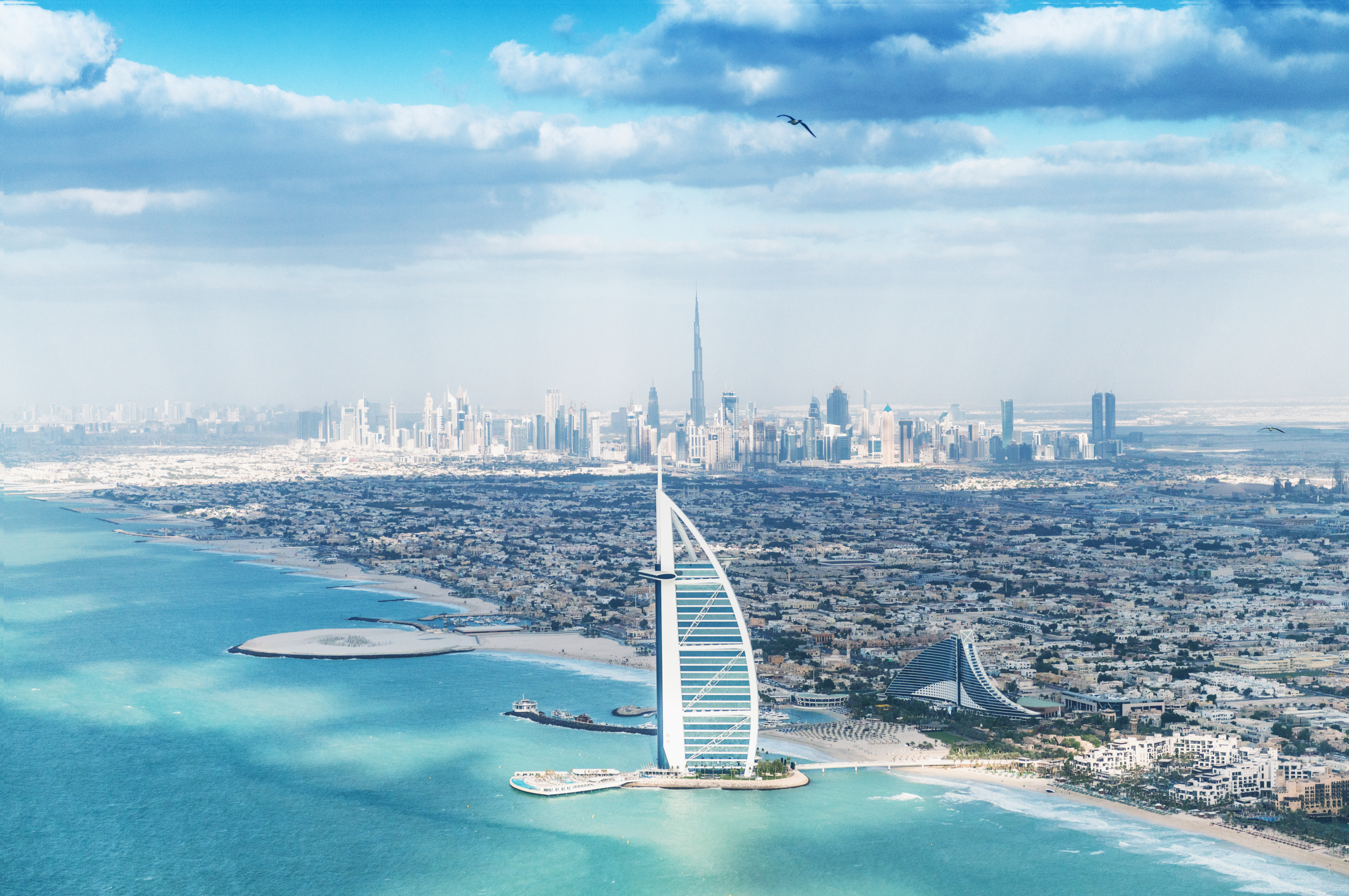
The luxury infrastructure is staggering. Bvlgari Resort Dubai (private seahorse-shaped island, opened 2017). Burj Al Arab Jumeirah (the 1999 7-star sail-shape icon, all-suite, helipad on the roof). Atlantis The Royal (the new 2023 Palm Jumeirah anchor, Heart of the Sea pool deck). One&Only The Palm (the discreet, low-rise option). The Michelin Guide arrived in 2022 — and in 2025 Dubai earned its first two three-star restaurants (Trèsind Studio and FZN by Björn Frantzén), Trèsind becoming the first three-star Indian restaurant in the world.
The trip works as 4–6 nights. November–March is the working window (October and April are heat-edge). 30-day visa-on-arrival for US passports. Pair with Abu Dhabi (1 hour drive), Ras Al Khaimah (1 hour north), or as a Maldives / Seychelles connector — Dubai is the global luxury hub for the Indian Ocean.

Before you arrive.

1833 to today.
Dubai splits in two. The new city is spectacle — the Burj Khalifa at 828 meters, the Palm rising out of the Gulf, glass towers along Sheikh Zayed Road, the most luxury hotel inventory of any city on the planet. That’s where you sleep, where you dine, where the world comes to be impressed. The old city is the other half: Al Fahidi’s wind-tower lanes from the 1890s, the gold and spice souks, the abra boatmen who have crossed the creek the same way for over a century. The creek is where Dubai actually started.
But you don’t come to Dubai only for the height. You come for the desert at sunrise, when the dunes are still cool and a falcon cuts across the sky. You come for the abra crossing at dusk, one dirham, the old trading town glowing on the far bank. You come for a 200-meter dinner and a sunrise from level 148 of the tallest building ever built. The reward of Dubai isn’t just the superlatives. It’s the contrast — ancient creek and impossible skyline, in the same afternoon.
Burj Khalifa at first light.
The Burj Khalifa is 828 meters tall — the tallest building ever constructed, completed in 2010 after six years and a height that no rival has come close to since. From the ground it’s a number. From level 148, the highest observation deck in the world at 555 meters, it becomes a map: the Palm Jumeirah laid out below, the creek snaking inland to Old Dubai, the desert sweeping to the horizon, the Gulf going silver toward Iran.
This is where you understand Dubai’s logic. The whole emirate makes sense from up here — how the new city threads along Sheikh Zayed Road, how the man-made islands fan into the sea, how the desert presses right up against the towers. You see in five minutes what would take three days to piece together on the ground.
Go at first light. The standard decks open at 9am and run hot with crowds; the experience to book is the early “At The Top SKY” slot, before the haze and the queues, when the low sun rakes across the city and the glass is still cool. Level 148 limits you to thirty private minutes up top, then you descend through 125 and 124 at your own pace.
Old Dubai by abra.
Before the towers, there was the creek. Al Fahidi — the Bastakiya quarter — dates to the 1890s, built by Persian pearl and textile merchants from Bastak who settled along Dubai Creek. Its coral-and-gypsum houses topped with barajeel wind towers — the original air conditioning — are the oldest standing architecture in the city, restored and preserved by the municipality. Narrow shaded lanes, art galleries, a single muezzin’s call. This is the Dubai that existed for a century before oil.
From the Bur Dubai bank you cross the water the way traders have for over a hundred years: a wooden abra, one dirham, five minutes, the engine chugging, dhows loaded with cargo on either side. The far bank is Deira — the Gold Souk, 350-plus dealers and one of the largest gold markets on earth, and the Spice Souk beside it, baskets of saffron, frankincense, and dried lime.
Do it at dusk. The light goes amber off the water, the souks switch on, and you get the one thing Dubai’s skyline can’t give you: the sense of how old this trading town actually is. It is the necessary counterweight to the Burj.
The dunes at dawn.
Forty minutes from the towers, the desert takes over. The Dubai Desert Conservation Reserve — 225 square kilometers, the UAE’s first national park, established in 1999 by Sheikh Mohammed bin Rashid Al Maktoum — protects the landscape Dubai grew out of. Red dunes, ghaf trees, and the Arabian oryx, the white antelope that was hunted to extinction in the wild and reintroduced here.
This is where you meet the culture beneath the spectacle. Falconry is the national heritage sport — the falcon on the glove, the lure swung, the bird stooping out of an empty sky at over 200km/h. You handle the bird yourself. A guide reads the dunes for oryx and gazelle. The reserve runs on Bedouin rhythms, not resort ones.
Go at sunrise, before the heat. The light is long and gold across the ridgelines, the air is still cool, and the desert is silent in a way nothing in the city ever is. Cap it with a majlis breakfast — dates, camel milk, Arabic coffee — under an open-sided tent. This is the oldest experience Dubai offers, and the one most visitors skip.
Skydive the Palm.
There is exactly one skydive in the world where the landmark below you is the size of a city. Skydive Dubai’s Palm Drop Zone — born out of the 2010 world parachuting championship the emirate hosted — puts you out of the aircraft at 13,000 feet directly above Palm Jumeirah, the man-made island engineered as a palm tree and visible from space.
You freefall for roughly sixty seconds at around 120 miles per hour. The fronds of the Palm spread out beneath your feet, the Burj Al Arab’s sail off to one side, the World Islands scattered across the Gulf, Ain Dubai turning slowly on the horizon. Then the canopy opens and you ride the silence down to the drop zone on the marina.
It is a tandem jump — you’re strapped to an instructor with thousands of jumps logged, and the safety operation is among the most professional on the planet. No experience required. High-resolution photos and edited video come standard, which matters here, because no one believes the backdrop without proof.
This recalibrates the city for the rest of the trip. After you’ve seen the Palm from above it, the rest of Dubai’s scale finally makes sense.
Skip the coach-load desert safari.
The advertised “desert safari” packs 30 people into shared 4WDs for dune-bashing, a henna tent, and a buffet show on a trampled patch outside the city. It’s loud, it’s crowded, and it isn’t the real desert. Book a private dawn drive in the Dubai Desert Conservation Reserve with a falconer instead — the protected dunes, no crowd, the actual landscape.
Don’t lose a day to the mega-mall.
The Dubai Mall aquarium, the indoor ski slope, the queue for a mall-floor photo — hours absorbed into air-conditioned sameness you could find anywhere. If you want the spectacle done right, take a private box at Dubai Opera or a sunset table at a DIFC rooftop. Use the mall for one thing: the fountain show, from a reserved lakeside seat.
Don’t queue for the midday deck.
The general-admission Burj Khalifa ticket means a timed line, a packed elevator, and levels 124–125 shoulder-to-shoulder at peak heat. Book the early “At The Top SKY” slot to level 148 instead — clearest air, smallest crowd, thirty private minutes at 555 meters before the city wakes.

Where you sleep matters.
Bvlgari Resort Dubai
Opened 2017. Bvlgari’s first Middle East resort — on a private 1.7M sqm seahorse-shaped island in the Jumeirah Bay coastline, accessed via a 300m sky bridge. 101 rooms + suites and 20 standalone Bvlgari Mansion villas. The signature Bvlgari aesthetic (Antonio Citterio interiors, dark wood, brass, Italian leather) translated to a Gulf-resort setting.
Burj Al Arab Jumeirah
Opened 1999. The hotel that put Dubai on the global luxury map. 202 duplex suites (no standard rooms exist), 321m tall, set on its own private island accessed via a private causeway. Every guest assigned a 24-hour butler. Rolls-Royce arrival service from anywhere in Dubai. Helipad on the roof. 18 dining venues across 28 floors.
Atlantis The Royal
Opened January 2023. Beyoncé performed the opening concert (her first concert in 4 years). The most-anticipated new luxury hotel opening in the Middle East since 2010 — 795 rooms across 17 floors on the outer crescent of Palm Jumeirah. Skyblaze — the world’s tallest restaurant — sits at 200m on the 22nd floor. The Heart of the Sea infinity pool is the most photographed pool in the city.
Mandarin Oriental Jumeira
On the Jumeirah beachfront, minutes from Downtown. The brand’s polished Asian-luxury service in a contemporary low-rise. Home to a serene spa and a private beach — for travelers who want the city close but the pace calm.
One&Only The Palm
An intimate, low-rise Moorish-Andalusian resort on the western crescent of Palm Jumeirah. Private and understated — the antithesis of the mega-hotel. Home to STAY by Yannick Alléno. For couples who want quiet, not spectacle.
Four Seasons Resort Dubai at Jumeirah Beach
A full-service beachfront resort on Jumeirah, central to Downtown and DIFC. Multiple pools, a long private beach, and the brand’s reliable family service. The dependable anchor when the trip skews multi-generational.

Two three-stars. Six favorites.
The three-star arrival.
Trèsind Studio
Chef Himanshu Saini’s 20-seat studio — the first Indian restaurant in the world to hold three Michelin stars (2025). A seasonal journey through the regions of India, reimagined with technique and restraint. The hardest reservation in the city; concierge assistance essential.
FZN by Björn Frantzén
Chef Björn Frantzén’s Dubai flagship earned three Michelin stars within a year of opening (2025) — making him the only chef in the world to hold three stars at three restaurants simultaneously. Nordic precision, Japanese influence, an immersive multi-room journey at Atlantis The Palm.
Il Ristorante — Niko Romito
Chef Niko Romito’s elegant, pared-back Italian inside the Bvlgari Resort. Two Michelin stars — refined essential cooking that lets the ingredients speak. The dining room opens onto the marina; the lightest of the top-tier kitchens, and the one to book first.
Three more across cuisines.
Ossiano
Chef Grégoire Berger’s ten-course seafood tasting set against a floor-to-ceiling aquarium — diners eat beside 65,000 marine animals. One Michelin star. The most theatrical dining room in Dubai, and the cooking earns the spectacle. A marble spiral staircase descends into the underwater setting.
Dinner by Heston Blumenthal
Heston Blumenthal’s historically inspired British cooking at Atlantis The Royal. One Michelin star. Dishes reconstructed from centuries-old British recipes — the Meat Fruit (c.1500) is the signature. A polished, witty counterpoint to the city’s flashier rooms.
Orfali Bros Bistro
Three Syrian brothers — Mohammad, Wassim, and Omar Orfali — run the most talked-about bistro in the Middle East. One Michelin star. Playful, globally-influenced small plates with Middle Eastern soul, from imam bayildi tartlets to wagyu shawarma. Books out weeks ahead.
Want a chef in your suite or villa?
For longer stays or special dietary protocols — recovery nutrition, performance macros, post-training meals — we arrange a private Dubai chef to cook in your suite or villa. Emirati majlis mezze, a tasting menu, or clean training meals — your direction. Single dinners or three meals a day. Quietly handled.
How the city moves.
DXB → city center.
Dubai International (DXB). The third busiest airport in the world. Terminal 3 is Emirates’ home base. ~20 min to the Burj Khalifa, ~25 min to the Palm. Marhaba meet-and-greet pre-arranged through your hotel.
Private Aviation · DWC. Al Maktoum (DWC) handles private jets — direct FBO-to-Bvlgari in 30 minutes, no main terminal. Sharjah (SHJ) is the budget fallback only.
Private Transfer. Rolls-Royce Cullinan or Mercedes Maybach for the home carrier hotels. Same driver for the duration — they know the school-run windows on Sheikh Zayed Road.
Once you’re in.
Private car and driver for the entire trip. Same English-fluent driver every day. Dubai is car-centric — distances are deceptive, and the heat makes walking impractical except in winter mornings.
Dubai Metro is clean and efficient — Red Line tracks Sheikh Zayed Road. Useful for avoiding rush-hour traffic on the road, less useful for direct hotel-to-restaurant moves.
Careem and Uber are reliable. Careem (the regional default) is sometimes faster than Uber. Both link to Dubai’s e-payments cleanly.
What you’ll actually do in Dubai.

What you actually need.
Required vs. recommended.
What to pack before you fly.
How Dubai affects the body.

What we tell you that nobody else does.
May–September shuts the outdoors down.
This is desert heat at sea level with Gulf humidity layered in. Midday temperatures hit 107°F+ from May through September, with heat-index numbers pushing 120°F. No amount of acclimation makes a midday walk on Sheikh Zayed Road tolerable. The city is built around AC for a reason.
What we do about it: we default to Nov–March for Dubai trips. If a client must travel summer, every outdoor experience is sunrise (5:30–7am) or after sunset (8pm onward). Mid-day is pool, spa, or indoor culture. The schedule is designed around the heat, not in defiance of it.
Daytime dining closes. Etiquette tightens.
During Ramadan (varies by year — typically Feb–April window through 2030), restaurants and cafés close for daytime food service. Hotels serve guests in screened rooms; some restaurants stay open with curtained areas. Drinking water in public during daylight is culturally inappropriate. The city wakes after sunset for iftar.
What we tell clients: Ramadan Dubai is beautiful — the city transforms after dark. But pace expectations shift. We brief on dates, recommend hotel-based daytime dining, and pre-arrange iftar at the most coveted seats.
The 12-lane highway becomes a parking lot.
Sheikh Zayed Road and the Al Khail are gridlocked 7–10am and 5–8pm on weekdays. A 15-minute hotel-to-restaurant move becomes 50. The Metro is faster than a car during these windows. Friday evening is its own thing — the city pours into restaurants and beaches simultaneously.
The plan: our drivers know the timing and the backup arteries. We avoid scheduling cross-city moves during peak windows, or use the Metro Red Line for parallel runs along Sheikh Zayed.
Dress and behavior codes apply outside the hotels.
In hotel pools, beach clubs, and most international restaurants, Western attire and norms apply freely. In public spaces — malls, traditional restaurants, the Old Dubai districts — covered shoulders and knees are expected, and PDAs draw stares (and sometimes police attention). Alcohol is only licensed in hotels and licensed venues; never in public.
What we brief: the rules are clearly defined, easy to follow, and locals appreciate visitors who respect them. Dress for the venue, not the temperature. Alcohol stays in the hotel orbit.
The ways you fly.
What locals notice.

The bespoke details.
Services not on any booking site.
Doors before opening hours. After closing.
Doors the city keeps closed.
The fluent people behind every visit.

We don’t ship itineraries.
The other guides give you a day-by-day plan. We don’t. A bespoke trip starts with what’s true for you: your training schedule, your dietary protocols, your sleep window, the experience you’d fly for. You answer. We build.
What we ask before we build.
The questions that shape your trip more than any itinerary ever could.
The moments we build around.
Not a checklist — a list of the kinds of anchors that often appear in a TBT-built trip.
Tell us about you. We build the rhythm.
Sanctum members answer the 7 prompts above. We build the trip from there. Flights, hotels, drivers, restaurants, private chef, motorcycle tour, paragliding, all pre-arranged before you land. No template. No itinerary you didn’t ask for.
What Dubai taught me.
Dubai is the city that decided in the early 2000s to skip every step of the conventional development curve and build the result directly. The Burj Khalifa, the Palm, the Burj Al Arab, Atlantis The Royal, the Bulgari Resort, the Dubai Mall — none of these would exist anywhere else on the timeline they appeared in Dubai. The city’s defining quality is its disregard for the conventional pace.
What that produces, for the traveler, is a hospitality density unmatched in the region. Nathan Outlaw and Heston Blumenthal both run kitchens at Atlantis The Royal. Nobu has its Atlantis residence. The Bulgari Resort holds the manmade Jumeira Bay island. The Madinat Jumeirah complex stretches along its own canal system. The Burj Al Arab dinner remains a destination meal three decades after the building first set the silhouette.
What Dubai actually rewards is the traveler who pairs the verticality with the older layer — the gold and spice souks across the Creek in Deira, the dhow harbor, the Al Fahidi historical district, and the desert at sunset thirty minutes from the city. The city is more than its skyline if the trip is shaped to find that.
Want Dubai handled?
Sanctum members can request a custom Dubai route — flights, hotels, drivers, Michelin reservations, private chef, desert falconry, yacht charter, skydive over the Palm — pre-booked, the whole rhythm of the trip mapped before you land.
Dubai is the launch pad.
Within a half-day’s drive, you can reach 5 different versions of the Gulf — the cultural capital, the mountain peaks, the dam valley, the arts emirate, and the fjords of Oman. Each gets its own dedicated guide. Or go solo and build your own way through them.
Enter your details to open this guide — and every guide in our atlas.
The trips we don’t list publicly
The full Dubai guide—our exact stays, tables, and routes—lives inside Sanctum.
Unlock the Guide