Đà Nẵng.
My Khe Beach was named by US service members during the war and ran 30 km of white sand directly along the city.It is the same beach today, with the InterContinental, Furama, and three Marriott properties facing the surf.
The luxury infrastructure is the strongest on the central coast. Banyan Tree Lăng Cô sits 60 km north on its own private beach. InterContinental Đà Nẵng Sun Peninsula (Bill Bensley design, 2012) terraces down the Sơn Trà peninsula on a private cove. The beach hotels in town serve the urban side of the trip.
The geography is the magic. North of Đà Nẵng, the Hai Van Pass climbs 500m over jungle headlands — Top Gear called it “one of the best coastal roads in the world.” 20 minutes south, Hội An’s UNESCO old town lights up with lanterns every evening. 90 km northwest, Huế’s Imperial Citadel holds 19th-century Nguyễn Dynasty palace ruins. 30 minutes inland, Bà Nà Hills holds the iconic Golden Bridge held aloft by two giant stone hands.
The right trip is 4–5 nights — beach mornings, Hội An evenings, a Huế day trip, the Hai Van Pass on the return.

Before you arrive.

Mountain to sea.
Đà Nẵng reads in three registers. There’s the city — Dragon Bridge breathing fire over the Hàn River, the beach hotels facing the surf, the riverside cafés. There’s the sacred geology — the five Marble Mountains rising straight out of the coastal plain, riddled with cave shrines the Cham held holy in the 9th century. And there’s the wild edge — Sơn Trà Peninsula, a 639m jungle headland with the tallest Buddha statue in Vietnam looking out to sea. The luxury infrastructure here is the strongest on the central coast. That’s where you sleep.
But you don’t come to Đà Nẵng for the city alone. You come for Mỹ Khê Beach at 6am, the South China Sea flat and warm before the day heats. You come for the climb up Thủy Sơn, the marble peak with 156 stone steps to a summit pagoda the emperor named in 1825. You come for the Hải Vân Pass — 21 km of switchbacks over the headland that once divided two kingdoms. The reward of Đà Nẵng isn’t a single monument. It’s the range: mountain, marble, jungle, and sea, all inside one coastline.
Mỹ Khê Beach at sunrise.
Mỹ Khê runs roughly 30 km of fine white sand directly along the eastern edge of the city — the stretch US service members nicknamed “China Beach” during the war. It faces due east, which makes it one of the few major Vietnamese beaches where you watch the sun come up over the water. At 5:30am the locals own it: swimmers in caps doing slow laps parallel to shore, fishermen working coracle boats just past the break, retirees stretching on the sand.
This is the city’s release valve. Unlike a temple or a monument, the beach asks nothing of you — you can run the firm sand at the waterline, float past the swimmers, or sit with a coffee and watch the headland of Sơn Trà light up to the north. By 8am the beach clubs of the resort strip open and the rhythm shifts, but the early window belongs to the city itself.
The whole point is that Mỹ Khê doesn’t perform. You show up, and whatever you came for — a workout, a swim, an hour of nothing — the sea is already there waiting.
The Marble Mountains.
Ngũ Hành Sơn — the Marble Mountains — is a cluster of five marble and limestone hills rising straight out of the flat coastal plain south of the city. In 1825 Emperor Minh Mạng named them for the five elements of Eastern philosophy: Metal, Wood, Fire, Earth, and Water. Long before that, in the 9th century, the Cham people made these peaks a sacred pilgrimage site.
Only one of the five — Thủy Sơn, the Water Mountain — is open to climb. A stairway of 156 stone steps leads to a summit threaded with grottoes and pagodas: the Tam Thai and Linh Ứng temples, and the great Huyền Không cave, a vaulted chamber where shafts of daylight fall through openings in the rock onto Buddhist and Hindu altars carved into the marble. There’s a glass elevator if you’d rather not take the steps; take the steps.
What the marble offers is what ultra-luxury travelers and serious athletes actually seek: stillness, depth, and a thousand years of meaning underfoot. Go early, before the tour groups and the marble-carving village at the base fill up. The light inside Huyền Không cave is best mid-morning.
Sơn Trà and the Lady Buddha.
Sơn Trà is the green wall north of the city — a 639m forested peninsula the US military called “Monkey Mountain,” now a protected nature reserve home to the rare red-shanked douc langur. The road that switchbacks up it is the single best drive in the city, and the reason to make it is the pagoda halfway up.
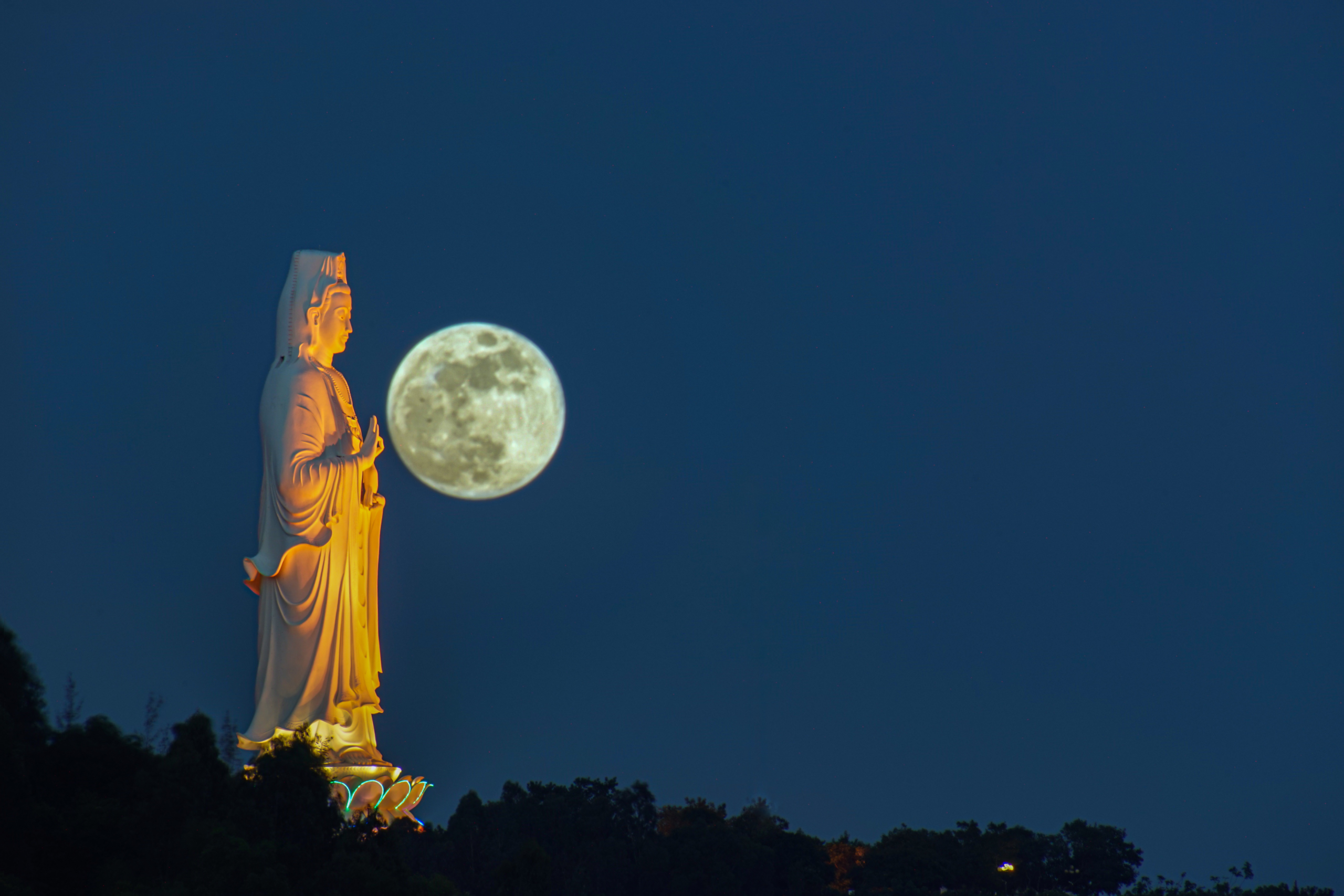
Linh Ứng Pagoda sits on the lower slope facing the sea. Its centerpiece is the Lady Buddha — a 67-meter statue of the Goddess of Mercy, the tallest Buddha statue in Vietnam, equal to a 30-storey building, completed in 2010 on a 35-meter lotus base. She stands with her back to the mountain and her gaze out over the fishing fleet and the bay, said by locals to calm the sea for the boats. From the temple terrace you get the cleanest panorama of Đà Nẵng there is: the full curve of Mỹ Khê, the river, Dragon Bridge, the marble peaks beyond.
Beyond the pagoda the road climbs into rainforest — banyan groves, viewpoints over hidden coves, the occasional troop of langurs in the canopy. Sunrise and late afternoon are the windows; midday the white marble glares and the langurs go quiet.
Bà Nà Hills and the Golden Bridge.
An hour west of the city, the French built a hill station at Bà Nà in the 1920s to escape the coastal heat — 1,487m up, where the air drops ten degrees and the clouds sit at eye level. Today you reach it by a cable car that holds the Guinness record for the longest non-stop single-track cable car in the world: 5,801 meters, climbing more than a kilometer of vertical in under twenty minutes, swinging out over rainforest and waterfalls.
At the top is the Golden Bridge — a 150-meter walkway that opened in 2018 and went around the planet overnight: a curving gold ribbon cradled by two enormous weathered stone hands rising out of the hillside. The hands look ancient and are in fact fiberglass and steel mesh, which is exactly the kind of Vietnamese theater Bà Nà runs on. The rest of the summit is a full-blown French village replica — chateau, gardens, funicular — manufactured and unapologetic about it.
Go in with clear eyes: this is spectacle, not subtlety, and it draws crowds. But the cable-car ascent through the cloud line is genuinely thrilling, the engineering is real, and the view from the bridge when the mist parts is unlike anything else on the coast. Arrive at opening, beat the day-trip buses, be back down by lunch.
Don’t do Bà Nà Hills on a bus tour.
The standard packaged day herds 40 people up the cable car at peak hours, into a two-hour queue for the Golden Bridge in full sun. The ascent is worth it; the crowd isn’t. Go private, at opening, with fast-track tickets — you’ll be on the bridge before the buses leave the city.
Skip the manufactured theme parks.
Đà Nẵng is ringed with Sun World attractions — Ferris wheels, splash parks, the “Asia Park” complex. They’re built for cruise-day crowds, not for you. Spend the time on Sơn Trà’s coves or a sunset on Mỹ Khê instead — the real coast outdoes any built one.
Don’t get steered into the marble showrooms.
At the foot of the Marble Mountains, guides and drivers funnel visitors into vast carving showrooms on commission — overpriced, hard-sell, and most of the stone is no longer locally quarried. Climb the mountain, admire the craft, and buy nothing on the spot. We arrange a vetted workshop if you genuinely want a piece.

Where you sleep matters.
InterContinental Đà Nẵng Sun Peninsula Resort
Opened 2012. Designed by Bill Bensley as a fantasy version of a French-colonial mountain retreat layered over a Vietnamese village — four levels (Heaven, Sky, Earth, Sea) connect by a private funicular running down the cliff to the beach. 197 rooms and villas. The hotel reset the bar for Vietnam beach luxury when it opened.
Banyan Tree Lăng Cô
Banyan Tree’s central Vietnam flagship, opened 2012. 49 lagoon and beach pool villas — every villa has a private pool. The property sits on a 3 km private white-sand beach 60 km north of Đà Nẵng (45 min by car), positioned perfectly for Huế day trips.
The TBT play is the Beach Pool Villa with direct sand access. Banyan Tree Spa — the brand’s hallmark — runs the longevity, wellness, and Royal Banyan ritual programs. The kitchen is Vietnamese + Mediterranean with a strong sustainability story.
Furama Resort Đà Nẵng
Opened 1997 — Vietnam’s first international 5-star beach resort. 198 rooms and villas directly on My Khe Beach (the 30 km urban beach the US service members named “China Beach”). The most established beach hotel in Đà Nẵng, with 25+ years of operational experience.
This is the right pick when the trip mixes city + beach — Furama puts you on My Khe with the city, Hội An, and the airport all within 20 minutes. Less remote than InterContinental Sun Peninsula. Easier in-and-out.
TIA Wellness Resort
All-villa, spa-inclusive on Mỹ Khê Beach (formerly Fusion Maia). 86 villas, each with a private pool; two spa treatments per person per day are built into the rate. Breakfast anytime, anywhere. The reset stay.
Sheraton Grand Đà Nẵng
On Non Nước Beach below the Marble Mountains. The longest infinity pool in the city at 250m, Shine Spa, and a serious kids’ club. Best for families and groups who want one beachfront base with everything on site.
Angsana Lăng Cô
Banyan Tree’s sister property 60 km north, on the same Laguna estate. Larger, family-friendlier, sharing the Nick Faldo golf course — the right pick when you want the Lăng Cô beach without the full Banyan Tree price.

The stars and the stools.
The Michelin tier.
La Maison 1888
Đà Nẵng’s only Michelin-starred restaurant, set in the Bill Bensley fantasy village of the InterContinental Sun Peninsula. A 5- or 7-course French set menu built on top ingredients from Vietnam, France, and Japan, served in cliffside rooms over the cove. Booking essential.
Nén Danang
Chef Summer Le’s modern Vietnamese tasting menu — the first restaurant in the country to earn a Michelin Green Star, for its serious commitment to local, seasonal, low-waste sourcing. Central-coast ingredients, reinterpreted course by course. The meal of the trip for most clients.
Olivia’s Prime Steakhouse
The polished Western option when you’ve had your fill of broth — premium imported beef and local seafood over a wood-fired grill, in the An Thượng quarter. Recognized in the Michelin Guide selection for Đà Nẵng. The reliable date-night room.
The central-coast icons.
Mì Quảng Bà Mua
The central coast’s defining dish: wide turmeric-stained noodles in a shallow, intense broth, topped with peanuts, herbs, and a shard of rice cracker. Bà Mua is the well-known local name for it, with branches across the city. This is the bowl Đà Nẵng is built on.
Bún Chả Cá 109
The coastal fishcake noodle soup the locals send you to — clean, tangy fish broth and house-made chả cá. A perennial pick when residents are asked for the city’s best, and a Michelin Bib Gourmand name. A working-lunch room, no frills.
Bánh Xèo Bà Dưỡng
Down a narrow alley, the city’s most famous bánh xèo — thin, golden, sizzling rice-flour crêpes you wrap yourself in rice paper with herbs and a thick peanut-sesame sauce. Come before 7pm. Pair with the grilled nem lụi skewers.
Bé Mặn / Năm Đảnh
Đà Nẵng is a fishing port first. The no-frills seafood houses near the beach serve the morning’s catch — clams, snails, prawns, fish — cooked simply and priced by weight. Năm Đảnh and Bé Mặn are the locals’ names; both carry Michelin Guide recognition.
Want a chef in your suite or villa?
For longer stays or special dietary protocols — recovery nutrition, performance macros, post-training meals — we arrange a private central-Vietnamese chef to cook in your suite or villa. Morning market run for the day’s catch included. Three meals a day or single dinners. Quietly handled.

How the city moves.
DAD → coast.
Đà Nẵng International (DAD). ~5km from the city center, 25–30 min to Furama, 35 min to InterContinental Sun Peninsula, 60–75 min south to Banyan Tree Lăng Cô. One of the rare Vietnamese airports actually built inside the city.
Private Transfer. Black car or Mercedes V-Class. Meet-and-greet at the gate with a name card, bags handled, straight to the resort.
The same driver stays with you for the trip — same standard whether you’re coast-only or doing the Hai Van loop to Lăng Cô.
Once you’re in.
Private car and driver extends for the whole trip. Same driver every day, English-fluent, on call. The coastline runs 30km; Marble Mountains, Hai Van Pass, and Hội An are all car-required.
The beach strip is walkable. My Khe and Non Nuoc beaches stretch along a single oceanfront road — sunrise runs, sunset cocktails, no car needed.
Grab (Vietnam’s Uber) works in central Đà Nẵng. Useful for hotel-to-Dragon-Bridge dinner runs or a quick Cham Museum visit.
What you’ll actually do in Đà Nẵng.

What you actually need.
Required vs. recommended.
What to pack before you fly.
How Đà Nẵng affects the body.

What we tell you that nobody else does.
September–December shuts the coast down.
Central Vietnam’s wet season is the most aggressive in the country. Typhoons land directly on the Đà Nẵng coast Sept through early Dec, with the worst weeks in Oct–Nov. October alone averages 615mm of rain — six times Hanoi’s wettest month. Flights reroute. Hai Van Pass closes. Bà Nà cable car shuts. The beach is unswimmable for weeks at a time.
What we do about it: the open window is Feb–Jul. If you must travel Sept–Dec, we build the trip around indoor experiences (Cham Museum, hotel spa, La Maison 1888) and monitor the 10-day storm track 14 days out. We have rebooking authority with the partner hotels if a system lands.
Cool the first time. Skip it the second.
Saturday and Sunday 9pm, the Dragon Bridge breathes fire and sprays water for about five minutes. It’s a worthwhile one-time stop — Đà Nẵng’s signature postcard. It’s also a Disney-level crowd of phone-cameras pressed against the railing.
The play: we book a private rooftop or riverside table 30 minutes before showtime. You watch from cocktails, not the curb. After one viewing, the bridge becomes a backdrop, not a destination.
Đà Nẵng is the basecamp, not the heart.
Đà Nẵng is mid-density modern — wide riverfront boulevards, the beach strip, new resorts. The cultural depth of central Vietnam sits 20 minutes south in Hội An (UNESCO old town) and 80 minutes north in Huế (imperial citadel). Cham culture’s last echo is in the Cham Museum and out at Mỹ Sơn.
The plan: 3–4 nights on the Đà Nẵng coast for beach and resort; pair it with 2 nights in Hội An (or commute) for the heritage day. Don’t book Đà Nẵng alone and expect a deep cultural week.
The Golden Bridge hands are real. The rest is Vegas.
The viral “Golden Bridge held by giant hands” sits inside a French-village theme park 1,500m above the city. The bridge is genuinely beautiful. The Sun World resort built around it is a wax-figure fairy castle with line-around-the-block cable cars and concrete gnomes.
The play: if you go, go private — we open the cable car at first light, hit the Golden Bridge before the park crowds, and you’re back at the coast by lunch. Half-day, not full-day. Or skip it and visit the Cham Museum instead.
The ways you fly.
What locals notice.

The bespoke details.
Services not on any booking site.
Doors before opening hours. After closing.
Doors the city keeps closed.
The fluent people behind every visit.
We don’t ship itineraries.
The other guides give you a day-by-day plan. We don’t. A bespoke trip starts with what’s true for you: your training schedule, your dietary protocols, your sleep window, the experience you’d fly for. You answer. We build.
What we ask before we build.
The questions that shape your trip more than any itinerary ever could.
The moments we build around.
Not a checklist — a list of the kinds of anchors that often appear in a TBT-built trip.
Tell us about you. We build the rhythm.
Sanctum members answer the 7 prompts above. We build the trip from there. Flights, hotels, drivers, restaurants, private chef, motorcycle tour, paragliding, all pre-arranged before you land. No template. No itinerary you didn’t ask for.
What Đà Nẵng taught me.
Want Đà Nẵng handled?
Sanctum members can request a custom Đà Nẵng route — flights, hotels, drivers, restaurants, private chef, the marble climb, Sơn Trà, the Hải Vân Pass, a Hội An or Huế day — pre-booked, the whole rhythm of the trip mapped before you land.
Đà Nẵng is the launch pad.
Đà Nẵng sits dead center on Vietnam’s coast, which makes it the access point for the whole central region — two UNESCO towns, a Cham temple valley, a cloud-station mountain, and the country’s most famous mountain pass. Each gets its own dedicated guide. Or go solo and build your own way through them.
Enter your details to open this guide — and every guide in our atlas.
The trips we don’t list publicly
The full Đà Nẵng guide—our exact stays, tables, and routes—lives inside Sanctum.
Unlock the Guide