Santo Domingo.
The Catedral Primada de América was completed in 1540 — the first cathedral in the New World.The Alcázar de Colón was Diego Columbus’s palace, the viceroy’s seat from 1511.
The luxury infrastructure is limited but credible. JW Marriott Santo Domingo (the modern flagship in Piantini), Casas del XVI (a 7-villa boutique collection inside the Zona Colonial — each villa is a restored 16th-century mansion), El Embajador, A Royal Hideaway Hotel (the legacy Trujillo-era property, reopened 2018). For ultra-luxury beach extensions, Casa de Campo (40 minutes east) is the right pairing.
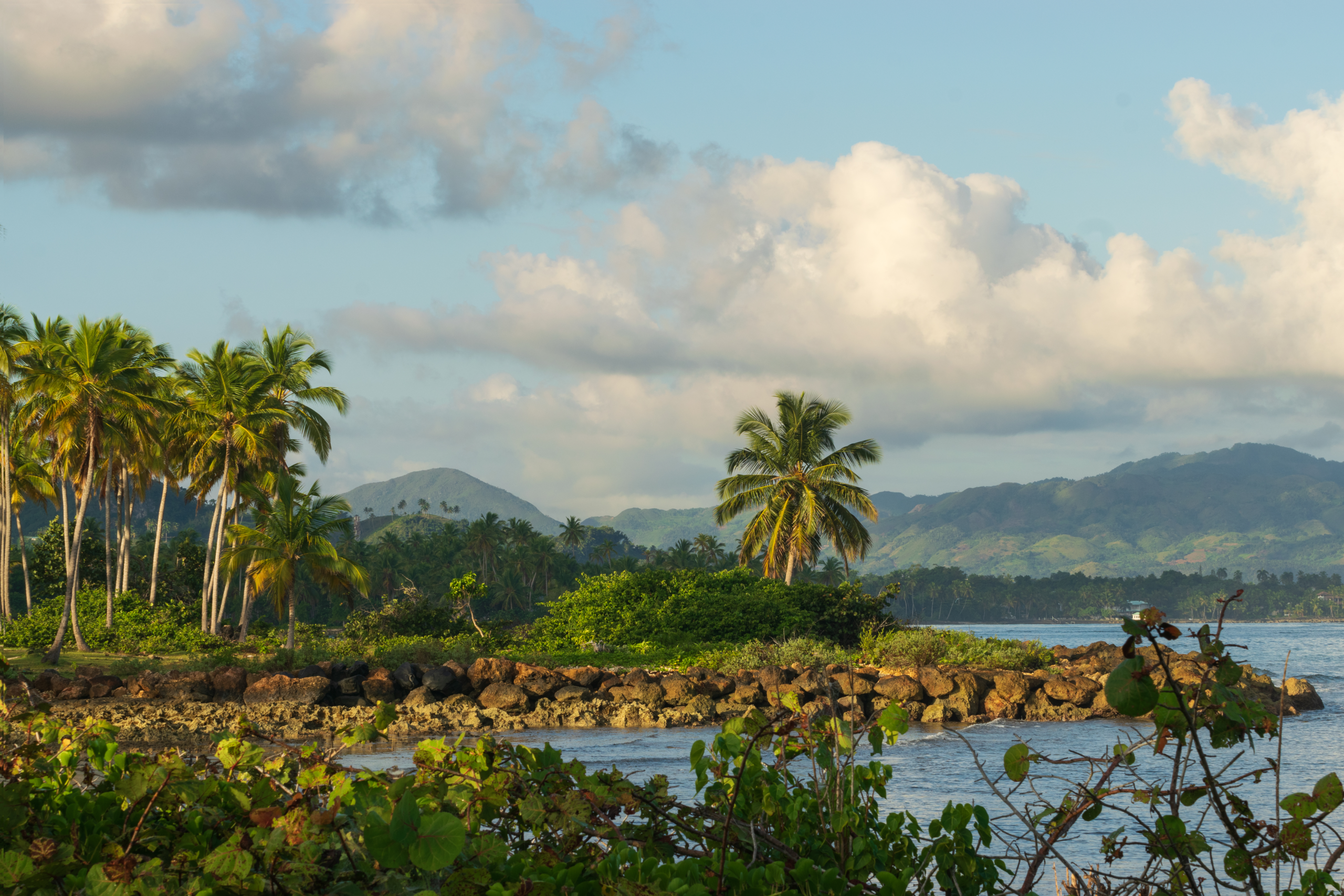
The trip works as 3 nights for the city + colonial Caribbean history, then onward to Casa de Campo (golf + beach), Punta Cana (resort beach), or Samaná (the country’s quietest coast). 30 days visa-free for US passports. Year-round 80–88°F. Hurricane risk Jul–Oct.

Before you arrive.

1498 to today.
Santo Domingo splits in two. The Zona Colonial is the soul — a 16th-century stone grid where the cathedral, the viceroy’s palace, and the oldest street in the Americas all sit within a five-minute walk. Cobblestones, hand-cut coral limestone, the Ozama River at its edge. This is where the entire Western Hemisphere’s colonial story begins, and where the boutique luxury hotels now live. The modern city — Piantini, the Malecón, the polished towers — is the other side of that coin.
But you don’t come to Santo Domingo for the towers. You come for the Catedral Primada at 9am before the cruise crowds, the Alcázar de Colón’s coral-stone arcades empty in the early light, a long lunch at a tavern operating since 1505. You come for the merengue spilling out of a colmado at dusk. The reward isn’t a checklist of monuments. It’s standing in the first city of the Americas and feeling exactly how old this place is — 500 years, and still alive every night.
The Zona Colonial at dawn.
The Zona Colonial is roughly a five-block grid, and at dawn it belongs to you. Start on Calle Las Damas — the first paved street in the Americas, laid in 1502, named for the noblewomen who once strolled it in the afternoon. The coral-limestone facades hold the early light. The cobblestones are wet from the night. There are no cruise crowds yet, no tour groups, no vendors — just the sound of your own steps echoing off 500-year-old walls.
Walk it slowly toward the Ozama River. You pass the Fortaleza Ozama (1502–1508, the oldest European military fortress in the New World), the Alcázar de Colón framing Plaza España, and the spires of the Catedral Primada rising over the rooftops. By 9am the squares fill and the cathedral opens. Until then, the first city of the Americas is silent and entirely yours.
This is the morning that recalibrates the whole trip. Once you’ve walked the empty grid at dawn, you understand the scale of what you’re standing in — not a recreated old town, but the actual place where the colonial Americas began.
Catedral Primada de América.
The Catedral Primada de América is the oldest cathedral in the Americas. Pope Julius II ordered its construction in 1504; the first stone was laid by Diego Columbus in 1514, and the building was completed in 1540. It is a textbook of the moment Europe arrived — a Gothic ribbed vault meeting Renaissance and Plateresque stonework, all carved from golden coral limestone quarried nearby.
Step inside and the temperature drops. The nave is long and quiet, the side chapels hold five centuries of Dominican faith, and the coral stone glows where the morning light reaches it. For nearly 500 years this was the spiritual center of the entire colonial hemisphere — every governor, every viceroy, every founding figure of Spanish America passed through these doors.
Go at 9am when it opens, before the cruise groups. The cathedral offers what serious travelers actually seek in a place like this — stillness, scale, and a direct line to something far older than yourself. It is the anchor of a city built on the same coral stone.
The first-city walk.
This is the walk that explains the hemisphere. Every “first” of colonial America stands within a half-mile of the Ozama River, and you can connect them in a single afternoon. There is no other place on earth where you can do this.
Start at the Fortaleza Ozama. Built 1502–1508 under Governor Ovando — the oldest formal European military fortress in the Americas. Its Torre del Homenaje was, in the 1500s, the tallest European structure in the New World, guarding the river mouth that every ship to the colonies had to pass.
Walk north along the river to the Alcázar de Colón. Built 1510–1514 as the palace of Diego Columbus, son of Christopher, when he was named Viceroy of the Indies. Two storeys of coral-stone arcades, no nails or mortar in the original construction. It governed Spain’s New World from this terrace. It now frames Plaza España, the city’s grandest open square.
Continue to Las Atarazanas — the colonial shipyards and customs houses, now restaurants and galleries — and the Museo de las Casas Reales, the seat of the Royal Audiencia, the first high court in the Americas. Each building is a founding institution: the first court, the first port, the first seat of government.
End at Parque Colón, beneath the Catedral Primada, as the light goes gold and the squares fill. One afternoon, 500 years, the complete origin story of colonial America — walked on foot.
Los Tres Ojos.
Los Tres Ojos — “the three eyes” — is a collapsed limestone cavern system in the east of the city, holding three open-air lagoons of impossibly clear turquoise water fed by an underground river. A fourth lagoon hides deeper in the rock. The Taíno, the island’s first people, are believed to have used these caves long before the Spanish ever arrived.
You descend a stone staircase carved into the rock and the city disappears. The temperature drops, the light filters down through the collapsed roof, and the water glows that specific mineral blue. Stalactites hang overhead; tropical vines spill down the walls. A small hand-pulled raft carries visitors to the most hidden of the lagoons — one of the few cave systems anywhere you reach this way.
It’s a fifteen-minute drive from the Zona Colonial and a complete change of register — from 500-year-old stone above ground to something far older below it. Go at opening, before the tour groups, and the caves are silent and cool.
Pair it with the Faro a Colón (the monumental cross-shaped Columbus Lighthouse) nearby, or keep the morning entirely to the caves and return to the city for lunch.
Skip the tourist trolley.
The motorized “chu-chu” trolleys loop the Zona Colonial with a canned audio track, rushing past the details that actually matter. The colonial city is small and flat — it’s meant to be walked. Take it on foot with a private historian instead, and the 500 years actually land.
Manage your expectations at the lighthouse.
The Faro a Colón is a vast cross-shaped monument built in 1992 — impressive in scale, but the interior is sparse and the surrounding area underwhelms many first-timers. Worth a quick exterior stop paired with Los Tres Ojos nearby; don’t build a half-day around it.
Skip the cruise-day group tours.
When ships are in port, large group tours flood Plaza España and Calle El Conde, herding 40 people past the squares in 90 minutes. A private car and guide takes the same route on your schedule — early, before the crowds — and you actually absorb the layers instead of fighting through them.

Where you sleep matters.
Casas del XVI
A boutique collection of restored colonial houses scattered through the heart of the Zona Colonial — each room set inside an authentic 16th-century mansion. Brick arcades, Spanish-tile floors, courtyard plunge pools, modern art against ancient stone. The most distinctly Dominican luxury stay in the city, and a MICHELIN Guide hotel.
Billini Hotel
A converted historic mansion in the center of the Zona Colonial — the first contemporary design hotel in the colonial city. Modernist interiors against original colonial bones, a rooftop pool with cathedral and Caribbean views, and a location that puts every monument within a short walk.
El Embajador, A Royal Hideaway Hotel
The capital’s legendary grand hotel, opened in 1956 and fully reborn in 2018 under Barceló’s Royal Hideaway luxury line. Set in leafy Gascue near the Malecón, it pairs mid-century glamour with a modern resort footprint — gardens, a large pool, and the polish the colonial boutiques can’t offer.
Hodelpa Nicolás de Ovando
MGallery, Zona Colonial. Set in the 1502 home of the city’s founder, Governor Nicolás de Ovando — three colonial houses, courtyard patios, a pool on Calle Las Damas. The most history-soaked hotel in the colonial city.
JW Marriott Santo Domingo
Piantini, the polished modern district. Infinity pool, full fitness center, business-luxury service. Best when you want a contemporary tower base with a short drive to the colonial city.
Casa de Campo · La Romana
One hour east. The country’s blue-chip resort estate — golf, marina, Altos de Chavón. The natural beach-and-golf pairing for a Santo Domingo city stay. Its own guide in the Region Arc.

The tables that matter.
The reservations to make first.
La Cassina
Widely regarded as the finest restaurant in the country — modern Mediterranean cooking under a retractable roof, set in a tropical garden room. Polished, refined, and the reservation to make if you make only one in Santo Domingo. Book ahead for weekend evenings.
Don Pepe
A greenhouse dining room built around more than 500 plants — impeccable seafood, beautifully handled steaks, and one of the deepest wine lists in the city. A long-standing benchmark for serious dining in the capital. Reserve ahead.
Pat’e Palo European Brasserie
Set in a 1505 building on Plaza España, facing the Alcázar de Colón — billed as the first tavern of the Americas. Modern European brasserie cooking inside original stone walls, with a terrace over the colonial square. The dinner with the best view of history in the city.
Three more across the range.
El Mesón de la Cava
Founded 1967 inside a natural limestone cave reached by spiral staircase — once used by the Taíno and later by buccaneers. Spanish-influenced Caribbean and classic French cooking in one of the most singular dining rooms in the hemisphere. The New York Times called it one of the Caribbean’s most unique restaurants.
Lulú Tasting Bar
A Zona Colonial favorite for creative small plates blending Dominican and international flavors, paired with an inventive, ever-changing cocktail program. The social, contemporary dinner of the colonial city — best for a group that wants to graze and drink well.
Adrian Tropical
The reference point for real Dominican food in the capital — mofongo, sancocho, and fresh seafood, with a Malecón location that puts the Caribbean at your table. Unpretentious, beloved by locals, and the truest taste of the island’s home cooking.
Want a chef in your suite or villa?
For longer stays or special dietary protocols — recovery nutrition, performance macros, post-training meals — we arrange a private Dominican chef to cook in your suite or villa. Mercado run included. Three meals a day or single dinners. Quietly handled.
How the city moves.
SDQ → Zona Colonial.
Las Américas International (SDQ). ~30km east of the city · 35–45 min by car. The primary international gateway for the capital.
Private Transfer. Black car or Mercedes V-Class. Your driver meets you at the gate with a name card — bags handled, paperwork handled, straight to your hotel along the Malecón.
The same driver stays with you throughout the trip. Arranged through your hotel or directly through us.
Once you’re in.
Private car and driver for the duration. Same driver every day, English-fluent, route-fluent — Santo Domingo traffic outside Zona Colonial is severe, and a good driver is not optional.
Zona Colonial is for walking only — cobblestones, narrow streets, 16th-century alleys. Calle Las Damas, Catedral Primada, Alcázar de Colón all sit inside one walkable grid. Your car waits at the perimeter.
Uber operates citywide. Useful as a backup — but for the modern city, our driver clears traffic and routes around the worst arteries (the John F. Kennedy, the 27 de Febrero).
What you’ll actually do in Santo Domingo.

What you actually need.
Required vs. recommended.
What to pack before you fly.
How Santo Domingo affects the body.

What we tell you that nobody else does.
Modern Santo Domingo is a car city, and the traffic is severe.
Once you leave Zona Colonial, the city is dispersed across motorways — the John F. Kennedy, the 27 de Febrero, the Máximo Gómez. Rush hour is unforgiving. Drivers ignore lanes. A 4-mile crosstown trip can take 50 minutes at 6pm.
What we do about it: a route-fluent private driver is non-negotiable. We schedule the day around traffic windows — major movements before 9am and between 1–4pm, never 5–7pm. Zona Colonial is walked, not driven.
The Caribbean weather is real, and it can shut a trip down.
July through October is hurricane season. Most years are fine. The years that aren’t can cancel flights, flood the Malecón, and close roads east toward Punta Cana for 48–72 hours. Coastal flooding from heavy rain happens without a named storm.
The plan: book Nov–Apr if the calendar allows. If summer is the only window, we monitor National Hurricane Center tracking from 14 days out and pre-build an inland or western Plan B (Casa de Campo, La Romana).
The good neighborhoods are very good. The wrong ones are not.
Zona Colonial, Piantini, Naco, Bella Vista, Polígono Central — all safe, well-lit, walkable in daylight. Outside that grid, Santo Domingo is a city of sharp neighborhood transitions, and a wrong turn matters. Pickpocketing is the most common issue; serious crime is rare in tourist zones but not impossible.
The fix: the same driver every day, every move. We don’t put guests in taxis at night. Hotels coordinate transfer logistics directly with our team.
The capital is history, not sand.
Travelers expecting Punta Cana with cathedrals are surprised. Santo Domingo’s coastline is the Malecón seawall — beautiful for running and golden-hour walks, not for swimming. Boca Chica beach is 30 km east and crowded.
If beach is essential: pair 2 nights Santo Domingo with 3 nights Casa de Campo (40 min east), Punta Cana (2 hrs east), or Samaná (2.5 hrs northeast). We map the extension before you land.
The ways you fly.
What Dominicans notice.

The bespoke details.
Services not on any booking site.
Doors before opening hours. After closing.
Doors the city keeps closed.
The fluent people behind every visit.

We don’t ship itineraries.
The other guides give you a day-by-day plan. We don’t. A bespoke trip starts with what’s true for you: your training schedule, your dietary protocols, your sleep window, the experience you’d fly for. You answer. We build.
What we ask before we build.
The questions that shape your trip more than any itinerary ever could.
The moments we build around.
Not a checklist — a list of the kinds of anchors that often appear in a TBT-built trip.
Tell us about you. We build the rhythm.
Sanctum members answer the 7 prompts above. We build the trip from there. Flights, hotels, drivers, restaurants, private chef, colonial-city historian, beach extension, all pre-arranged before you land. No template. No itinerary you didn’t ask for.
What Santo Domingo taught me.
Want Santo Domingo handled?
Sanctum members can request a custom Santo Domingo route — flights, hotels, drivers, restaurant reservations, private chef, colonial-city historian, Los Tres Ojos before-crowds access, region arc extension — pre-booked, the whole rhythm of the trip mapped before you land.
Santo Domingo is the launch pad.
Within a half-day’s drive or a short flight, you can reach 5 different versions of the Dominican Republic — the blue-chip golf coast, the resort beaches of the east, the whale bay of the northeast, the Amber Coast, and the most untouched beach in the country. Each gets its own dedicated guide.
Enter your details to open this guide — and every guide in our atlas.
The trips we don’t list publicly
The full Santo Domingo guide—our exact stays, tables, and routes—lives inside Sanctum.
Unlock the Guide