Luquillo — rainforest, reef, and a bioluminescent bay in one day.
This is the most concentrated outdoor-experience day in the Caribbean. The pieces — and the operator we trust — are below.

El Yunque — the only tropical rainforest in the U.S. National Forest System.
El Yunque covers 28,000 acres of mountain rainforest in northeast Puerto Rico, rising from sea level to the 3,494-foot El Toro peak. It is the only tropical rainforest under the U.S. Forest Service. The Caribbean National Forest, as it was historically called, was first protected by Spanish royal decree in 1876 — making it one of the oldest continuously-protected forest reserves in the Western Hemisphere.
The forest receives 200 inches of rain per year. The ecosystem is dense: more than 240 native plant species, 23 endemic to the island, and the famous coquí tree frog whose call is the night soundtrack of Puerto Rico (a 1.5-inch-long frog with a chirp audible at 100 feet — the population in El Yunque is one of the densest in the Caribbean).
The honest way to do El Yunque:
You can be done with El Yunque by 11:30 a.m. and onto the beach by noon.
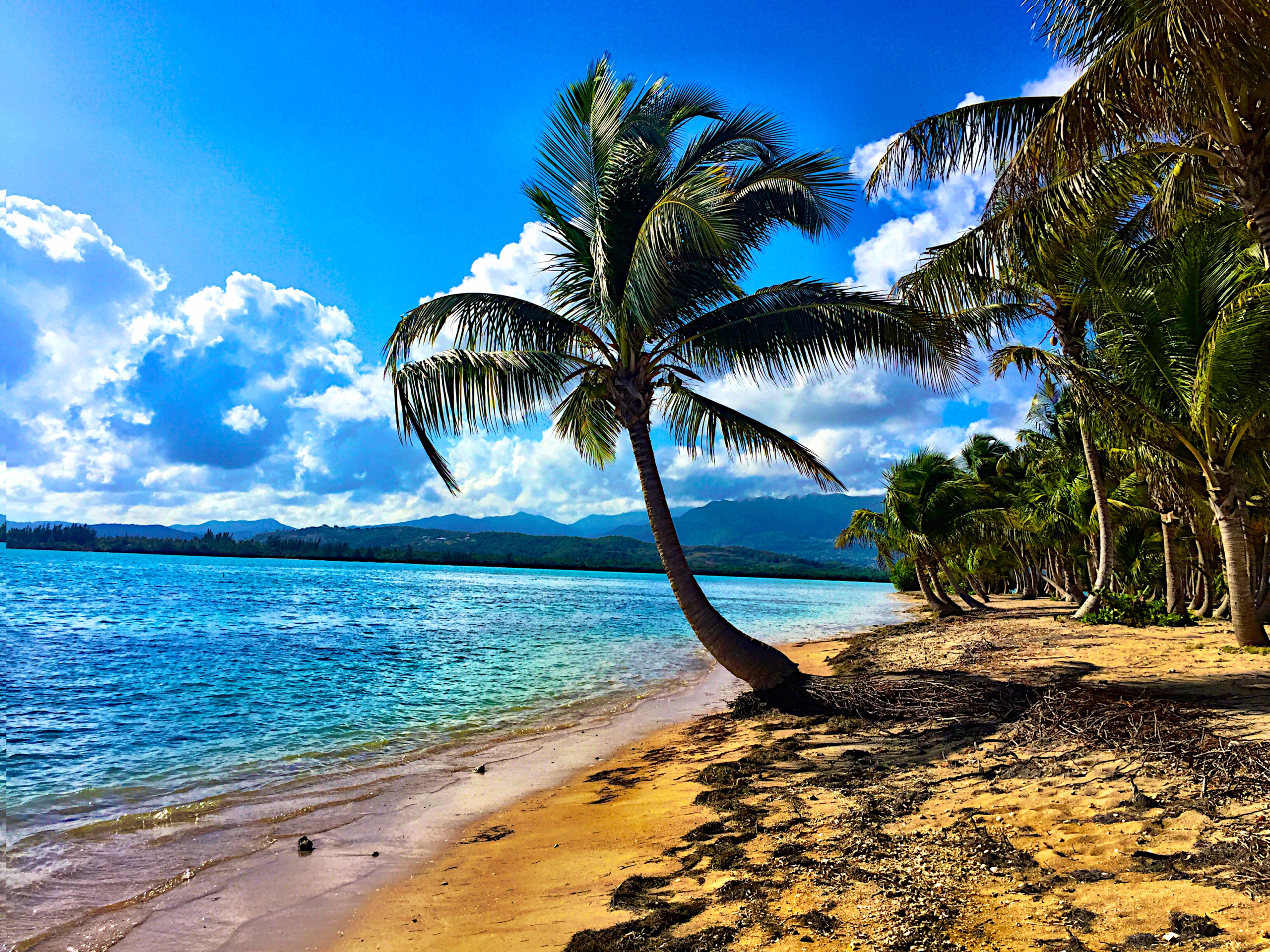
Playa Luquillo — the seven-mile crescent.
The town beach at Luquillo runs seven miles along the Atlantic in a single continuous crescent of golden sand backed by coconut palms. It is the broadest and longest Atlantic beach in the eastern Caribbean and one of the very few Atlantic-facing beaches in the region with calm enough water for casual swimming year-round.
The geography is what makes it work. A coral reef sits about 300 yards offshore, parallel to the beach. The reef breaks the open Atlantic swell before it reaches the sand. The water inside the reef line is generally calm — small, gentle surf, shoulder-deep within fifty yards of shore. The water outside the reef is open Atlantic and not suitable for casual swimming.
The beach has three distinct sections by character:
The eastern end — Playa Azul. The quietest stretch. Backed by low coastal forest. The fewest visitors, the easiest parking, the most likely to feel empty even on a weekend. The right section if you want a swim beach with minimal infrastructure.
The central stretch — Balneario La Monserrate. The town’s official public beach. Lifeguards, restrooms, palm trees set in long rows, picnic tables. The water here is the calmest, and there is a designated swimming zone with marker buoys. This is the right section for families and casual swimmers.
The western end — Playa La Pared. The local surf break. A small left-breaking wave at the western end of the crescent, popular with Puerto Rican surfers. The water is choppier here. Not a swim beach.
The third element of Playa Luquillo is the kioskos — the line of about sixty open-air food stalls along the road behind the central stretch. The stalls have been there since the 1950s, owned and run by Puerto Rican families. The local pinchos (skewers of marinated grilled meat), bacalaítos (cod fritters), and alcapurrias (yuca-and-meat fritters) are the local meal. You eat standing at the counter or in plastic chairs in the back. The whole row is a Puerto Rican food institution.

The bioluminescent bay — Laguna Grande.
Twenty minutes east of Luquillo, in the town of Fajardo, sits Laguna Grande — one of three bioluminescent bays in Puerto Rico (the others are Mosquito Bay on Vieques island and La Parguera on the southwest coast). Of the three, Mosquito Bay is brighter but harder to reach. Laguna Grande is the most accessible bio bay from the San Juan corridor.
The bay is a 250-acre saltwater lagoon fed through a narrow mangrove channel from the Atlantic. The dinoflagellate species in the water — Pyrodinium bahamense — produces a blue-green chemiluminescent flash when disturbed. Single-celled organism, harmless, present in the water column in concentrations high enough to make the lagoon glow visibly at night when something moves through it.
You can only see the bioluminescence after dark on a moonless or low-moon night. The full-moon nights — and the three nights on either side — are the wrong dates to visit, because the moonlight overwhelms the bio glow. Plan around the lunar calendar.
The access is by guided kayak only. The mangrove channel is too narrow for motorboats. A typical tour:
The full experience takes two hours. The water temperature is 80°F year-round. You will get wet from spray. Bring a dry change of clothes for the drive back.

The operator we route through.
Multiple operators run trips on this stretch — Yokahú Kayak Trips, Bio Island, several smaller outfits. The one we route members to is a third-generation Puerto Rican family operation that has been on this coast since the 1960s. They run trips with a maximum of six guests per boat. They are the only operator on Laguna Grande who employs a marine biologist as a full-time guide. They run the El Yunque trail walks in the morning, transfer you to Playa Luquillo for the afternoon, and lead the bio-bay kayak in the evening — a complete twelve-hour package.
What they do that the larger operators do not:
The full-day package, booked through us, runs about $350 per person. Group size held to six. Pre-book by at least two weeks in high season.

Where to stay.
Luquillo town itself has limited high-end accommodation. The accommodation logic is to stay either at El Conquistador Resort (the larger Waldorf-Astoria-affiliated property fifteen minutes east, on a cliff with its own private island accessed by ferry) or at Dorado Beach, a Ritz-Carlton Reserve (forty-five minutes west, the more refined option) and day-trip to the Luquillo coast.
For travelers who want to stay closer and accept a more local experience, the Casa Cubuy Ecolodge on the El Yunque-side of Luquillo is a five-bungalow eco-lodge run by a Puerto Rican family — minimal, well-located for the rainforest, but not a luxury property.
The reason to do all three in a single day — rainforest, beach, bio bay — is that nothing else in the Caribbean offers this density. Costa Rica has the rainforest. The BVI has the beaches. Belize has the bio bay. Puerto Rico is the only Caribbean destination where you can do all three before midnight in a single coastal corridor.
The right pace, if you have it, is two days. One day for El Yunque and the beach. A second day for the bio bay, with a slow morning and the boat after dark. But the one-day version works. The local operator’s package is built around it.
For the full Luquillo guide — the rainforest, the reef, the bay after dark.
Enter your details to open this guide — and every guide in our atlas.
The trips we don’t list publicly
Our exact stays, tables, and routes live inside Sanctum.
Unlock the Guide