Bogotá.
The altitude is the first thing the body learns.88°F in the lowlands becomes 65°F at 2,640m — Bogotá runs cool year-round, with no real summer or winter.
The luxury infrastructure is recent but credible. Four Seasons Hotel Casa Medina Bogotá (62 rooms in a 1946 restored Spanish-colonial mansion, the city’s most beloved luxury property), Four Seasons Bogotá (the modern 64-room sister property in the Zona Rosa financial district), Hotel B.O.G (the design-forward 55-room boutique on the same street). For ultra-luxury Colombia clients, Bogotá pairs as the cultural anchor before Cartagena’s UNESCO old town and the Caribbean coast.
The cultural anchors: La Candelaria (the colonial heart — 16th-century churches, Plaza de Bolívar, the original Spanish street grid), the Museo del Oro (Gold Museum, the world’s largest collection of pre-Columbian gold work — some 34,000 gold and tumbaga pieces among 55,000 objects, drawn from the Muisca, Quimbaya, Calima, and Tairona cultures), Monserrate (the 3,152m peak with a 1929 funicular and the city’s signature sunset view), and the dining scene in Zona G and Chapinero — where El Chato was named Latin America’s #1 restaurant in 2025 and Leonor Espinosa’s Leo built one of the continent’s most acclaimed kitchens.
The trip works as 3 nights. 90 days visa-free for US passports. Year-round 50–68°F at the city level (bring layers — Bogotá is cooler than most clients expect). Best windows December–February (driest) and July–August (mid-year dry stretch). Pair with Cartagena (~1.5 hr flight north for the Caribbean colonial city) and Medellín (~1 hr flight) for the full Colombian circuit.

Before you arrive.

1538 to today.
Bogotá splits north and south. La Candelaria is the colonial heart — the original 16th-century Spanish street grid, ochre and indigo façades, Plaza de Bolívar, the churches and museums, the weight of five centuries on cobblestone. It is daytime territory; you walk it, you don’t linger after dark. The north — Zona G, Zona Rosa, Chapinero, Usaquén — is where modern Bogotá lives: the luxury hotels, the world-class kitchens, the galleries and the quiet money. That’s where you sleep.
But you don’t come to Bogotá for any one neighborhood. You come for Monserrate at first light, when the cloud is still below you and the savanna stretches flat to the horizon. You come for the Gold Museum, room after room of pre-Columbian gold the Spanish never melted down. You come for the table at El Chato or Leo, where Colombian biodiversity is plated at a level the rest of the world only recently noticed. The reward of Bogotá isn’t the altitude. It’s what the altitude protects — a city that spent thirty years rebuilding, and is finally being seen.
Monserrate at first light.
Monserrate is the mountain that watches over Bogotá — a sheer peak rising to 3,152 meters directly behind the old city. It was sacred to the Muisca long before the Spanish arrived. In 1650, a brotherhood secured permission from the archbishop to build a hermitage at the summit, dedicated to El Señor Caído — “The Fallen Lord.” It has been a pilgrimage site for nearly four centuries since.
You go up at dawn. By mid-morning the Andean cloud rolls in and the view closes; in the first clear hour after sunrise, the whole savanna lies flat and grey-gold below you, the city waking under a sheet of mist. Pilgrims still climb the path on foot — a Sunday devotion for Bogotanos. Most visitors take the funicular (built 1929, the first in South America) up and the cable car (1955) down, or the reverse. At 3,152m the air is thin; move slowly, especially in your first days.
The summit holds the sanctuary, a handful of restaurants, and a market lane of Andean crafts. But you come for the altitude and the light. Monserrate is where you understand Bogotá’s geography in a single glance — and why a city this high spent five centuries looking up at this peak.
La Candelaria.
La Candelaria is where Bogotá began. When Gonzalo Jiménez de Quesada founded the city in 1538, this is the ground he laid out — the colonial street grid still runs the way the Spanish drew it, ochre and cobalt façades, wooden balconies, churches that have stood since the 1500s. It is the historic core, dense with museums and plazas, and the one part of the city you experience entirely on foot.
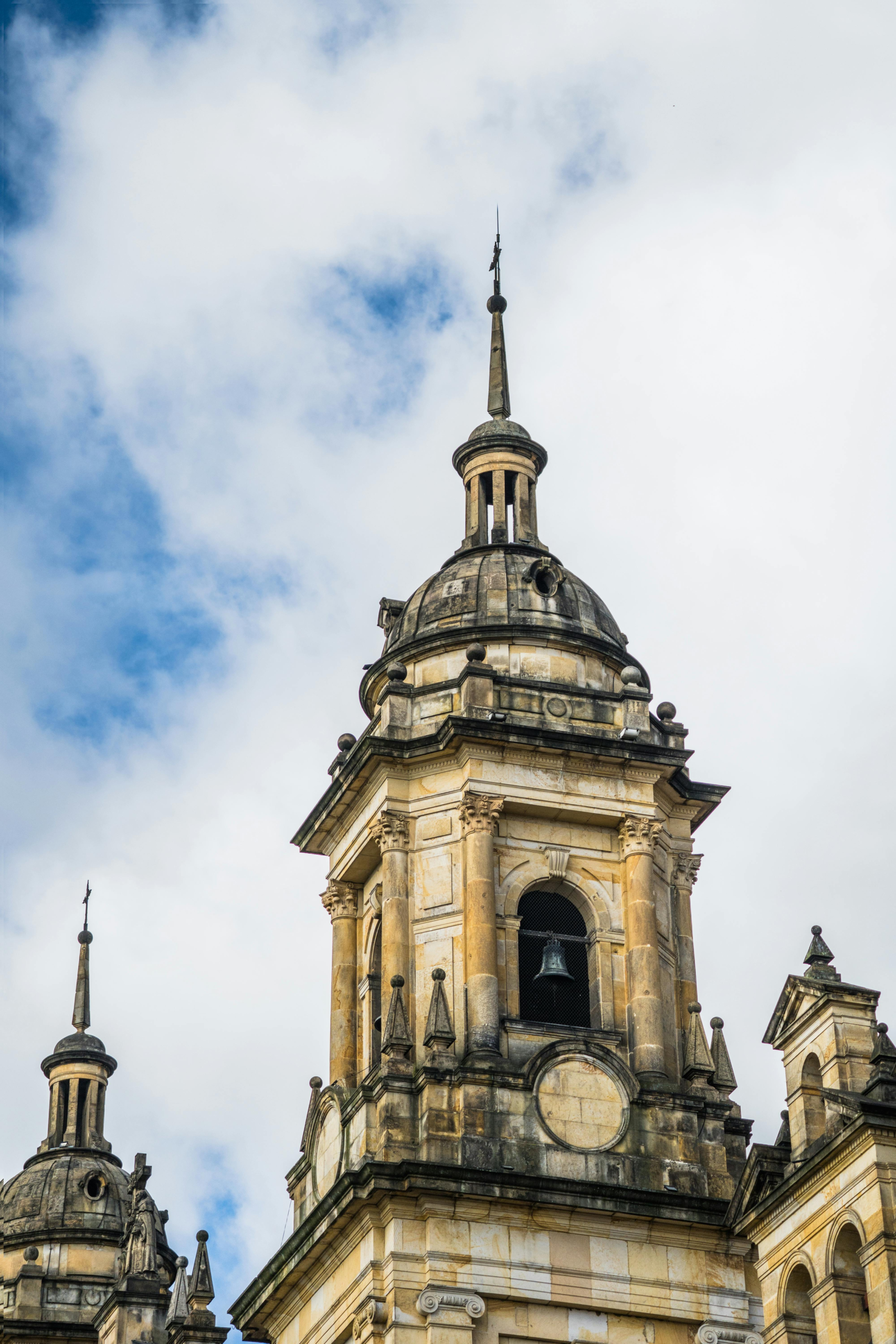
The anchor is Plaza de Bolívar — the main square, ringed by the Catedral Primada (the current cathedral completed in 1823 on a site consecrated since 1539), the Capitolio Nacional, the Palace of Justice, and the colonial Casa del Florero where Colombia’s independence movement ignited in 1810. From the square, narrow streets climb toward Monserrate past the Botero Museum, the Gold Museum, and the writers’ cafés of the Chorro de Quevedo, the spot where the city is said to have been founded.
Go in daylight, with a guide who can read the layers — pre-Columbian, colonial, republican, modern — in a single block. By dusk, La Candelaria empties and the rule changes: this is a daytime quarter for our clients, and your car meets you at the perimeter.
The Gold Museum and the Botero.
This is the cultural core of Bogotá — two collections most first-timers underestimate, both in La Candelaria, both walkable from Plaza de Bolívar.
Start at the Museo del Oro — the Gold Museum. It holds the world’s largest collection of pre-Columbian gold work: roughly 34,000 gold and tumbaga pieces among some 55,000 objects, drawn from the Muisca, Quimbaya, Calima, Tairona, and Zenú cultures. This is the gold the Spanish never got to melt down — the offerings, masks, and ceremonial pieces behind the El Dorado myth. The top-floor Offering Room, a circular vault that fills with light around a Muisca raft, is the single most powerful room in the city.
Walk ten minutes to the Museo Botero. In 2000, Colombia’s most famous artist, Fernando Botero, donated 208 works to the nation — 123 of his own unmistakable rounded figures, plus 85 by Picasso, Monet, Dalí, Chagall, Renoir, and Miró. Housed in a restored colonial mansion, free to the public, it is one of the finest small museums in Latin America and an effortless complement to the gold.
Two collections, one afternoon — the pre-Columbian depth and the modern master, the full cultural argument of Colombia in a few walkable blocks.
Usaquén, Paloquemao, and the table.
Bogotá’s fourth anchor is its produce and its plates — the thread that runs from the market stall to the tasting menu, and the reason the city is finally on the world’s food map.
Start on a Sunday in Usaquén, a colonial village absorbed into the north of the city. Its Sunday flea market (the Mercado de las Pulgas, roughly 10am–5pm) fills cobblestone streets around a quiet plaza — antiques, emeralds, Colombian crafts, coffee, and a strong brunch scene under the trees. It is the most relaxed morning in Bogotá.
For the real engine, go to Paloquemao — the city’s great wholesale food market, operating since 1946. More than sixty kinds of fruit at peak season, half of them you will not recognize: lulo, guanábana, mangostino, granadilla, uchuva. A guided early-morning fruit tour here is the best primer in the country for what Colombian biodiversity actually tastes like.
Then the table. The dining district runs through Zona G and Chapinero, and in 2025 it produced the headline: El Chato, chef Álvaro Clavijo’s restaurant, was named the No. 1 restaurant in Latin America. Down the same street, Leonor Espinosa’s Leo has spent two decades plating Colombia’s ecosystems course by course. This is no longer an underrated food city. It’s a destination one. (Full table in §4.)
Skip the unregulated street tours.
Touts around La Candelaria and Monserrate sell cheap walking, “drug history,” and city tours on the spot. They are unvetted and uninsured, and the narco angle is exactly the chapter Colombians have spent thirty years moving past. Use a licensed private guide — same streets, real context, and the dignity the city has earned.
Don’t linger in La Candelaria at night.
The old town is rewarding by day and thins out fast after sunset, when petty crime rises on the quiet streets. The tourist-bar scene there isn’t worth the exposure. See it in daylight, then head north — Zona G, Zona Rosa, and Usaquén are where the good evenings are, and your car meets you at the perimeter.
Skip the mass graffiti tours.
Bogotá’s street-art scene is genuinely world-class — but the large free/tip-based group tours move forty people at a time and turn it into a queue. A private guide on foot, ideally a working muralist, takes you to the same walls without the crowd — and can introduce you to the artists behind them.

Where you sleep matters.
Four Seasons Hotel Casa Medina Bogotá
Originally built 1946 by Santiago Medina as his private mansion — converted to a hotel in 1989, taken over by Four Seasons in 2015. 62 rooms in restored colonial architecture — hand-painted ceilings, original mosaic floors, balconied courtyards. The most beloved luxury property in Bogotá, repeatedly named to Travel + Leisure’s “World’s Best Hotels.”
Four Seasons Hotel Bogotá
Four Seasons’ second Bogotá property — opened 2015 in the Zona Rosa financial district, 10 minutes from Casa Medina. 64 rooms in contemporary architecture with floor-to-ceiling Andean-cordillera views. The right pick when the trip is business-led, or when the client wants modern over heritage.
Hotel B.O.G
Boutique 5-star on Carrera 11 — the same Zona G corridor as Casa Medina. 55 rooms in a contemporary architecture program with strong design-led interiors. The rooftop bar Plataforma is one of the city’s best high-altitude sunset views. The right pick when the brief calls for design-forward rather than colonial-heritage.
Sofitel Bogotá Victoria Regia
102 rooms in the heart of Zona Rosa — the shopping-and-nightlife district. French savoir-faire with Colombian warmth, walking distance to the Parque de la 93 dining scene. The reliable Zona Rosa anchor.
W Bogotá
168 rooms in Usaquén’s financial corridor, themed around the El Dorado legend — gold-chain curtains, an emerald-and-gold palette. High-energy, design-forward, with the city’s liveliest hotel bar. Best for travelers who want buzz over hush.
Casa Legado
A tiny family-run mansion-hotel in Chapinero, awarded a Michelin Key in 2025. A handful of rooms, residential feel, deeply personal service. Best when the brief calls for privacy and home over scale.

The continent’s new capital.
The world-stage rooms.
El Chato
Chef Álvaro Clavijo’s contemporary bistro — named the No. 1 restaurant in Latin America in 2025, the first Colombian restaurant to take the top spot. Technique-driven plates built on seasonal Colombian produce: squid and mushroom tartare, coca-flour cake, fermentation throughout. The meal of the trip.
Leo
Chef Leonor Espinosa’s twenty-year project — a tasting menu organized around Colombia’s ecosystems, sourcing little-known ingredients from rural communities through her FUNLEO foundation. Espinosa won the World’s Best Female Chef award; Leo is a fixture on Latin America’s 50 Best. Wine pairings by her daughter Laura.
Harry Sasson
Bogotá’s most established fine-dining name — chef Harry Sasson’s product-first kitchen in a glass-roofed mansion in Chapinero. Less avant-garde than El Chato or Leo, more reliable: this is where the city’s elite has eaten for years. The room to book when you want polish without a tasting-menu commitment.
Where the city actually eats.
Mesa Franca
Chef Iván Cadena’s relaxed Chapinero bistro — local produce, bistro technique, and one of the city’s best experimental bars. A regular on Latin America’s 50 Best. The right call for a looser, conversation-first dinner.
Villanos en Bermudas
An art-filled converted mansion in Chapinero — a daily-changing tasting menu of sweet-savory surprises, preceded by a cocktail lounge. Made Latin America’s 50 Best in its very first year. Playful, ambitious, and one of the best-value high-end seats in town.
Prudencia
A precise, casual lunch-only room in a colonial house in La Candelaria — chef Mario Rosero and Meghan Flanigan reinvent a four-course menu weekly, wood-oven bread from a sunlit dining room. The best meal to pair with a morning in the old town.
La Puerta Falsa
Open since 1816 — Bogotá’s oldest restaurant, a tiny two-floor room steps off Plaza de Bolívar. The home of ajiaco santafereño, the city’s signature three-potato chicken soup with corn, capers, and cream. Pair it with hot chocolate and almojábana — the local ritual. This is the soul plate of the savanna.
Want a chef in your suite or villa?
For longer stays or special dietary protocols — recovery nutrition, performance macros, post-training meals — we arrange a private Colombian chef to cook in your suite or villa. Paloquemao market run included. Three meals a day or single dinners. Quietly handled.

How the city moves.
BOG → city center.
El Dorado International (BOG). ~15km · 30–45 min from the city center depending on traffic. Two terminals; T1 international, T2 domestic and low-cost.
Private Transfer. Black car or Mercedes V-Class. Your driver meets you at the arrivals gate with a name card, handles bags and customs egress, straight to your hotel.
The same driver stays with you throughout your trip. Arranged through your hotel or directly through us.
Once you’re in.
Private car and driver extends for the whole trip. Same driver every day, English-fluent, on call — your guy. Bogotá traffic is severe; a known driver is the difference between a 20-minute trip and a 70-minute one.
La Candelaria is for walking — the historic UNESCO district moves on foot, the cobblestones don’t tolerate fast cars. Step out, walk in, walk out, car picks you up at the perimeter.
Uber works in Bogotá (officially gray-zone, in practice ubiquitous). Useful for short hops in Zona G or Zona Rosa when your driver is parked elsewhere.
What you’ll actually do in Bogotá.

What you actually need.
Required vs. recommended.
What to pack before you fly.
How Bogotá affects the body.

What we tell you that nobody else does.
2,640m. Higher than Aspen. Clients underestimate it.
Bogotá sits at 8,660 feet above sea level — higher than Aspen, higher than Cusco. The body feels it within the first hour: light-headedness, shortness of breath on stairs, a thicker quality to fatigue. It is real and it is universal.
What we do about it: day 1 is gentle — hotel, slow walks, no alcohol, 3L water. Diamox for altitude-sensitive clients (discuss with your doctor 2 weeks pre-trip). Coca tea on arrival — legal, locally normal, the Andean acclimation tool. Hard workouts and high-altitude side trips (Monserrate, Salt Cathedral Zipaquirá) wait until day 2–3.
It is not a warm city. Ever.
Clients fly into “South America” expecting warmth and pack accordingly. Bogotá is cool year-round — 50°F at dawn, low-60s by mid-day, every single day of the year. There is no summer.
The fix: layers. Merino base, light shell, a smart-casual sweater for dinner. Cartagena is the warm Colombia. Bogotá is the cool one.
Bogotá is safer than the reputation. With rules.
The city has changed dramatically over the last 15 years. Zona Rosa, Zona G, Usaquén, and La Candelaria (daytime) are entirely safe for TBT clients. Outside these zones — and La Candelaria after dark — the rule is private car only, never walk alone.
The protocol: private driver door-to-door after sunset. No street-hailed taxis (use Uber or your driver). Phones tucked away on the street. Hotel safe for passports and excess cash.
10 km can be a 70-minute drive.
Bogotá traffic is among the worst in Latin America. The pico y placa rotation (license-plate-based driving restrictions) compounds it. A trip from the airport to Zona G can take 30 minutes at 6am or 90 minutes at 6pm.
The fix: a known driver who reads the city, departures planned around the peaks (7–9am, 5–8pm), and a tolerance for the rhythm. La Candelaria, Zona G, and the Cerros are clustered enough that smart planning keeps the day flowing.
The ways you fly.
What locals notice.

The bespoke details.
Services not on any booking site.
Doors before opening hours. After closing.
Doors the city keeps closed.
The fluent people behind every visit.
We don’t ship itineraries.
The other guides give you a day-by-day plan. We don’t. A bespoke trip starts with what’s true for you: your training schedule, your dietary protocols, your sleep window, the experience you’d fly for. You answer. We build.
What we ask before we build.
The questions that shape your trip more than any itinerary ever could.
The moments we build around.
Not a checklist — a list of the kinds of anchors that often appear in a TBT-built trip.
Tell us about you. We build the rhythm.
Sanctum members answer the 7 prompts above. We build the trip from there. Flights, hotels, drivers, restaurants, private chef, the Salt Cathedral day trip, the Gold Museum after-hours, all pre-arranged before you land. No template. No itinerary you didn’t ask for.
What Bogotá taught me.
Want Bogotá handled?
Sanctum members can request a custom Bogotá route — flights, hotels, drivers, restaurants, private chef, the Salt Cathedral day trip, after-hours at the Gold Museum — pre-booked, the whole rhythm of the trip mapped before you land.
Bogotá is the launch pad.
A short flight or a scenic drive from the capital reaches five different versions of Colombia — the Caribbean walled city, the city of eternal spring, a colonial time capsule, the wax-palm coffee valleys, and a granite monolith over an emerald lake. Each gets its own dedicated guide. Or go solo and build your own way through them.
Enter your details to open this guide — and every guide in our atlas.
The trips we don’t list publicly
The full Bogotá guide—our exact stays, tables, and routes—lives inside Sanctum.
Unlock the Guide