Lisbon.
Lisbon is Western Europe’s most under-priced luxury capital.Full-tier hotels run 60% of Paris or London prices for similar quality.
The luxury infrastructure: Four Seasons Hotel Ritz Lisbon (the 1959 Salazar-era grand hotel, 282 rooms, the city’s defining luxury property), Bairro Alto Hotel (boutique 87-room property on Camões Square), Tivoli Avenida Liberdade (the historic Avenida flagship). For ultra-luxury Sintra extensions, Penha Longa Resort and Tivoli Palácio de Seteais are 30 minutes west.
The trip works as 4–5 nights. 90 days visa-free Schengen. The city is mild year-round — 50–70°F in winter, 70–90°F in summer (cooler than Madrid or Rome). Best windows April–June and September–October. Pair with Sintra (the UNESCO palace town 30 min west), Porto (3 hours north by train), or as the European gateway to Madeira / Azores.

Before you arrive.

1147 to today.
Lisbon splits across seven hills. Alfama is the soul — the one quarter the 1755 earthquake spared, a tangle of medieval lanes too steep and too narrow for cars, where laundry still hangs between windows and fado leaks from doorways after dark. Belém is the empire — riverside, monumental, the stone gateway from which Vasco da Gama and the explorers sailed for India. The Baixa downtown is the rebuild — a perfect Pombaline grid, one of Europe’s first earthquake-engineered cities. That’s where the wide avenues and the luxury hotels are. That’s where you sleep.
But you don’t come to Lisbon for any one of those. You come for the miradouros at golden hour, when the light turns the whole city terracotta and the Tagus runs gold to the Atlantic. You come for a warm pastel de Belém before the line forms, an espresso standing at the counter, the slow click of Tram 28 climbing into Alfama. The reward of Lisbon isn’t the monuments. It’s the light and the pace — the sense that this Atlantic-facing capital has nothing left to prove and all the time in the world.
Alfama at golden hour.
Alfama is the one quarter the 1755 earthquake left standing — the medieval Moorish heart of Lisbon, a maze of lanes too steep and too narrow for any car. The name comes from the Arabic al-hamma, “the springs.” Walk it at first light or in the last hour before sunset and the crowds thin, the laundry lines glow, and the whole hillside tilts down toward the Tagus.
You climb it through the miradouros — the public terraces that crown every hill. Miradouro das Portas do Sol and Miradouro de Santa Luzia look straight down over Alfama’s terracotta roofs to the river. Miradouro da Senhora do Monte, the highest in the city, is where Lisbon turns pink and gold at dusk. Bring nothing but a glass of vinho verde and let the light do the work.
This is where you understand Lisbon’s first lesson: the city was built to be looked at from above. Nine centuries of red roofs, the castle on the crown, the river running west to the ocean. The reward isn’t a checklist. It’s the slow climb and the view that resets you.
São Jorge Castle.
São Jorge Castle sits on the highest hill in Lisbon, the stone crown the whole city climbs toward. The Moors built the citadel in the mid-11th century, fortifying a site that Phoenicians, Romans, and Visigoths had all held before them. In 1147, Afonso Henriques — Portugal’s first king — took it from the Moors during the Siege of Lisbon, and the castle became a royal palace for the next four centuries.
The ramparts are the point. Walk the walls and the entire city falls away beneath you — the Baixa grid, the red roofs of Alfama, the 25 de Abril Bridge spanning the Tagus, the river opening to the Atlantic. On a clear morning you can see the Christ the King statue on the far bank. This is the single best orientation to Lisbon’s geography, and the place its whole 3,000-year layering finally makes sense.
Go at opening, before the tour groups arrive, or in the last light before close. The castle gives you what serious travelers actually want: altitude, silence, and the long view over a city that has been conquered and rebuilt more times than anyone can count.
Belém in one morning.
Belém is the riverside district from which the Portuguese empire sailed. Three monuments, all within a short walk along the Tagus, and a custard tart that has been baked from the same secret recipe since 1837. Do it as a single morning, before the tour buses arrive at 10am.
Start at the Jerónimos Monastery. Built between 1501 and 1601 to celebrate Vasco da Gama’s return from India, funded by the pepper-and-spice wealth of the sea route he opened. It is the masterpiece of Manueline architecture — Portugal’s own late-Gothic style, every column carved with rope, coral, and navigational instruments. A UNESCO World Heritage Site. Vasco da Gama is entombed inside.
Walk to the river and the Belém Tower. Designed by Francisco de Arruda and finished in 1519, the limestone fortress guarded the harbor mouth and served as the ceremonial gateway to Lisbon — the last sight of home for explorers, the first on the way back. Also UNESCO. The Manueline detail on the river-facing balconies is the finest in the city.
Between them stands the Padrão dos Descobrimentos, the 1960 Monument to the Discoveries, a 52-meter limestone prow facing the Atlantic with Henry the Navigator at its bow.
End at Pastéis de Belém. Since 1837, the Antiga Confeitaria de Belém has baked the original pastel de nata to a recipe passed down from the monks of Jerónimos — still secret, still made on site. Two warm, dusted with cinnamon, an espresso standing at the counter. Get there before the line.
One morning. Five centuries. The complete argument of the Age of Discovery, walked along the water.
Surf the Lisbon coast.
Lisbon is the only European capital with serious surf on its doorstep. The Atlantic coast west of the city — Cascais, Carcavelos, Guincho — is a 30-minute drive, and the swell is honest year-round. This is the same coastline that runs north to Nazaré, where the largest waves ever surfed are ridden each winter.
Carcavelos is the closest and most consistent beach break — a long sandy stretch, beginner-friendly on small days, punchy when the swell builds, and home to Lisbon’s surf schools and a reliable lineup. Cascais and nearby Guincho deliver the more advanced, wind-exposed Atlantic conditions; Guincho’s cross-shore wind also makes it a kitesurf and windsurf capital.
Whether you’ve never stood up or you’ve been surfing for years, the Lisbon coast meets you where you are. Private instructor, all gear handled, water time matched to the morning’s forecast. Pair it with a coastal seafood lunch in Cascais and you’ve spent the day the way locals do — city in the morning, ocean in the afternoon.
For the experienced: we can run a dawn session at the better break of the day, then a Nazaré day trip in winter to watch the giants from the lighthouse fort. You bring the willingness. We handle the rest.
Ride Tram 28, but not the way the crowds do.
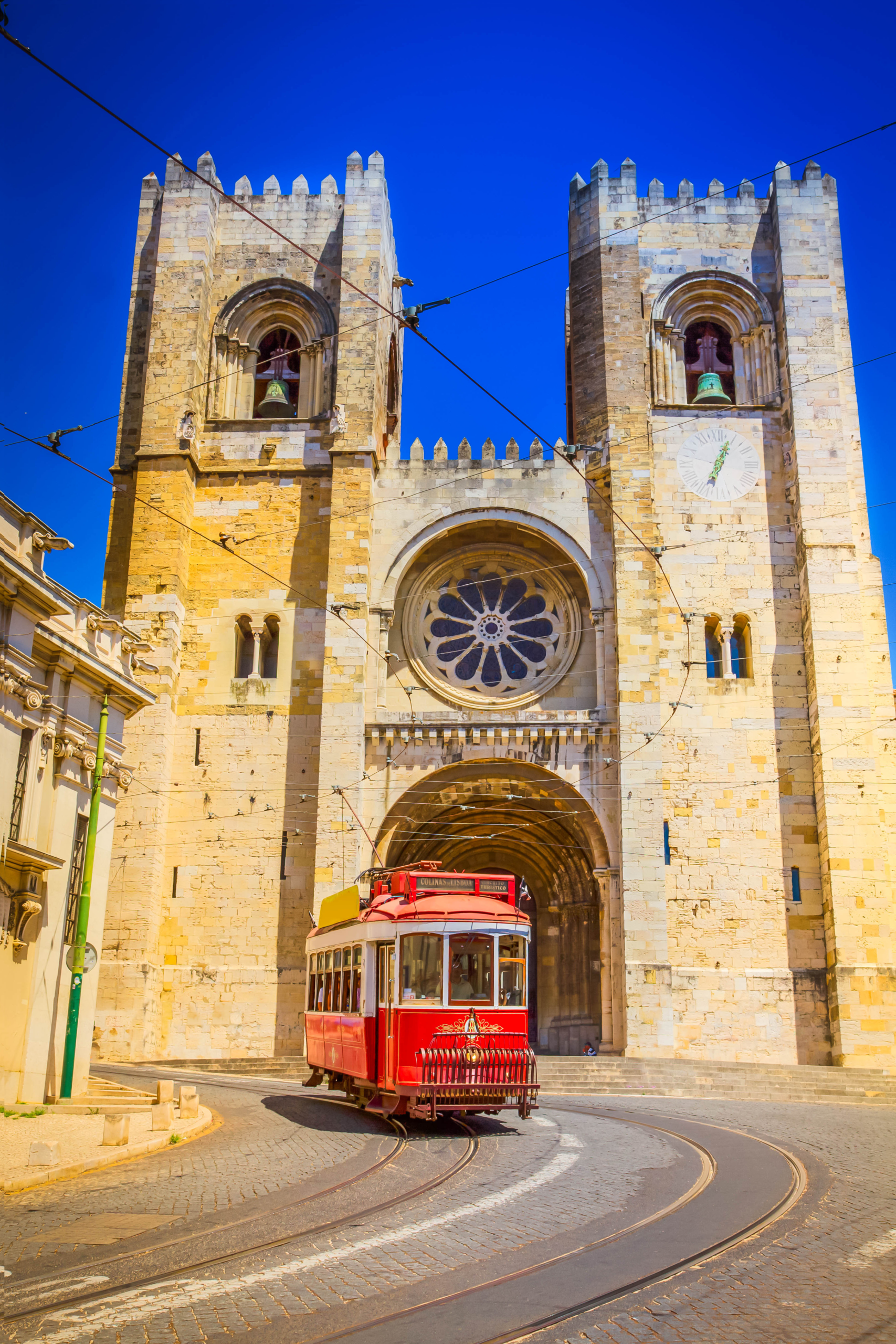
The yellow Tram 28 is a genuine Lisbon icon — but at midday it’s a sardine tin of tourists and pickpockets, often a 40-minute queue at Martim Moniz. Ride it the right way: board at the quiet Campo de Ourique terminus at 7am, or skip the queue entirely and ride one short downhill stretch through Alfama with the driver tipped off by your guide.
Skip the tourist fado dinner shows.
Bairro Alto is full of fixed-menu “fado dinners” where the singing is piped-in or perfunctory and the food is an afterthought. The real thing is in Alfama — an intimate house like Clube de Fado near the cathedral, where the room goes silent for the singer. We book the front table and the late seating the locals use.
Skip the hop-on-hop-off buses.
The open-top tour buses can’t even enter Alfama or Bairro Alto — the lanes are too narrow — so they circle the wide avenues and miss the actual city. A private car with a driver-guide takes you to the perimeter and walks you in, so you see the lanes, the miradouros, and the details the bus drives past.

Where you sleep matters.
Four Seasons Hotel Ritz Lisbon
Lisbon’s flagship luxury property, opened in 1959 and operated by Four Seasons. 282 rooms above Eduardo VII Park, walking distance to Avenida da Liberdade. The mid-century building holds one of Europe’s great private art collections — original works line the corridors. The defining address in the city.
Bairro Alto Hotel
An intimate 87-room boutique property on Praça Luís de Camões, the hinge point between elegant Chiado and nightlife-led Bairro Alto. A restored 18th-century building, member of The Leading Hotels of the World. The location is unmatched — Lisbon’s best shopping, cafés, and fado all on foot from the door.
The rooftop terrace bar is one of the finest in central Lisbon — open views over the Baixa rooftops to the Tagus and the castle. Sunset from here is the reason regulars return.
Tivoli Avenida Liberdade
The historic flagship on Avenida da Liberdade, Lisbon’s tree-lined luxury boulevard — the Champs-Élysées of Portugal. Opened in 1933, fully restored, anchoring the city’s flagship-shopping and embassy district. Five-star, central, and walkable to everything in the Baixa.
The SkyBar rooftop on the ninth floor is a Lisbon institution — cocktails and a 360° view over the Avenida to the river and the castle hill. The most glamorous evening address on the boulevard.
Verride Palácio Santa Catarina
A restored hilltop palace above the Santa Catarina miradouro, between Bairro Alto and Cais do Sodré. 19 rooms, a rooftop pool, and some of the best private river views in the city. The most distinctive boutique address in Lisbon.
Palácio Príncipe Real
An intimate Relais & Châteaux townhouse in leafy Príncipe Real — Lisbon’s most refined residential quarter. 28 rooms, a garden, a pool, and a calm that the busier downtown hotels can’t offer. Walking distance to the design boutiques.
One Palácio da Anunciada
A 16th-century palace turned five-star hotel just off Avenida da Liberdade, with a centuries-old private garden and outdoor pool in the heart of the city. Heritage architecture, full spa, central but hidden from the street noise.

16 stars. Six favorites.
The two-star tier.
Belcanto
Chef José Avillez’s flagship in elegant Chiado — Portugal’s most celebrated kitchen, blending modern technique with deep-rooted Portuguese tradition. Two Michelin stars. The reference point for fine dining in Lisbon. Booking essential, weeks ahead; concierge access first.
Alma
Chef Henrique Sá Pessoa’s celebration of Portuguese flavor — regional ingredients, refined yet generous, the Atlantic on the plate. Two Michelin stars. The other summit of Lisbon dining, in a restored Chiado warehouse near the Carmo ruins.
Encanto
Avillez’s vegetable-forward room beside Belcanto — the first vegetarian restaurant on the Iberian Peninsula to win a Michelin star, just nine months after opening. Seasonal, organic, locally sourced produce treated with fine-dining rigor. One Michelin star.
Two more stars + the seafood institution.
LOCO
Chef Alexandre Silva’s experimental room beside the 18th-century Basílica da Estrela — a single surprise tasting of 16 “moments,” rooted in Portuguese tradition, built on micro-seasons and a zero-waste philosophy. Seven tables, all facing the open kitchen. One Michelin star.
100 Maneiras
Chef Ljubomir Stanišić’s high-wire tasting in Bairro Alto — a Sarajevo-born chef who came to Portugal after the war and cooks with absolute freedom, risk, and ingredients “from the future.” Provocative, personal, and consistently thrilling. One Michelin star.
Cervejaria Ramiro
The Lisbon seafood institution since the 1950s — tiger prawns, garlic clams, goose barnacles (percebes), crab, all at a marble counter, finished with the prego steak sandwich every Lisboner orders last. World’s 50 Best Discovery. No stars, no need — this is the meal locals send you to.
Want a chef in your suite or villa?
For longer stays or special dietary protocols — recovery nutrition, performance macros, post-training meals — we arrange a private Portuguese chef to cook in your suite or rented Sintra quinta. Market run at the Time Out / Mercado da Ribeira included, fresh-catch fish, family-recipe bacalhau. Three meals a day or single dinners. Quietly handled.

How the city moves.
LIS → city center.
Humberto Delgado Airport (LIS). ~7km · 20 min by private car from the city center (25 min by Metro red line). Single terminal, compact — TAP Portugal dominates international arrivals.
Private Transfer. Mercedes S-Class or V-Class. Your driver handles everything — meet and greet at the arrivals hall with a name card, bags, straight to your hotel on Avenida da Liberdade or up into Bairro Alto.
The same driver stays with you throughout your trip. Arranged through your hotel or directly through us.
Once you’re in.
Private car and driver extends for the whole trip. Same driver every day, English-fluent, on call. They handle Sintra, Cascais, and the Atlantic coast day trips that the city itself can’t deliver.
Alfama and Bairro Alto are walking-only territory — the lanes are too narrow and the cobblestones too steep for cars. Step out, walk in, walk out, driver picks you up at the perimeter. Comfortable rubber-soled shoes are non-negotiable.
Tram 28 is the iconic Alfama line — worth one slow ride for the experience, not a daily mover. Bolt (Lisbon’s Uber) is downloadable and reliable for a quick hop if you’re moving on your own.
What you’ll actually do in Lisbon.

What you actually need.
Required vs. recommended.
What to pack before you fly.
How Lisbon affects the body.

What we tell you that nobody else does.
Lisbon is built on seven hills. Clients underestimate them.
Lisbon’s defining geography is also its most underestimated challenge. Alfama and Bairro Alto sit at the top of steep gradients paved in calçada portuguesa — worn limestone cobblestones that turn glass-slick the moment it rains. A “10-minute walk” on the map is a calf workout. Heels are dangerous. Designer leather soles are dangerous.
What we do about it: we pre-brief every client on shoe choice before they pack, we map daily routes so the climbing happens fresh in the morning (not after a Belcanto tasting menu), and we have the driver waiting at perimeter pickup points so you walk downhill, never up.
The most common itinerary mistake.
Every guidebook says “Sintra is a half-day from Lisbon.” It isn’t. The drive is 30 minutes each way, but Pena Palace, Quinta da Regaleira, and the Moorish Castle each demand 90+ minutes — and the lines without pre-arranged access can swallow another 60. Plan a full day, or skip it.
The fix: we arrange before-hours private access to Pena Palace and pair it with a private Sintra historian, lunch at Lawrence’s (Byron stayed here in 1809), and a Penha Longa golf round or spa afternoon to make the day worth the drive.
The Atlantic wind that surprises every August visitor.
August looks like summer on paper — 80°F+, no rain. The reality: the “nortada” — a north-Atlantic wind that funnels down the coast — can drop Cascais and Sintra temps 10°F below Lisbon in a single afternoon. A linen-shirt beach day becomes a sweater situation in 20 minutes. Inland Lisbon stays hot; the coast doesn’t.
The plan: we pack a light shell layer into every Cascais or Atlantic-coast day, monitor the marine forecast 48h out, and shift sea-side experiences inland on the windiest days.
The Portuguese clock isn’t the American clock.
Lisbon dinner reservations at the city’s best tables — Belcanto, Alma, Eleven, Mesa de Frades — open at 8pm and don’t fill until 9–10pm. A 6:30pm dinner brands you as a tourist. Fado clubs don’t start until 10pm, often running past midnight. This is a late-dining city.
If you keep East Coast hours, push lunch later (2pm at Ramiro), program a full afternoon hotel reset, and let dinner anchor the day. The rhythm rewards travelers who lean in.
The ways you fly.
What locals notice.

The bespoke details.
Services not on any booking site.
Doors before opening hours. After closing.
Doors the city keeps closed.
The fluent people behind every visit.
We don’t ship itineraries.
The other guides give you a day-by-day plan. We don’t. A bespoke trip starts with what’s true for you: your training schedule, your dietary protocols, your sleep window, the experience you’d fly for. You answer. We build.
What we ask before we build.
The questions that shape your trip more than any itinerary ever could.
The moments we build around.
Not a checklist — a list of the kinds of anchors that often appear in a TBT-built trip.
Tell us about you. We build the rhythm.
Sanctum members answer the 7 prompts above. We build the trip from there. Flights, hotels, drivers, restaurants, private chef, fado tables, Sintra day, surf sessions, all pre-arranged before you land. No template. No itinerary you didn’t ask for.
What Lisbon taught me.
Lisbon is the European capital that took the longest to be discovered by the modern luxury map, which is part of why it now reads as one of the continent’s most rewarding cities. Seven hills above the Tagus, a 12-century history layered through Alfama and Belem, and a food culture that the Michelin Guide finally caught up to in the 2010s.
The Four Seasons Ritz Lisbon remains the city’s defining luxury anchor, set above the Eduardo VII park with the longest sightline in central Lisbon. Belcanto, Chef Jose Avillez’s two-star kitchen in the Chiado, runs the country’s most ambitious modern Portuguese tasting menu. Cervejaria Ramiro on Almirante Reis runs the city’s most famous casual seafood. The contrast is the city.
What Lisbon offers, for the traveler willing to walk it slowly, is the rare combination of light, geography, and a price ceiling that hasn’t yet caught up to Paris or Rome. The 28 tram, the Belem Tower morning, the Sintra day trip, a late evening fado dinner — these are the anchors. The reward of Lisbon is a European trip that still feels personal.
Want Lisbon handled?
Sanctum members can request a custom Lisbon route — flights, hotels, drivers, Michelin reservations, private chef, fado tables, before-hours Belém access, Sintra day, Atlantic surf — pre-booked, the whole rhythm of the trip mapped before you land.
Lisbon is the launch pad.
Within a half-day’s reach by car, train, or short flight, you can land in 5 different versions of Portugal — fairy-tale palaces, Atlantic coast, wine country, walled-city heritage, and golden-coast beaches. Each gets its own dedicated guide. Or go solo and build your own way through them.
Enter your details to open this guide — and every guide in our atlas.
The trips we don’t list publicly
The full Lisbon guide—our exact stays, tables, and routes—lives inside Sanctum.
Unlock the Guide