Kuala Lumpur.
The luxury infrastructure is mature.Mandarin Oriental KL (the original landmark, 1998), Four Seasons KL (2018), and Banyan Tree Signatures all anchor the KLCC district directly facing the Twin Towers.
The Michelin Guide hasn’t reached Malaysia yet, but KL is one of Asia’s strongest food cities. Dewakan — the country’s first restaurant on Asia’s 50 Best — runs modern Malay tasting menus. Beta KL for refined Malay. Nadodi for South Indian fine dining. Street-side: nasi lemak at Village Park, char kway teow in Imbi, banana-leaf rice in Brickfields. The hawker culture rivals Singapore at one-third the price.
The trip works as 3–4 nights, often paired with Singapore (4-hour drive or 1-hour flight) or with the Malaysian east-coast islands (Langkawi, Penang). 90-day visa-free for US passports. The city itself is hot year-round, with afternoon thunderstorms April–November — the standard SE Asia rhythm of morning out, midday in, evening out.

Before you arrive.

1857 to skyline.
KL layers three civilizations on one grid. The Malay city is mosques and the Lake Gardens. The Chinese city is Petaling Street, the clan houses, the kopitiams that have poured the same Hainanese coffee for 60 years. The Indian city is Brickfields — Little India — temple bells, banana-leaf rice, garland sellers. They don’t blend so much as sit shoulder to shoulder, and the food is where they meet. KL’s hawker culture is the most underrated in Asia.
But you don’t come to KL for any single one of those. You come for Batu Caves at first light, before the macaques and the heat. You come for the Petronas Twin Towers lit at blue hour and Merdeka 118 rising behind them — the old icon and the new one in one frame. You come for the canopy walk in a rainforest that predates the city, ten minutes from the towers. The reward of KL isn’t a single monument. It’s the collision — ancient faith, colonial bones, and equatorial steel, all in one skyline.
The Twin Towers, then 118.
The Petronas Twin Towers opened in 1998 and held the title of tallest building in the world until 2004 — 452 meters, 88 floors, the stainless-steel-and-glass Islamic geometry that put KL on the global skyline. The double-decker Skybridge connects the two towers at the 41st and 42nd floors; the observation deck sits on the 86th. From KLCC Park below, the 1.3km lake-and-fountain loop frames the towers — the city’s signature dawn run before the heat builds.
Now look south. Merdeka 118 — completed in 2023, grand-opened January 2024 — rises 678.9 meters, making it the second-tallest building on earth after Dubai’s Burj Khalifa, and the tallest in Southeast Asia. Its spire-and-glass form references the raised hand of Malaysia’s first prime minister declaring independence on this ground in 1957. The View at 118 observation deck is the highest in the region.
The move is to see both in one evening: the Twin Towers from KLCC at blue hour, then Merdeka 118 catching the last light behind the older skyline. Two icons, 25 years apart, in a single frame — the whole arc of modern KL.
Batu Caves at first light.
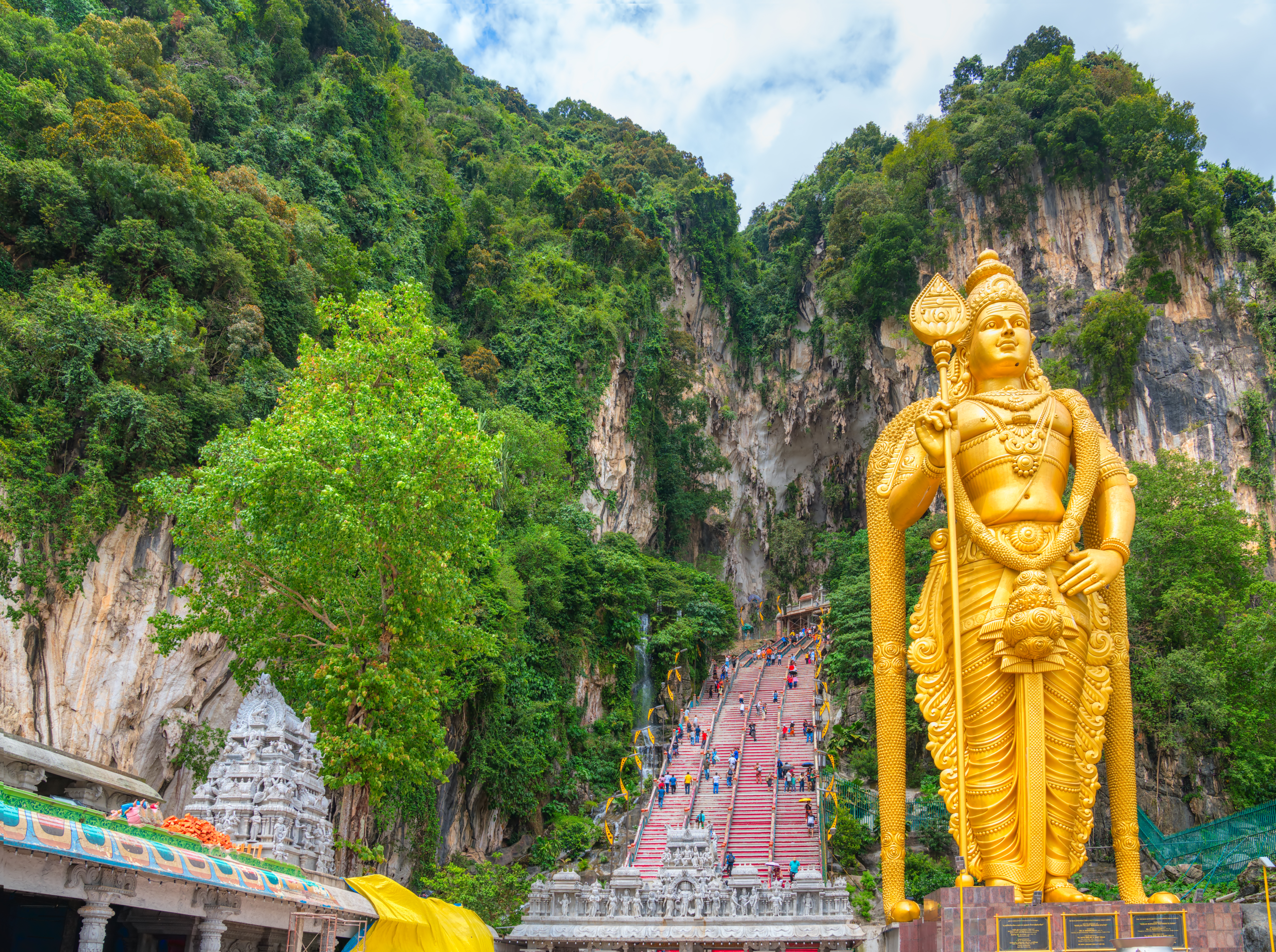
Batu Caves is a series of caverns carved into a limestone outcrop roughly 400 million years old, 13km north of central KL. A Tamil trader, K. Thamboosamy Pillay, consecrated the main cave as a shrine to Lord Murugan in 1891; the Hindu Tamil community has worshipped here ever since. The 272 steps rising to the Temple Cave were built in 1940 and repainted in their now-famous rainbow colors in 2018.
Guarding the entrance is the 42.7-meter golden statue of Murugan, unveiled in 2006 — one of the tallest Hindu deity statues in the world. During Thaipusam (January/February), well over a million devotees climb these steps in one of the largest Hindu pilgrimages on earth, many carrying ornate kavadi.
Come at first light. By 8am the day crowds arrive and the resident long-tailed macaques get aggressive around food. Before then, the climb is quiet, the cave’s ceiling open to the sky, the morning sun cutting through the limestone. It’s the single most spiritually charged morning in greater KL.
Three cultures in one afternoon.
This walk isn’t on most guides. Three of KL’s communities, three distinct quarters, all within a compact core. It’s how you actually understand a city that layers Malay, Chinese, and Indian life on the same grid.
Start at Merdeka Square (Dataran Merdeka). This is colonial KL — the Moorish-style Sultan Abdul Samad Building (1897) with its copper domes and clock tower, the manicured cricket green of the old Royal Selangor Club, and the flagpole where the Union Jack came down and the Malaysian flag first rose at independence in 1957. Beside it, where the Klang and Gombak rivers meet, sits the Masjid Jamek (1909), one of the oldest mosques in the city.
Walk south into Chinatown — Petaling Street. Tin-mining-era shophouses, the Sri Mahamariamman Hindu temple (1873, KL’s oldest), the Guan Di and Sin Sze Si Ya Taoist temples, and the covered market arcade. This is 19th-century Chinese KL, still trading.
End in Brickfields — Little India. Garland sellers, sari shops, temple bells, the smell of jasmine and frying dosa. Banana-leaf rice eaten by hand is the meal here. A short hop away, the colonial-era KL Railway Station (1910) shows the same Moorish architecture in white.
One afternoon, three civilizations. The complete cultural argument of Kuala Lumpur.
A rainforest in the skyline.
Hidden in the middle of the city is KL Forest Eco Park — formerly the Bukit Nanas Forest Reserve, gazetted in 1906, making it one of the oldest protected forest reserves in Malaysia and the only remaining stretch of primary tropical rainforest inside KL’s city limits. It predates almost everything around it.
The centerpiece is the canopy walkway: a steel-and-timber suspension bridge running 200 meters through the treetops, 21 meters above the forest floor. You walk it surrounded by some of the city’s most ancient trees — hardwoods, strangler figs, and the calls of birds and the occasional dusky leaf monkey — with the KL Tower and the skyline rising directly through the leaves above you. Few cities on earth put untouched rainforest this close to a financial district.
It’s a short, accessible loop — under an hour — but it recalibrates how you read KL. The skyline and the jungle aren’t separate here. They’re stacked. Pair it with the adjacent Menara KL (KL Tower) for the deck view, or with a dawn run before the heat.
For travelers who want more nature: KL is the gateway to Taman Negara, one of the oldest rainforests in the world, a few hours northeast — covered in the Region Arc.
Skip Central Market for souvenirs.
The art-deco Central Market (Pasar Seni) is a heritage building, but inside it’s mass-produced fridge magnets and batik aimed squarely at tour groups. For real craft, we route you to the Islamic Arts Museum’s gift gallery and to Royal Selangor’s pewter atelier instead — actual Malaysian artistry, no tourist markup.
Jalan Alor — go early, eat selectively.
The famous Bukit Bintang food street is real, but after 7pm it’s a wall of touts pulling tourists into the loudest, weakest stalls. Go between 5:30 and 7pm, walk it once, and eat only where the locals queue — Wong Ah Wah chicken wings, the claypot stalls. Or let a guide order the street’s actual best for you.
Skip the hop-on-hop-off bus.
KL’s double-decker tourist bus crawls through the city’s notorious traffic and dumps you at the obvious stops with 100 other people. A private car with a guide covers the same ground on the day’s actual weather and traffic windows — and the covered KLCC–Bukit Bintang walkway handles the core on foot, air-conditioned.

Where you sleep matters.
Mandarin Oriental Kuala Lumpur
Opened 1998 alongside the Twin Towers. The defining luxury hotel of KL since opening — every visiting head of state stays here. 629 rooms across 31 floors. The Premier Park rooms above floor 25 have the Twin Towers framed in your bedroom window — the signature KL photograph.
Four Seasons Hotel Kuala Lumpur
Opened 2018. The newest ultra-luxury hotel in KL. 209 rooms on floors 4–32 of a 65-floor mixed-use tower opposite the Twin Towers. The tower also holds the Four Seasons Private Residences above. The Bar by Yana — on the 27th floor sky lounge — is one of the city’s best sunset cocktails.
Banyan Tree Signatures KL
55 oversized suites on floors 48–58 of the Pavilion Damansara Heights tower. The 51st-floor infinity pool is one of the most photographed in Asia — clear water, glass-bottomed edge, directly facing the Twin Towers from the side. Boutique scale, intimate service, more discreet than Mandarin Oriental or Four Seasons.
Shangri-La Kuala Lumpur
A KL institution on Jalan Sultan Ismail, set back in mature tropical gardens. Lake Gardens and the colonial core close by. Quieter than the KLCC towers — heritage Asian luxury, generous rooms, and Lafite, one of the city’s longtime fine-dining names.
The St. Regis Kuala Lumpur
Beside KL Sentral, all-suite and butler-serviced in the St. Regis tradition. The Drawing Room afternoon tea and a serious art collection through the lobby. Direct rail to the airport and the smoothest base for a city-plus-island pairing.
The RuMa Hotel and Residences
A boutique, design-forward property steps from the Twin Towers, woven with Malaysian craft and contemporary art. Intimate scale, the seventh-floor pool, and a more discreet feel than the big-flag KLCC hotels.

The stars and the stalls.
The Michelin tier.
Dewakan
Chef Darren Teoh’s temple to indigenous Malaysian terroir — foraged, fermented, and dry-aged ingredients turned into one of Asia’s most original tasting menus. Malaysia’s only two-Michelin-star restaurant + a Green Star, on the 48th floor of Naza Tower with sweeping KLCC views. Book weeks ahead.
Beta KL
Chef Raymond Tham’s gastronomic odyssey through Malaysia’s multiethnic canon — regional dishes reinvented with contemporary technique and real storytelling. One Michelin star, retained in 2026. Our pick for the meal that explains the country on a plate.
DC. by Darren Chin
Chef Darren Chin’s French fine dining in a 1970s TTDI townhouse — classical technique, premium imported produce, and one of KL’s deepest wine cellars. One Michelin star, retained in 2026. The polished-European option among the city’s stars.
The hawker icons.
Chim by Chef Noom
Bangkok-born Chef Noom’s modern Thai — bold, precise, and refined. One Michelin star, retained in 2026, and KL’s benchmark for fine Thai dining. High in TSLAW Tower in Imbi, minutes from Bukit Bintang.
Village Park Restaurant
Open in Uptown Damansara since 2002 and widely called the best nasi lemak near KL — fragrant coconut rice, fierce sambal, and the spice-fried chicken that draws the morning queue. The dish that defines Malaysian breakfast, done at the top of its class.
Petaling Street hawkers
KL’s Chinatown is a living food court of clan-era stalls — wok-charred Hokkien mee, char kway teow, and bubbling claypot chicken rice, plus old kopitiams pouring Hainanese coffee since the 1950s. A guide gets you to the stalls the locals actually line up for.
Banana-leaf rice
In Brickfields (Little India), rice and curries are served on a banana leaf and eaten by hand — South Indian tradition, KL-perfected. Endless rasam, three vegetable curries, papadum, and the leaf folded toward you when you’re full. The most communal meal in the city.
Want a chef in your suite?
For longer stays or special dietary protocols — recovery nutrition, performance macros, post-training meals — we arrange a private KL chef in your suite. Wet-market run optional. Single dinners or three meals a day. Quietly handled.

How the city moves.
KUL → city center.
Kuala Lumpur International (KUL). ~50km · 1 hour by car or 30 minutes by KLIA Ekspres train. 2 terminals; KLIA1 is full-service, KLIA2 is low-cost.
Private Transfer. Mercedes S-Class or BMW 7-Series. Your driver meets you at the gate with a name card, bags handled, climate-controlled straight to the hotel.
For the express move, the KLIA Ekspres train runs every 15 minutes — but the private car is the only setup that handles luggage and afternoon traffic properly. We default to private.
Once you’re in.
Private car + driver for any cross-city run — KLCC to Bangsar, KLCC to Mont Kiara, KLCC to Batu Caves. English is universal in KL, so you can brief the driver directly.
KLCC ↔ Bukit Bintang is for walking — the elevated covered pedestrian walkway connects the two in 12 minutes, air-conditioned, mall-to-mall. Don’t drive that stretch.
Grab + MRT essential. KL traffic is severe — Grab handles the off-hours, the MRT and Monorail handle the rush. Both are clean and fast. Pair with the private car for headliner moments.
What you’ll actually do in Kuala Lumpur.

What you actually need.
Required vs. recommended.
What to pack before you fly.
How Kuala Lumpur affects the body.

What we tell you that nobody else does.
KL traffic is the underrated logistical issue.
Kuala Lumpur traffic is among the heaviest in Southeast Asia — rush hour 7:30–9:30am and 4:30–7:30pm regularly stretches a 4km drive to 45 minutes. Friday afternoon (Muslim prayer day) and Sunday evening (weekend return) compound it.
What we do about it: we map the day to KLCC ↔ Bukit Bintang ↔ Bangsar windows that bypass traffic — walking the covered KLCC walkway, taking the MRT through the choke points, and reserving the private car for off-peak runs. The hotel choice (MO, Four Seasons, or Banyan Tree, all KLCC-adjacent) is part of the traffic strategy.
Apr–Nov, the sky opens at 2pm.
KL sits on the equator. Apr–Nov, afternoon thunderstorms roll in between 2 and 5pm — heavy enough to stop outdoor experiences, brief enough that they pass in an hour. The Dec–Feb dry window is shorter and lighter.
The fix: we schedule Batu Caves, KLCC Park, and any outdoor moment for the morning window (before 11am). Afternoon is hotel-pool, spa, indoor mall, or covered walkway time. Evening unlocks again after 6pm.
KL is the urban anchor, not the beach.
Kuala Lumpur is landlocked, inland, urban. The malls, the towers, the food culture — that’s the offer. If you came for sand and water, KL is the wrong city.
The pairing: 3 nights KL + 3 nights Langkawi (The Datai, Four Seasons), or 3 nights KL + 3 nights Penang (E&O). The pairing turns the trip into Malaysia rather than just the capital.
Malaysia is on Asia’s 50 Best, not in Michelin.
As of 2026, Michelin hasn’t published a Malaysia guide. Dewakan is on Asia’s 50 Best Restaurants list — the indigenous-Malaysian tasting menu that earned KL’s first Asia-50 ranking. Nadodi runs a strong modern-Tamil program. The fine-dining infrastructure is real; the star system isn’t here yet.
The fix: our pre-arranged tables at Dewakan, Beta KL, and Nadodi get you the city’s actual ceiling. Hawker culture — Jalan Alor at night, Madras Lane dim sum — does the depth.
The ways you fly.
What locals notice in KL.

The bespoke details.
Services not on any booking site.
Doors before opening hours. After closing.
Doors the city keeps closed.
The fluent people behind every visit.
We don’t ship itineraries.
The other guides give you a day-by-day plan. We don’t. A bespoke trip starts with what’s true for you: your training schedule, your dietary protocols, your sleep window, the experience you’d fly for. You answer. We build.
What we ask before we build.
The questions that shape your trip more than any itinerary ever could.
The moments we build around.
Not a checklist — a list of the kinds of anchors that often appear in a TBT-built trip.
Tell us about you. We build the rhythm.
Sanctum members answer the 7 prompts above. We build the trip from there. Flights, hotels, drivers, restaurants, private chef, motorcycle tour, paragliding, all pre-arranged before you land. No template. No itinerary you didn’t ask for.
What Kuala Lumpur taught me.
Kuala Lumpur is Southeast Asia’s most diverse capital and one of its most under-rated luxury cities. Mosques on the same block as Hindu temples and Chinese Buddhist shrines, a state language sitting beside Tamil, Hokkien, and English, and a hawker culture that locals will defend as Asia’s deepest. The Petronas Twin Towers and Merdeka 118 frame the skyline; what defines the city sits at street level.
The luxury infrastructure has matured quietly: Mandarin Oriental directly facing the Twin Towers, Four Seasons in the 65-floor mixed-use tower opposite, Banyan Tree Signatures with the 51st-floor infinity pool. Dewakan, the country’s first restaurant on Asia’s 50 Best list, runs the indigenous-Malaysian tasting menu that earned KL its first two Michelin stars in 2026. Beta KL and Nadodi do the regional work.
What KL rewards is the traveler who refuses to treat it as a Singapore stopover. Batu Caves at first light, the Twin-Towers-to-Merdeka-118 blue hour frame, a slow afternoon at the hotel pool while the daily 2pm thunderstorm passes, dinner in a tri-cultural city where the food argument has been settled and the only question is which tradition you choose for the night. Done that way, KL holds its own.
Want Kuala Lumpur handled?
Sanctum members can request a custom Kuala Lumpur route — flights, hotels, drivers, Michelin reservations, private chef, Batu Caves pre-dawn access, observation-deck timed entry, region arc extension — pre-booked, the whole rhythm of the trip mapped before you land.
Kuala Lumpur is the launch pad.
Within a half-day’s drive, train, or short flight, you can land in 5 different versions of Malaysia — a UNESCO trading port, a heritage food capital, cool tea-country highlands, a rainforest island, and one of the oldest jungles on earth. Each gets its own dedicated guide.
Enter your details to open this guide — and every guide in our atlas.
The trips we don’t list publicly
The full Kuala Lumpur guide—our exact stays, tables, and routes—lives inside Sanctum.
Unlock the Guide