Kaohsiung.
Kaohsiung is the Taiwan trip extension — not the standalone trip.Most TBT clients pair 2 nights here with 3 in Taipei.
The luxury infrastructure is smaller than Taipei but credible. InterContinental Kaohsiung (the harbor-tower flagship), Silks Club (the art-led design hotel), The Howard Plaza Hotel (the legacy 5-star). The food scene is the draw — Kaohsiung now holds its own MICHELIN stars, the Cijin Island seafood-stall row is a half-day pilgrimage, and the Yancheng District restaurants run modern Taiwanese on every corner.
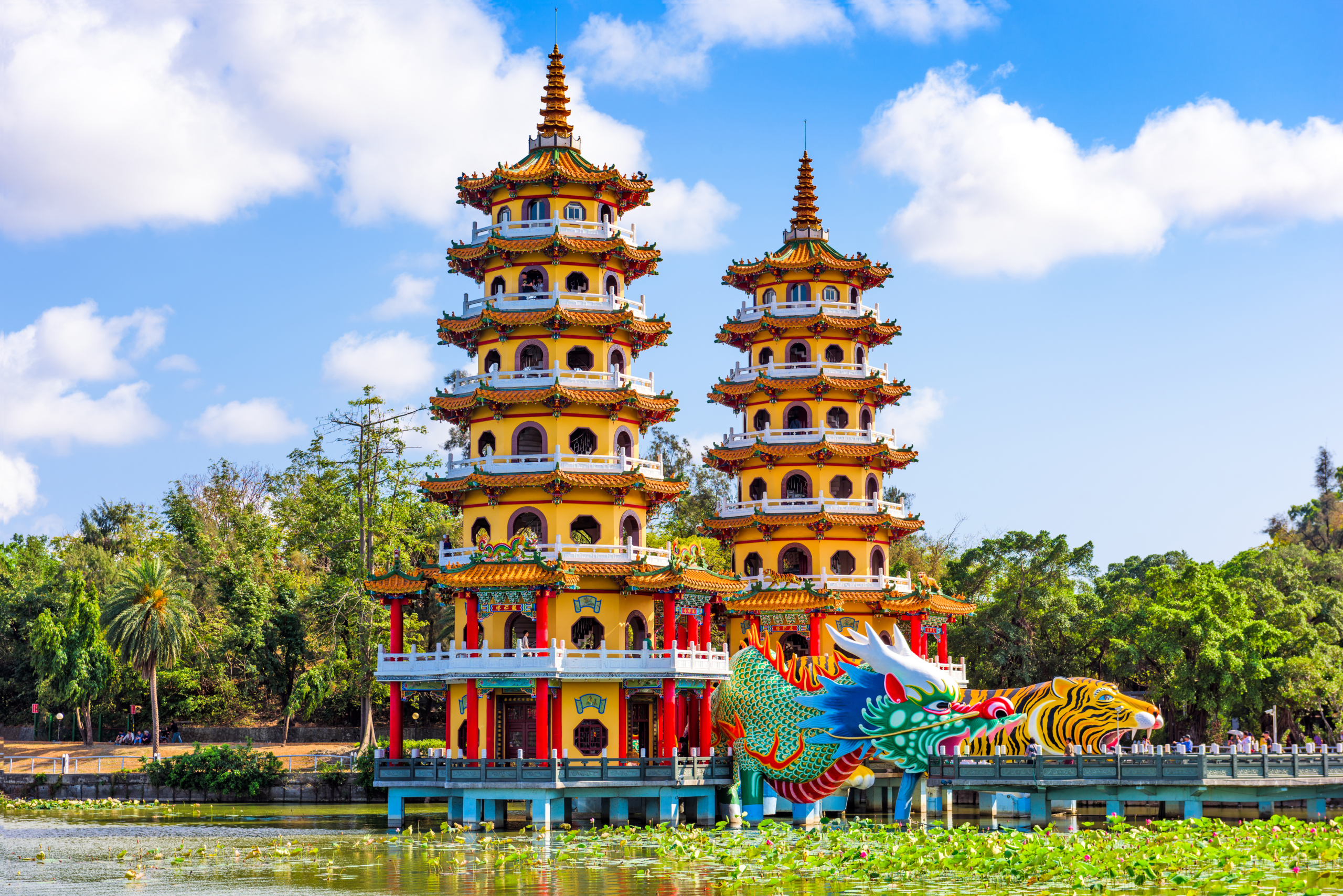
The trip works as 2 nights. Lotus Pond’s iconic Dragon-and-Tiger Pagodas at sunset. Sizihwan beach for a sunset. Pier-2 Art Center for the daytime culture. Cijin Island ferry + seafood. Day trip 1 hour south to Kenting National Park beaches if you want to extend.

Before you arrive.

Harbor to mountain.
Kaohsiung sits on the water and lives by it. The harbor that made the city — once one of the busiest container ports on earth — now frames its best hours: the Pier-2 Art Center, where abandoned 1970s shipping warehouses were turned into one of Taiwan’s largest creative districts in 2006; the five-minute ferry to Cijin Island and its Qing-era lighthouse; the sunset over Sizihwan Bay. North of downtown, Lotus Pond mirrors the Dragon and Tiger Pagodas. East, the Fo Guang Shan monastery rises out of the hills.
But you don’t come to Kaohsiung for a single monument. You come for the contrast: a hard industrial port that learned to be beautiful. The Love River cutting green through the center. The night markets warmer and less touristed than Taipei’s. A southern Taiwanese openness you feel within an hour of arriving. The reward of Kaohsiung is the ease — a major city that moves at the pace of a coastal town, with the food and the art to match.
Lotus Pond at first light.
Lotus Pond is a 1.4-kilometer man-made lake in the Zuoying district, ringed by more than twenty temples and pavilions. Built in the 1950s, it became the spiritual heart of northern Kaohsiung — and its signature image is the Dragon and Tiger Pagodas, a pair of seven-story towers reached by a zigzag causeway over the water. The custom is fixed: you enter through the dragon’s mouth and exit through the tiger’s, a passage said to turn bad fortune to good.
Come at first light. The pagodas reopened fully in 2025 after years of restoration, and at dawn the causeway belongs to a handful of locals doing tai chi and walking the perimeter. The water is still, the colors saturate as the sun comes up, and the whole lake — pagodas, Spring and Autumn Pavilions, the giant Xuantian Shangdi statue — reflects clean off the surface.
This is the calm anchor of a Kaohsiung trip: a slow lakeside loop, temple by temple, before the heat and the tour buses arrive. Whatever you came south for, the pond gives you the quiet version of it first.
Fo Guang Shan.
Fo Guang Shan — “Buddha’s Light Mountain” — is the largest Buddhist monastery in Taiwan, founded in 1967 by the late Venerable Master Hsing Yun. It sits in the hills about 40 minutes east of downtown Kaohsiung, a vast complex of halls, pagodas, and gardens that anchors one of the most influential modern Buddhist movements in the world.
The piece every visitor comes for is the Fo Guang Big Buddha, completed in 2011 at the adjoining Buddha Museum: a seated bronze figure 40 meters tall on a 10-meter base — 108 meters in all, an auspicious number — cast from roughly 1,800 tonnes of bronze. It is the tallest bronze seated Buddha on earth, flanked by eight pagodas leading up the central promenade.
For the traveler who wants depth, this is the cultural anchor of the south: a working monastery, not a tourist set piece. Vegetarian dining in the refectory, sutra halls open to the public, the long approach walk that resets your pace. Go early, before the heat, and let the scale do its work.
Pier-2 to Cijin Island.
This is the walk that explains Kaohsiung. The city was Taiwan’s industrial port — one of the busiest container harbors in the world — and its best half-day traces how that port reinvented itself as a waterfront for people instead of cargo.
Start at the Pier-2 Art Center. A run of derelict shipping warehouses on the harbor’s edge, abandoned when the trade moved on, then revived in 2006 into one of the largest arts districts in Taiwan — galleries, studios, public sculpture, the old rail spurs left in place. This is where Kaohsiung’s creative identity lives now.
Walk the waterfront promenade past the Great Harbor Bridge and the light-rail line, then take the five-minute ferry to Cijin Island — the long sandbar guarding the harbor mouth. Cijin was a fishing village and, during the Qing dynasty, a fortified trading base; its lighthouse and old fort still stand above the strait.
End on Cijin’s seafront — the black-sand beach, the seafood street, the view back across the water to the skyline. From the island, the whole arc is in one frame: working port, art district, open sea.
One afternoon. One harbor, three lives — industry, art, and the coast.
The harbor at sunset.
Kaohsiung is a harbor city, and the truest way to feel it is from the water. The move is a private boat out of Kaohsiung Harbor at sunset — past Cijin Island and the breakwater, into the open strait off Sizihwan Bay, where the sun drops straight into the Taiwan Strait and the whole skyline catches the last light behind you.
Sizihwan, tucked beneath Shoushan (“Monkey Mountain”) and the old British consulate on the bluff, is the city’s classic sunset stage. From the deck you watch the working port, the towers, and the new harbor bridge go gold, then blue, then lit.
Close the night on the Love River. The green ribbon through the center of the city is at its best after dark — a slow gondola or river cruise under the lit bridges, café terraces along the banks, the temperature finally dropping. It’s the gentle counterweight to the open-water hour: harbor adrenaline, then river calm, in one evening.
For the more active: kayaking and stand-up paddle off Sizihwan in the morning, before the wind comes up, is the other side of the same coin.
Liuhe is the famous one. It’s not the best one.
Liuhe Night Market is the one every guidebook names, which is exactly why it’s the most touristed and the most diluted in Kaohsiung. Go to Ruifeng Night Market instead — bigger, busier with locals, and far better food. We send you with a guide who orders the right things and skips the souvenir stalls.
Skip the 85 Sky Tower observation deck.
The Tuntex 85 Tower’s observation floor is dated and the view is through tired glass. For the skyline, take a private harbor sail at sunset or drink at a Sizihwan-side terrace — same height of feeling, far better setting. Or ride the ferry to Cijin and look back at the city for the price of a token.
Skip the hop-on-hop-off circuits.
The double-decker loops rush a hundred people past Kaohsiung’s surfaces in two hours and teach you nothing. A private car with an English-fluent guide covers the same ground in a half-day — Lotus Pond, Fo Guang Shan, the harbor — and you actually understand the city instead of photographing it from a moving deck.

Where you sleep matters.
InterContinental Kaohsiung
Opened November 2021 on the lower floors of one of Kaohsiung’s tallest skyscrapers, in the Asia New Bay Area by the harbor. 253 rooms and suites, floor-to-ceiling glass, and the highest infinity pool in the city. The most polished international-luxury stay in southern Taiwan, 15 minutes from both the airport and the main station.
Kaohsiung Marriott Hotel
Completed 2020 in the Gushan district on the city’s north side, near Lotus Pond and the high-speed rail. A 156-meter tower with 700 rooms plus 94 premium suites — the largest full-service luxury hotel in Kaohsiung, with a resort-scale pool deck and one of the best skyline panoramas in the city.
The Howard Plaza Hotel Kaohsiung
Completed 1996, a 30-floor landmark in the central Sinsing district — the long-standing grand hotel of downtown Kaohsiung. 283 rooms and suites, classic full-service luxury, walking distance to the Liuhe and Ruifeng night markets and the central MRT lines.
Silks Club Kaohsiung
147 suites in the Cianjhen district, curated by ALIEN Art — bespoke pieces in every room and a “Dancing Particles” kinetic installation in the lobby. Understated wood-toned luxury with a rooftop infinity pool. Also home to a Michelin-recognized kitchen.
H2O Hotel
Design-forward five-star in Gushan, minutes from Ruifeng Night Market and the Kaohsiung Arena. Rooftop pool, three restaurants, easy reach of Lotus Pond and the HSR. Best for a north-side base near the markets.
Hotel dùa
“Dùa” means home in Taiwanese. An elegant central design hotel — dim-sum restaurant and rooftop bar — in the heart of the city. Smaller, character-led, best for couples who want personality over scale.

The stars and the stalls.
The Michelin year.
the FRONT HOUSE
Chef Tsai Chung-ho — Ledbury-trained — weaves French haute cuisine through the terroir and food memories of southern Taiwan. Opened 2023; took its first MICHELIN star and the Guide’s Best Service Award in the 2025 Taiwan selection. Our pick for the meal of the trip.
HAILI
One set menu of local and Japanese produce, prepared in a precise Japanese-French style. The menu changes every season but always keeps one course inspired by Kaohsiung’s own culture. One MICHELIN star in the 2025 Taiwan Guide.
SHO
The first overseas sister restaurant of Tokyo’s celebrated Den. The menu carries the same playful spirit, built around Taiwan’s ingredients pushed to their fullest. One MICHELIN star in the 2025 Taiwan Guide — and the most fun seat in the city.
The street icons.
Ruifeng Night Market
The largest and best night market in Kaohsiung — where locals go while tourists head to Liuhe. Taiwan’s best fried chicken cutlets, scallion pancakes, frozen-yogurt cubes, the famous milk-tea queue. Closed Mon & Wed; busiest 7–9pm.
Liuhe Night Market
The famous, central, tourist-friendly market — and the easiest one to reach by MRT. Best known for fresh seafood off the grill, papaya milk, and a run of Halal stalls. Touristed, yes; still a lively first-night warm-up.
Miaoqian Seafood Street
The seafood street that runs the length of Cijin Island, a five-minute ferry across the harbor mouth. Choose your fish from the tanks out front and tell them how to cook it. The freshest catch in Kaohsiung, eaten with the strait in view.
Yancheng District eats
The old downtown by Pier-2 — Kaohsiung’s deepest street-food district. Duck rice with savory gravy, oyster omelettes, oyster vermicelli, and tall glasses of papaya milk. Best worked through slowly, stall by stall, with a guide who knows the order.
Want a chef in your suite or villa?
For longer stays or special dietary protocols — recovery nutrition, performance macros, post-training meals — we arrange a private Taiwanese chef to cook in your suite. Southern seafood, a market run included, three meals a day or single dinners. Quietly handled.

How the city moves.
KHH → city center.
Kaohsiung International (KHH). ~10km from the city center · 20 min by private car, 30 min by MRT Red Line. Smaller and calmer than TPE — international arrivals are mostly regional Asian carriers.
Private Transfer. Black Mercedes E-Class or V-Class. Meet and greet at the gate, bags handled, straight to your hotel in Yancheng or Lingya.
If arriving via Taipei (TPE), the HSR from Zuoying is 90 minutes — your driver picks you up at Zuoying HSR station instead.
Once you’re in.
Kaohsiung MRT (Red + Orange Lines) is clean and underused — easy moves between the airport, Pier-2, Lotus Pond, and Zuoying HSR. EasyCard tap-in.
Private car and driver for Lotus Pond temples, Fo Guang Shan, and the Kenting day trip (2.5 hr south). Same driver every day, English-fluent.
Cijin Ferry from Gushan to Cijin Island — 5 minutes across the harbor mouth, scooters and pedestrians only. Skip the public ferry on weekend lunch hours.
What you’ll actually do in Kaohsiung.

What you actually need.
Required vs. recommended.
What to pack before you fly.
How Kaohsiung affects the body.

What we tell you that nobody else does.
Kaohsiung is not Taipei. Calibrate expectations.
Kaohsiung is a working harbor city in transformation — Pier-2’s art revival, Cijin’s reclamation, the MRT build-out are recent. The Michelin scene is small (a handful of Bib Gourmands, no 3-stars). Top-tier hotels are credible but the international-flag depth is shallower than Taipei.
What we do about it: we frame Kaohsiung as a 2–3 night stay paired with Kenting (south) or as a Taipei extension. The play here is southern Taiwan’s pace, the harbor light, the temples — not a Michelin marathon.
Don’t skip the 2.5-hour drive south.
Kaohsiung is the gateway. Kenting National Park — Taiwan’s only tropical region, the south-coast beaches, Hengchun’s walled old town — is the reason to come south. The drive is 2.5 hours each way; doing it as a day trip is rushed.
The plan: 2 nights Kaohsiung, 2 nights Kenting (Gloria Manor or H Resort Kenting), back through Kaohsiung to the HSR. Or pair with our Kenting guide for the full southern arc.
Typhoon-edge days are not ferry days.
The Gushan-Cijin ferry crosses the open harbor mouth. On typhoon-edge days (and through Jun–Sep generally) the swell can make the 5-minute crossing genuinely rough. The ferry runs anyway until officially suspended.
The fix: we book a private speedboat instead — same crossing, dramatically smoother, and on your schedule. Public ferry is fine on calm-weather days only.
Kaohsiung is not a late-night city.
Dinner kitchens close by 10pm, most bars by midnight. The Liuhe Night Market is the evening center. If you came for clubs or sustained nightlife, southern Taiwan rewards you with sunrise temple light instead.
If you came for nightlife, you came for the wrong city. Kaohsiung rewards travelers who lean into the slower pace and treat it as a regional anchor for Kenting and the Fo Guang Shan circuit.
The ways you fly.
What locals notice.

The bespoke details.
Services not on any booking site.
Doors before opening hours. After closing.
Doors the city keeps closed.
The fluent people behind every visit.
We don’t ship itineraries.
The other guides give you a day-by-day plan. We don’t. A bespoke trip starts with what’s true for you: your training schedule, your dietary protocols, your sleep window, the experience you’d fly for. You answer. We build.
What we ask before we build.
The questions that shape your trip more than any itinerary ever could.
The moments we build around.
Not a checklist — a list of the kinds of anchors that often appear in a TBT-built trip.
Tell us about you. We build the rhythm.
Sanctum members answer the 7 prompts above. We build the trip from there. Flights, hotels, drivers, restaurants, private chef, harbor boat, temple dawn visits, the Kenting extension — all pre-arranged before you land. No template. No itinerary you didn’t ask for.
What Kaohsiung taught me.
Kaohsiung sits an hour-and-a-half south of Taipei by high-speed rail and feels deliberately less polished — a working harbor city that has reshaped itself around design rather than business. The Pier-2 Art Center, the Love River, the Cijin Island ferry — none of these read as luxury destinations. They read as a southern Taiwan that has chosen its own register.
The trip works as a one- or two-night southern leg from a Taipei base. Travelers who give Kaohsiung the time discover the lotus-pond temple cluster, the night-market discipline, and a slower food culture than the north. The light is different here too — flatter, hotter, more direct — and it changes how the city photographs.
What Kaohsiung clarifies is that Taiwan is not a single city with extensions. It is a country with at least two centers, each with its own rhythm. The southern center is quieter and more design-driven, and any serious Taiwan trip earns its depth by including it.
Want Kaohsiung handled?
Sanctum members can request a custom Kaohsiung route — flights, hotels, drivers, restaurants, private chef, harbor boat, Lotus Pond dawn visits, the Kenting extension — pre-booked, the whole rhythm of the trip mapped before you land.
Kaohsiung is the base camp.
Within a half-day’s drive, ferry, or short train, you can reach 5 different versions of Taiwan — the tropical south coast, an old capital, a sacred lake, a high-mountain forest, and a coral island. Each gets its own dedicated guide. Or go solo and build your own way through them.
Enter your details to open this guide — and every guide in our atlas.
The trips we don’t list publicly
The full Kaohsiung guide—our exact stays, tables, and routes—lives inside Sanctum.
Unlock the Guide