Kyoto.
1,600 Buddhist temples. 400 Shinto shrines. 17 UNESCO World Heritage sites.The most concentrated cultural archive in Asia.
What every first-time visitor underestimates is that Kyoto isn’t slow — it’s deliberate. There’s a difference. Kyoto runs at the pace it has run for a millennium, which means the tea ceremony takes 90 minutes by design, the kaiseki dinner is 14 courses for a reason, the temple bow is performed precisely. Watch the locals: the maiko walking to her teahouse appointment moves at exactly one speed. Match it or get out of the way.
The restraint here is total. The dress code is more formal than Tokyo’s. The hospitality is quieter. The food is more intricate. Even the language is softer — Kyoto’s Kansai-ben dialect has a famous indirectness to it that takes longer to read. If Tokyo is the modern Japanese performance, Kyoto is the original Japanese text.
Slowness here isn’t laziness. It’s the operating mode of a city that doesn’t have to prove anything to anyone.

Before you arrive.

794 to today.
Kyoto splits in two. Higashiyama is the eastern hills — temples, geisha districts, the original streets the imperial court walked. Kiyomizu-dera, Sanjusangen-do, Gion, Pontocho — all here, all walking-distance from each other, all functioning on the same rhythm they have for 12 centuries. This is where you stay, this is where you wander, this is where you eat your kaiseki.
But you don’t come to Kyoto for the temples alone. You come for Fushimi Inari at 5:30am, when the 10,000 torii gates are silent. You come for the maiko shadow flashing past a paper lantern in Pontocho. You come for a 14-course kaiseki at Hyotei that’s been served on the same Nanzenji grounds for 200 years. The reward of Kyoto isn’t the monument count. It’s the precision. It’s knowing that every meal, every tea ceremony, every temple bow has been refined for a millennium and is being performed for you with that exact same care.
Fushimi Inari at dawn.
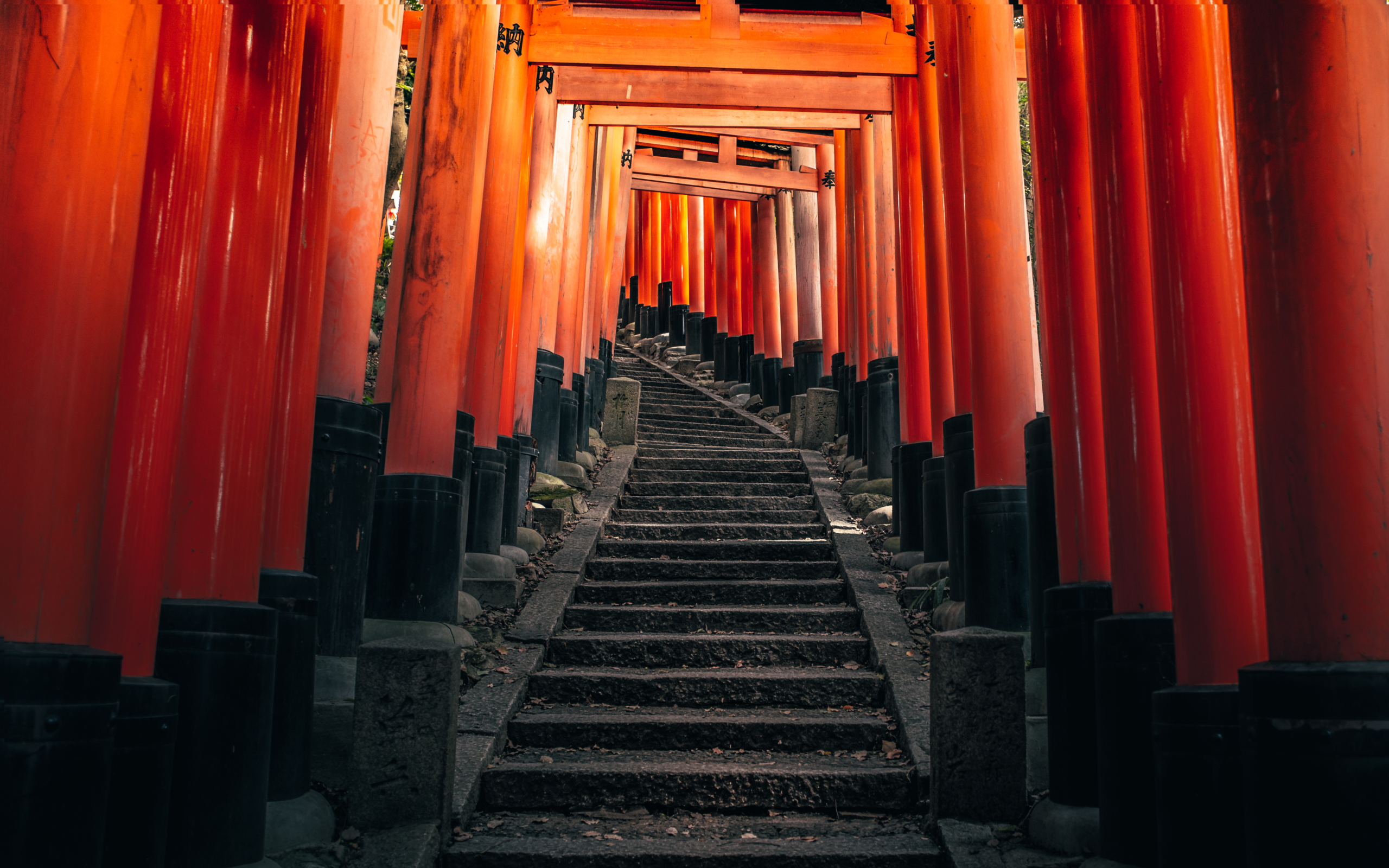
Fushimi Inari is Kyoto’s most photographed shrine. Roughly 10,000 vermilion torii gates wind 4 kilometers up Mount Inari, donated by individual businesses and patrons over 1,300 years. The bottom 200 meters are clogged with tour buses by 9am. The full ascent is empty before 7.
The play is to be at the Romon Gate at 5:30am. You climb in dim blue light through the first dense cluster of gates — Senbon Torii — alone, with the foxes (Inari’s messengers) on every plinth. The full loop takes 2 hours at a meditative pace, 45 minutes at a fast hike, and roughly 25 minutes at a true run. You see the city open below you at the halfway mark, Yotsutsuji intersection. The Pacific to the east, the mountain quiet in front of you.
You’re back at the base by 7:30, before the buses arrive. The locals running the morning loop are mostly Kyoto residents — this is their daily route. Match their pace. Don’t talk. The mountain is the operating system here.
Private tea ceremony.
The Japanese tea ceremony — sadō (the way of tea) — was perfected in Kyoto in the 16th century by Sen no Rikyū. It is the most exacting cultural practice in Japan: every movement, every utensil, every grain of matcha is calibrated. The host has trained for 10+ years before performing publicly. The 90-minute ceremony is the closest thing in the world to active meditation.
The tourist version of this — the 30-minute “tea experience” in a converted house — misses the point entirely. The TBT version is a private ceremony with a recognized tea master in an actual tea room (chashitsu), often arranged through Aman Kyoto’s cultural team, Four Seasons’ Shakusui-tei teahouse, or via a direct introduction to one of Kyoto’s three remaining authentic tea schools: Urasenke, Omotesenke, or Mushakōjisenke.
You sit seiza (kneeling) on tatami. The master prepares thick matcha (koicha) in silence. You bow when offered, rotate the bowl twice clockwise, drink in three sips, return the bowl. Then thin matcha (usucha) is served with seasonal wagashi sweets. The ritual is finite, complete, and unrepeatable — the same as every kaiseki course, every shrine bow, every Kyoto interaction at its highest level.
Higashiyama walking arc.
The Higashiyama district — Kyoto’s eastern hills — holds the largest concentration of intact historic Kyoto in the city. 5 kilometers, 6 anchor sites, 1,200 years of Japanese court culture compressed into one walking arc. Most travelers do half of this and miss the connection. The full route ties it all together.
Start at Kiyomizu-dera (778 AD). The wooden veranda extends 13m off the hillside without a single nail — UNESCO World Heritage. The Otowa Waterfall beneath splits into 3 streams: longevity, success, love. Drink from one, not all three.
Walk down Sannenzaka and Ninenzaka — the preserved 200-year-old shopping streets, sloped stone lanes, tea houses, ceramic shops. This is the Kyoto every photographer chases.
Yasaka Shrine anchors the western end — 9th century, Gion Matsuri’s host shrine. Walk through the south gate at dusk for the lantern lighting.
Enter Gion. The geisha district. Stone-paved Hanami-koji is the iconic photograph. Maiko (apprentice geiko) walk to appointments between 5:30 and 6:30pm. Do not stop them. Do not flash-photograph. Do not block the alley. The district is enforced via fines.
End at Pontocho. A 500m-long alley along the Kamogawa River. 130+ restaurants and bars in narrow wooden buildings, the riverbanks below crowded with locals on summer nights. Choose a kaiseki here for the trip’s anchor dinner.
One afternoon. 1,200 years. This is the architectural and cultural argument of Kyoto.
Miyamasou mountain ryokan.
An hour by car from central Kyoto, deep in the Hanase mountain village at the edge of Sakyo-ku, there’s a 120-year-old ryokan called Miyamasou. In 2026, it was promoted to three Michelin stars — the first Kyoto restaurant to earn that promotion in 6 years. The chef, Hisato Nakahigashi, forages the mountain the morning of your service. The cuisine is called tsumikusa ryori — “foraged-grass cuisine” — and you cannot have it anywhere else on earth.
The ryokan has 7 rooms. You stay overnight. You eat dinner in the small dining room facing the forest. You sleep on tatami. You take a cypress-bath in the morning. You eat breakfast on the veranda watching the mountain wake up. Then your car arrives and takes you back to Kyoto.
This is the single most refined experience in Kyoto for travelers who want something the average ultra-luxury circuit doesn’t offer. It’s not in any guidebook’s top 10. It requires booking 3+ months out. And it’s the trip’s anchor memory.
The 5-minute photo, then the elbow crowd.
The Arashiyama Bamboo Grove is iconic — and 350 meters long. Every guidebook lists it. By 10am it’s a shoulder-to-shoulder selfie tunnel. The play: arrive at sunrise (6:00am) when the bamboo is silent, or skip the grove entirely and route to Tenryū-ji Temple’s Sōgen Garden next door — same area, 1/10 the crowd, 100× the depth.
The maiko are not props.
In 2019, Gion’s private alleys (Hanami-koji and Pontocho) implemented fines for unauthorized photography. Tourists chasing maiko down the street is a real problem the district is actively pushing back on. The respectful way: watch from across the alley, no flash, never block, never grab. Or book a private dinner with a maiko + geiko through Aman Kyoto or Four Seasons’ cultural team.
Skip the staged “ninja training.”
You’ll see ads for Samurai Kembu Theater, Ninja Kyoto, etc. — costume-and-throwing-star tourist experiences. Theatrical, expensive, hollow. If the warrior tradition matters to you, we book a private session with a kyudo (Japanese archery) master at a working dojo — the same practice the samurai trained at for 400 years.

Where you sleep matters.
Aman Kyoto
Hidden in a private 32-acre garden in Higashiyama at the foot of Mt. Hidari Daimonji. 26 suites + 2 private villas across 6 pavilions in dense pine forest. Designed by Kerry Hill — the late Aman architect — interiors blend natural cedar, washi paper, and Kyoto craft. Aman Spa onsen pools draw from natural hot springs.
Four Seasons Hotel Kyoto
Higashiyama, central Kyoto. Built around the Shakusui-en pond garden — over 800 years old, mentioned in the 12th-century Tale of Heike. 123 rooms, 57 suites. The hotel is essentially a contemporary glass-and-cedar envelope wrapped around a Heian-era pond — every room sees water and momiji.
Kafele’s confirmed pick (per Japan Travel Glossary). Best for travelers who want modern luxury bones with deep historical context, walking distance to Sanjusangen-do Temple and Kyoto National Museum.
ROKU Kyoto, LXR Hotels & Resorts
Newly awarded Forbes Travel Guide Five-Star for 2026. Forested setting in Takagamine, northern Kyoto — 20 minutes from city center. 114 rooms, all overlooking the Tenjin River valley. Hilton’s Luxury Reserve brand.
Kafele’s “affordable shift” pick — moves budget toward bigger experiences elsewhere (e.g., Aman Tokyo) while still delivering 5-star Kyoto. Natural onsen pools drawn from Takagamine hot springs.
The Ritz-Carlton, Kyoto
9 consecutive years Forbes Five-Star — Kyoto’s longest-tenured top rating. Riverside Kamogawa, near Nijō Castle. Classic luxury. (NOT in TBT’s 7-brand stable, but Forbes anchor.)
HOTEL THE MITSUI KYOTO
Luxury Collection / Marriott. Former Mitsui family residence opposite Nijō Castle. Has natural onsen drawn from a 1,000-meter underground spring. Contemporary design meets Edo-period history.
Tawaraya Ryokan
Operating since 1709. 18 rooms only. Has hosted Apple Jobs, Bill Gates, Sting. The most discreet luxury experience in Kyoto. Bookings 12 months out via personal introduction; we arrange.

Six anchors of kaiseki.
The grand kaiseki tier.
Hyotei
~200 years old. Located on the grounds of Nanzenji Temple. Fourteen generations of one family. Master Yoshihiro Takahashi continues a culinary lineage that began as a roadside teahouse for pilgrims in the Edo period. The Kyoto temple of kaiseki.
Mizai
Only 6 diners per service. Reservations booked a year in advance. Maruyama Park, secluded teahouse setting. Chef Hitoshi Ishihara delivers the most intimate kaiseki experience in Japan. The grail of Kyoto fine dining.
Gion Sasaki
Chef Hiroshi Sasaki’s modern kaiseki in the heart of Gion — the geisha district. The counter seats 10. Sasaki was raised in a kaiseki family but built his name independently. Three Michelin stars retained since 2012. The geisha-quarter setting is part of the experience.
Three more across cuisines + booking tiers.
Kikunoi Honten
Master Yoshihiro Murata’s flagship. Founded 1912. Higashiyama. Murata literally wrote the book on kaiseki (the definitive English-language guide to the cuisine). Three Michelin stars for over a decade. Honten = Main House.
Miyamasou
NEW Three Michelin Stars 2026 — the first Kyoto restaurant promoted to 3-star in 6 years. A 120-year-old inn in Hanase mountain village, 45 min from central Kyoto. Chef Hisato Nakahigashi forages the mountain morning of service (“tsumikusa ryori” = foraged-grass cuisine). Stay overnight; the inn has 7 rooms.
Kikunoi Roan
Sister restaurant to Kikunoi Honten — same Murata family lineage. Two Michelin stars + a more accessible booking. The Kikunoi philosophy at a slightly more achievable reservation tier. Best lunch counter in Kyoto.
Want kaiseki in your suite or ryokan?
For longer stays or special dietary protocols — we arrange a private kaiseki chef to cook in your suite at Aman Kyoto, Four Seasons, or your ryokan. Kyoto-style multi-course tasting, market run included. Quietly handled.

How the city moves.
KIX or HND → Kyoto.
Kansai International (KIX) — 100km from Kyoto. Direct private transfer ~80 min, or Haruka Limited Express train 75 min to Kyoto Station (Green Car / 1st class available). KIX is the standard route into Kansai.
From Tokyo Haneda (HND) — Shinkansen Nozomi from Tokyo Station, 2 hr 15 min in Green Car. Often the right move if pairing Tokyo + Kyoto: fly into HND, train to Kyoto.
Private Mercedes V-Class or Lexus LS arranged through Aman Kyoto / Four Seasons / ROKU. Driver meets at the gate or train platform.
Once you’re in.
Private car + English-fluent driver is the default — same driver every day. Kyoto’s grid is logical (north-south streets, east-west streets), but traffic in central Higashiyama and Gion is dense. Your driver knows the shortcuts.
Higashiyama is for walking — too narrow for cars in many alleys, and the experience is the walk itself. Car drops at Yasaka Shrine or Kiyomizu base, picks up at Pontocho riverbank.
Shinkansen + Green Car for Osaka (15 min), Nara (45 min), Himeji (45 min), Kanazawa (2h 15min). Tokyo (2h 15min). Faster than flying for everything Kansai.
What you’ll actually do in Kyoto.

What you actually need.
Required vs. recommended.
What to pack before you fly.
How Kyoto affects the body.

What we tell you that nobody else does.
Kyoto is the most touristed city in Japan.
50 million visitors a year to a city of 1.45 million residents. By 10am Kiyomizu-dera, Fushimi Inari, Arashiyama Bamboo Grove, and Golden Pavilion are wall-to-wall tour buses. The locals have started actively pushing back — Gion fines, alley closures, posted “no photos” zones.
What we do about it: sunrise visits to every iconic site (5:30am Fushimi · 6am Kinkaku-ji · 7am Arashiyama). After-hours private temple access via TBT concierge. Off-the-list temples (Daitoku-ji subtemples, Honen-in, Anraku-ji) for the deep-Kyoto afternoons. Tour buses don’t go there.
Kyoto summer is worse than Tokyo.
Kyoto sits in a basin surrounded by mountains. Summer heat gets trapped — July–August averages 80%+ humidity and 90°F+ daily highs. Heat index pushes 100°F+. It’s the hottest of the 3 Japan cities. Mid-day outdoor temple visits Jun–Sep are tolerable only with strategy.
The fix: sunrise temple visits (5:30–8am), mid-afternoon hotel-spa reset (Aman Kyoto onsen, Four Seasons spa), evening experiences from 5pm onward.
August–September can disrupt.
Typhoon systems hitting Kyoto can shut down Shinkansen service for 24–48 hours, ground domestic flights, and force outdoor temple visits indoors. Kyoto itself handles them fine, but the day-trip plans (Nara, Himeji) get derailed.
The plan: if booking Aug–Sep, build flex into the itinerary. We monitor JMA (Japan Meteorological Agency) 7 days out and adjust day-trip timing.
English is thinner here than in Tokyo.
Kyoto’s English signage is decent at major temples and Higashiyama tourist zones. But step into a small kissaten in Pontocho or a ryokan in Gion and the language drops — Kyoto’s dialect (Kansai-ben) is softer and more indirect than Tokyo’s, with famous double meanings that confuse even other Japanese.
The fix: Google Translate works. Hotel concierge handles bookings + dietary needs in Japanese. For deep cultural sites (kaiseki, tea ceremony, ryokan) we always send a brief in advance.
The ways you fly.
What locals notice.

The bespoke details.
Services not on any booking site.
Doors before opening hours. After closing.
Doors the city keeps closed.
The fluent people behind every visit.
We don’t ship itineraries.
The other guides give you a day-by-day plan. We don’t. A bespoke trip starts with what’s true for you: your training schedule, your dietary protocols, your sleep window, the experience you’d fly for. You answer. We build.
What we ask before we build.
The questions that shape your trip more than any itinerary ever could.
The moments we build around.
Not a checklist — a list of the kinds of anchors that often appear in a TBT-built trip.
Tell us about you. We build the rhythm.
Sanctum members answer the 7 prompts above. We build the trip from there. Flights, hotels, drivers, restaurants, private chef, motorcycle tour, paragliding, all pre-arranged before you land. No template. No itinerary you didn’t ask for.
What Kyoto taught me.
Want Kyoto handled?
Sanctum members can request a custom Kyoto route — flights, hotels, drivers, kaiseki reservations, tea ceremony master, maiko + geiko dinner, Miyamasou overnight, region arc extension — pre-booked, the whole rhythm of the trip mapped before you land.
Kyoto opens to all of Kansai.
Within an hour to two hours by Shinkansen or train, Kyoto opens into the 5 destinations that complete a Kansai trip — Japan’s food capital, the deer city, the white-castle photograph, the gold-leaf court, and a working Shingon Buddhist mountain. Each gets its own dedicated guide.
Enter your details to open this guide — and every guide in our atlas.
The trips we don’t list publicly
The full Kyoto guide—our exact stays, tables, and routes—lives inside Sanctum.
Unlock the Guide