Phuket.
Phuket is where Aman invented Asian ultra-luxury in 1988 with a single resort called Amanpuri — “place of peace.”It is also where the rest of Southeast Asia learned what a beach hotel could be.
The east coast is for the boats. The west coast is for the hotels. The center is Phuket Old Town, where the tin-mine money from the 1890s built the shophouses that now hold the Peranakan kitchens that hold the food culture nobody outside the island talks about.
The weather is split into two truths. November to April is the dry season — calm seas, blue skies, every boat running. May to October is monsoon — west-coast surf shuts down, beaches close on red-flag days, the rain lasts hours not minutes. There is no negotiating with the calendar. The trip works in the dry window or it does not work.
This is the island we send clients to when they want the south of Thailand done properly — Amanpuri or Rosewood, a Phang Nga Bay boat day, a Phuket Old Town walk, a Muay Thai session if they train, and a Phi Phi day trip out of the bay only when the weather agrees. The Patong nightlife strip is not part of this trip. We work the quieter coast.

Before you arrive.

1988 to today.
Phuket splits in three. The west coast is the resort coast — Surin (Amanpuri), Emerald Bay (Rosewood), Bang Tao (Banyan Tree), Layan, Mai Khao. White sand, calm sea, sunset over the Andaman. The east coast is the working coast — Phuket Town, the port, the boats that run Phang Nga Bay and Phi Phi. The Old Town is the center — 200-year-old Sino-Portuguese shophouses, Peranakan kitchens, the cultural anchor.
The trip lives on the west coast. The mornings are pool. The afternoons are spa, beach, slow lunch. The day trips are Phang Nga Bay or Phi Phi by boat, James Bond Island, Koh Hong sea caves. The evening lap is the Old Town walk + dinner at Raya or Suay. The neon strip at Patong is not part of this trip. The right Phuket is quieter than its reputation — and twice as good as the postcard.
Phang Nga Bay by private speedboat.
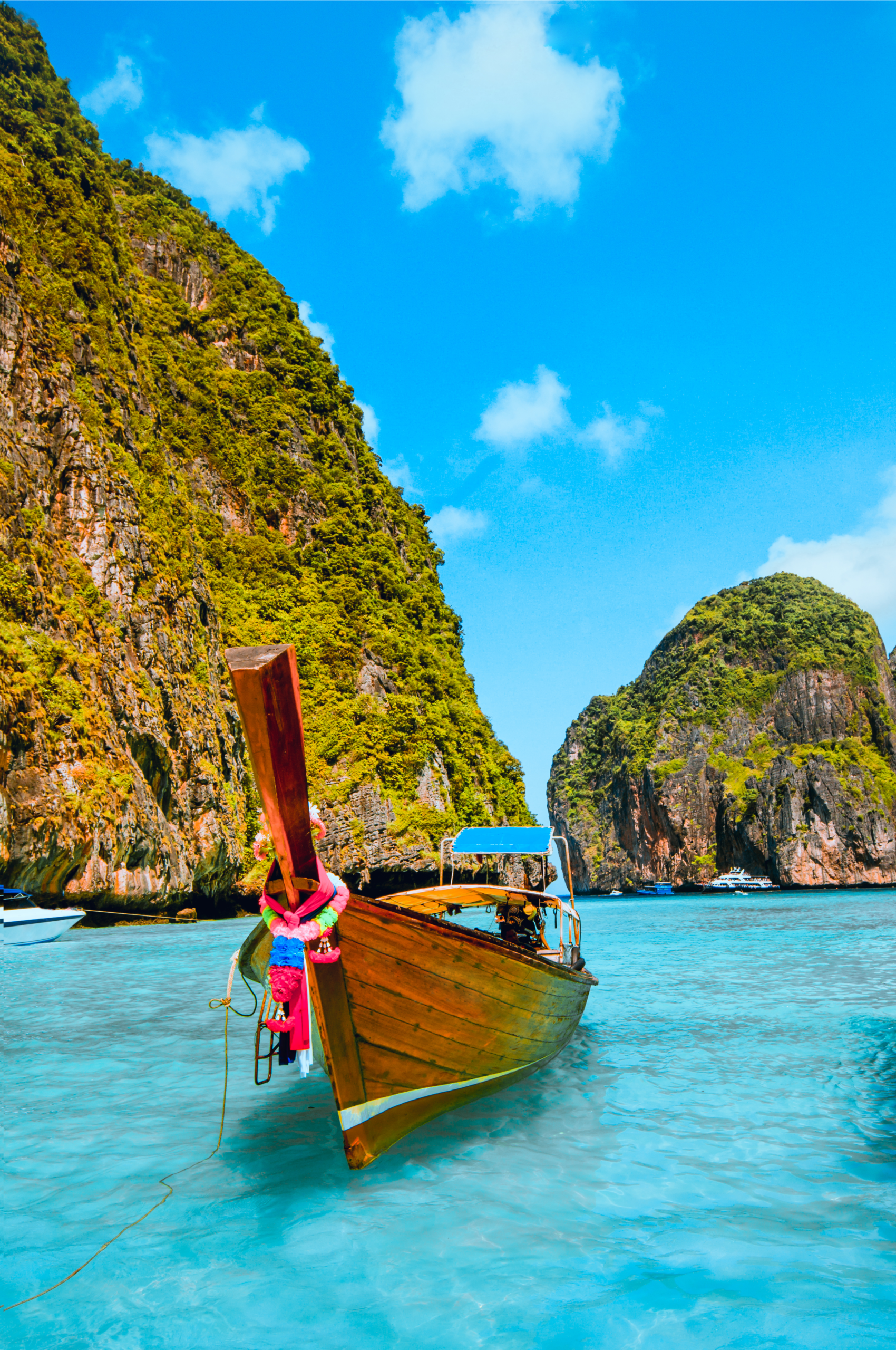
Phang Nga Bay is the visual signature of southern Thailand — 400 limestone karsts rising 200 meters out of emerald-green water across 400 km² of marine national park. The water is calm, the light is theatrical, and the karsts hide sea caves and hidden lagoons that only open at low tide.
Koh Phing Kan — the leaning karst made famous by The Man with the Golden Gun (1974) — is the iconic stop. Locals call it James Bond Island. Koh Hong is the secret — a hidden lagoon you reach by paddling through a 100m sea cave at low tide. The inside is a circular emerald pool surrounded by 150m cliffs. Phones come out. Phones get put away. Few experiences in Southeast Asia compare.
The move is a private speedboat from Royal Phuket Marina, chartered through Amanpuri or Rosewood — captain, crew, chef. 8 hours on the water, anchored for lunch in a hidden bay, snorkeling on the way back. Not the 60-passenger group tour out of Patong. That trip is a different trip.
Phuket Old Town walking afternoon.
Phuket Old Town is one of the great hidden food and architecture districts of Southeast Asia — a 200-year-old grid of pastel Sino-Portuguese shophouses built by Hokkien Chinese tin-mine families in the late 1800s. The architecture is what the Penang and Melaka heritage districts look like with half the tourists. The food culture (Peranakan / Baba-Nyonya) is one of Asia’s most distinctive cross-cultural cuisines and very little of it survives anywhere else.
Start on Thalang Road — the main artery, anchored by the Tavorn Hotel (1932) and the Phuket Trickeye Museum. Walk south to Soi Romanee, the most-photographed lane on the island — 30 meters of restored 1900s shophouses painted ochre, sage and powder blue. Cross to Krabi Road for the Thai Hua Museum (a former Chinese-language school, now the best Peranakan heritage museum on the island). Lunch at Raya Restaurant — the 100-year-old Sino-Portuguese mansion serving the crab curry (gaeng phu) Anthony Bourdain returned for twice.
Finish at Lock Tien Food Court for the Hokkien-Thai street food — moo hong (pork belly in dark soy), oh tao (oyster omelette), ohh aew (shaved ice with red beans). This is the food the resorts can’t replicate. The Old Town walk is the cultural anchor of the trip.
Big Buddha at sunset, Wat Chalong before.
The Phuket interior holds two sacred anchors most visitors skip because they’re staring at the beach. We do them in one half-day, late afternoon, in the right order.
Start at Wat Chalong. The most revered Buddhist temple on the island, built in the early 1800s and dedicated to two monks — Luang Pho Chaem and Luang Pho Chuang — who led the islanders during the 1876 Chinese rebellion. The Grand Pagoda (Phra Mahathat Chedi) houses a relic of the Buddha and 60-foot murals telling the Buddha’s life story. Shoes off, shoulders covered, no pointing feet at any Buddha image. Donate to the temple, light incense, take time.
Drive 20 minutes to Big Buddha at sunset. 45 meters of white Burmese marble (jade in the morning light, alabaster at sundown) standing on top of the Nakkerd Hills — the highest visible point on Phuket. From the platform the view runs from Chalong Bay east to Kata Beach west to Karon south. The full island is laid out under your feet. Sun sets behind the western horizon at 6:30pm year-round. There is no better viewpoint on Phuket. Stay until the bells ring.
Muay Thai at Tiger Camp.
This hero is for the clients who train — and Phuket happens to be the global capital of Muay Thai training. Tiger Muay Thai in Chalong has trained UFC champions, world-title boxers, and Olympic kickboxers. Same gym. Open to the public. The morning class roster reads like a Bellator card. It is the most credible combat-sports facility in Asia.
For the visiting athlete, the play is a private morning session — 60 to 90 minutes one-on-one with a Thai Kru (master trainer), often a former Lumpinee Stadium fighter. Pad work, footwork, knees-and-elbows clinch instruction, the clinch-and-sweep that doesn’t exist outside Thailand. You get an hour with a fighter who’s done 100+ pro bouts. You leave with technique that travels.
For the athlete who wants to go further — a 5-day immersion, two-a-day sessions, Thai diet, full recovery protocol arranged at Amanpuri. Tiger Muay Thai issues a certificate, and you spar with active fighters by day 4 if your level allows. For non-fighters: a single private session is the right introduction. The technique is real. The Kru is real. The trip changes.
Stay off the Patong strip.
Patong Beach Road and Bangla Road are the neon-and-beer-bar version of Phuket the international tabloids cover. Jet-ski scams (damage extortion is standard), tuk-tuk overcharging, aggressive bar touts. None of it is the Phuket we book. Our clients stay on Surin, Bang Tao, Layan or Mai Khao — and the only reason to drive through Patong is to leave it.
Skip animal attractions.
Tiger Kingdom, the snake shows, the monkey shows — all of them are animal-welfare red flags. Elephant riding is now widely understood to be cruel. If elephants matter to you, we book the Phuket Elephant Sanctuary — Asia’s first true sanctuary, no riding, no chains, the animals are rescued from logging and tourism.
Skip the cultural theme parks.
Siam Niramit, Phuket FantaSea and the cabaret-show extravaganzas position themselves as “cultural shows.” They are not — they are theme-park spectacle. The actual cultural experience is the Old Town walk + a private Peranakan dinner at Raya. Skip the casino-grade pyrotechnics.

Where you sleep matters.
Amanpuri
40 freestanding pavilions and 40 private villas on Pansea Beach, Surin — Phuket’s quiet northwest coast. Designed by Ed Tuttle in a contemporary Thai pavilion style and opened in 1988 — Amanpuri is the first Aman property in the world. The Aman brand was created to operate this single resort. Every Aman that has opened since is a descendant.
The pavilions follow the contour of a coconut grove down to a private beach. The wellness program — fasting, sleep, performance, longevity — is one of the most respected residential wellness programs in Asia. Hollywood, royalty and finance treat it as a private club.
Rosewood Phuket
Tucked into Emerald Bay — Patong’s quieter cousin, an unbuilt cove on the west coast. 71 villas, all with private pools. Designed by Bill Bensley with a focus on sustainability and wellbeing — the resort runs on a stricter ecological footprint than any of its peers. Opened 2017.
The play is the cliffside Pool Villa — private pool overhanging the bay, 270° ocean view. Asaya — Rosewood’s flagship wellbeing brand — runs the spa: longevity protocols, IV therapy, sleep diagnostics, sports recovery.
Banyan Tree Phuket
Bang Tao Beach, on Phuket’s central west coast — the home property of the entire Banyan Tree brand, opened 1994 as the founding hotel of the chain. 175 villas, all with private pools, set inside Laguna Phuket — a 1,000-acre integrated resort with golf, lagoons, and 4 sister hotels on the same lagoon system.
This is the mid-tier-with-luxury-DNA pick — the same DNA as Amanpuri at roughly half the rate. Best for families and longer stays. The DoublePool Villas have two pools — one private, one shared with the master bedroom’s open-air bath.
Trisara
40 villas on a private 12-hectare estate above Layan Beach. Considered Phuket’s quietest 5-star — no day-trippers, no group conferences. PRU restaurant has one Michelin star and a sister-farm 1 hour inland that supplies the kitchen.
Six Senses Yao Noi
Technically Koh Yao Noi — 30 min speedboat from Phuket. The most awarded wellness resort in the Andaman. 54 villas in the cliff-and-jungle setting between Phuket and Krabi. The pairing-with-Phuket move: 4 nights Aman + 3 nights Six Senses.
JW Marriott Phuket Resort & Spa
Mai Khao Beach, on the turtle-conservation coast near the airport. 265 rooms — larger scale, family-oriented, the resort with the easiest in-and-out for shorter Phuket pairings (Bangkok + Phuket 4-night combos).

The resort kitchens + the Old Town.
The resort fine dining.
Arva
Amanpuri’s signature Italian restaurant — the wood-fired oven runs all night, the pasta room is in view of the counter, and the wine cellar holds 350 labels from Sicily to Friuli. This is the most refined Italian on the island. Open to non-resort guests with advance reservation (Aman policy). Sunset terrace seating is the move — book the 6:30pm table.
Nahm Yen
The in-house Thai temple at Amanpuri — authentic regional Thai cooking, no foreigner-tuned spice levels, no fusion. The chef sources from his home village outside Krabi for the Andaman seafood and the southern Thai dry curries. The room is open-walled to the ocean. The meal is the southern coast’s argument for itself.
Ta Khai
Rosewood Phuket’s signature Southern Thai restaurant — named after a coastal Thai fishing village. The kitchen runs on Phang Nga + Phuket-coast fishermen day-boat catches: mackerel, prawns, mud crab, squid. Open kitchen, the wok station is in view of the room. Considered the best Thai restaurant of any luxury hotel on the island. The crab curry is the lock-in order.
Phuket Old Town · Peranakan + Hokkien-Thai.
Suay
Chef Tammasak Chootong’s modern Thai inside a renovated 1920s mansion in Phuket Town. The expat and local-elite favorite — refined Thai with French technique, served in a setting that feels more Bangkok-fine-dining than resort coast. The pad Thai with lobster is the dish.
Raya Restaurant
A 100-year-old Sino-Portuguese mansion converted to a restaurant by the same family that lived in it. Two-story shophouse with original wood floors, family altars and 1920s tiling. The Peranakan kitchen is the most authentic on the island — the crab curry (gaeng phu) is the Bourdain dish. Cash only. Lunch is the move; dinner books out.
Lock Tien Food Court
The Hokkien-Thai food court at the corner of Yaowarat and Dibuk in Phuket Old Town. Open-air, hawker-style, family-run stalls running 50+ years deep. Moo hong (pork belly in dark soy and 5-spice), oh tao (oyster omelette), ohh aew (shaved ice with red beans + jackfruit syrup). Cash only, ฿80–150 per dish.
Want a chef in your villa?
For longer stays or special dietary protocols — recovery nutrition, performance macros, post-training meals — we arrange a private Thai chef to cook in your villa (Amanpuri’s villa kitchens, Rosewood’s pavilion kitchens, Banyan Tree’s DoublePool kitchens). Phuket Town wet-market run included. Three meals a day or single sunset dinners. Quietly handled.

How the city moves.
HKT → west-coast resorts.
Phuket International (HKT). Located at the north end of the island. ~25km · 35 min to Amanpuri (Surin), 40 min to Rosewood (Emerald Bay), 20 min to Banyan Tree (Bang Tao). 90 min to the deep south (Nai Harn, Kata).
Private Transfer. Mercedes V-Class booked through your resort. Aman, Rosewood and Banyan Tree all run their own fleets. Meet-and-greet at the gate; bags + customs handled before you leave the curb.
Private aviation — Phuket Airport handles business jets. The FBO is on the east side of the terminal. Hotel cars meet planeside.
Once you’re in.
Resort cars + private drivers. The standard for the trip. Same driver every day, English-fluent, on call. Your resort dispatcher manages every move.
Phuket Town is for walking. Old Town shophouses are too tight for cars — drop at Thalang Road, walk in, walk out, car picks you up at the perimeter.
Avoid tuk-tuks. Tuk-tuk pricing in Phuket is the worst in Thailand — non-metered, non-negotiable, often 5×–10× the rate. Grab (Thailand’s Uber) works in Phuket Town but not all west-coast areas. Your resort car solves it.
What you’ll actually do in Phuket.

What you actually need.
Required vs. recommended.
What to pack before you fly.
How Phuket affects the body.

What we tell you that nobody else does.
Phuket only works November–April. It’s binary.
The west coast is on the Andaman side of the monsoon line. From May to October, the southwest monsoon brings 280–370mm of rain per month, red-flag conditions on every beach, and the cancellation of every snorkel, dive and longtail-boat operator on the island. Patong’s surf shuts down — literally, swimming becomes prohibited. The resorts stay open. The water does not.
What we do about it: we only book Phuket Nov–April. Off-season clients get redirected to Koh Samui (east coast, opposite monsoon cycle) or the Maldives. Peak season is December–February; late November and April are the underrated sweet spots.
Patong is the wrong Phuket.
Patong Beach Road and Bangla Road are the beer-bar, jet-ski-scam, neon-strip version of Phuket the tabloids cover. Jet-ski damage extortion (operators photo scratches that already exist and demand ฿20,000 on return) is documented at scale. Tuk-tuk pricing 5×–10× the metered rate. Aggressive bar touts after 11pm.
The fix: our clients stay on the quieter coast — Surin (Amanpuri), Emerald Bay (Rosewood), Bang Tao (Banyan Tree), Layan, Mai Khao. Patong is a strip we drive past, not into. No exceptions.
Three scams you’ll be offered.
Jet ski damage scam (Patong, Karon): photo every scratch on the ski before renting, or skip entirely. We strongly recommend skipping. Gem scam (Phuket Town): tuk-tuk driver “knows a special shop” — fake gems, high pressure. Decline any unsolicited shop detour. Tuk-tuk gouging: Phuket tuk-tuks are the worst-priced in Thailand. Use hotel cars or Grab.
Phuket is a resort destination, not a city.
The reward of Phuket is the west coast — Aman, Rosewood, Banyan Tree, the boat days, the Old Town afternoon. There is no museum quarter, no metropolitan dining scene at the level of Bangkok or Singapore, no nightlife outside the Patong strip we just told you to skip.
If you came for city life, you came for the wrong island. Phuket rewards travelers who treat it as a resort + boat trip. 5–7 nights here, then a Bangkok stopover or onward to Bali, Maldives, Singapore.
The ways you fly.
What locals notice.

The bespoke details.
Services not on any booking site.
Doors before opening hours. After closing.
Doors the island keeps closed.
The fluent people behind every visit.
We don’t ship itineraries.
The other guides give you a day-by-day plan. We don’t. A bespoke trip starts with what’s true for you: your training schedule, your dietary protocols, your sleep window, the experience you’d fly for. You answer. We build.
What we ask before we build.
The questions that shape your trip more than any itinerary ever could.
The moments we build around.
Not a checklist — a list of the kinds of anchors that often appear in a TBT-built trip.
Tell us about you. We build the rhythm.
Sanctum members answer the 7 prompts above. We build the trip from there. Flights, resort villas, drivers, restaurants, private speedboat, Muay Thai sessions, Old Town historian — all pre-arranged before you land. No template. No itinerary you didn’t ask for.
What Phuket taught me.
Phuket teaches you the difference between a destination and a city. I came in expecting Bangkok-by-the-sea — markets, density, energy, problem-solving every five minutes. What I got was something quieter and harder to read. The island doesn’t perform for you. It opens slowly. The first 48 hours you wonder why you came. By day 4, you stop wondering.
The boat day is when it lands. You leave Royal Phuket Marina at 8am, you’re in Koh Hong lagoon by 10, and the silence inside the sea cave is the silence I came looking for and didn’t know I was looking for. 150-meter cliffs in every direction. No phone signal. The captain idles. You sit in the boat, and the bay does the rest.
Amanpuri is the other lesson. Aman invented this category here in 1988. You stay there and you understand why nothing built since has surpassed it — not Bali, not the Maldives, not the Riviera. There’s a discipline to Amanpuri that the imitators can’t fake. Service that doesn’t announce itself. Architecture that doesn’t perform. A wellness program that actually works.
The Old Town is the city Phuket still keeps inside itself. 200 years of Sino-Portuguese shophouses, Peranakan kitchens, families who haven’t moved. Most resort guests never see it. That’s their loss.
Don’t book Phuket as a beach trip. Book it as an Asian-ultra-luxury original — 5 nights minimum, the boat day at the center, the Old Town and the Big Buddha as bookends, the resort as the home.
Want Phuket handled?
Sanctum members can request a custom Phuket route — flights, resort villa, drivers, restaurants, private speedboat, Muay Thai, Old Town historian — pre-booked, the whole rhythm of the trip mapped before you land.
Phuket is the home base.
Within a 3-hour boat ride or short hop, you can reach 5 different versions of the Andaman — Phi Phi’s limestone cliffs, Koh Yao Noi’s silence, Krabi’s rock-climbing capital, James Bond Island’s sea caves, Koh Lanta’s longer beaches. Each gets its own dedicated guide. Or go solo and build your own way through them.
Enter your details to open this guide — and every guide in our atlas.
The trips we don’t list publicly
The full Phuket guide—our exact stays, tables, and routes—lives inside Sanctum.
Unlock the Guide